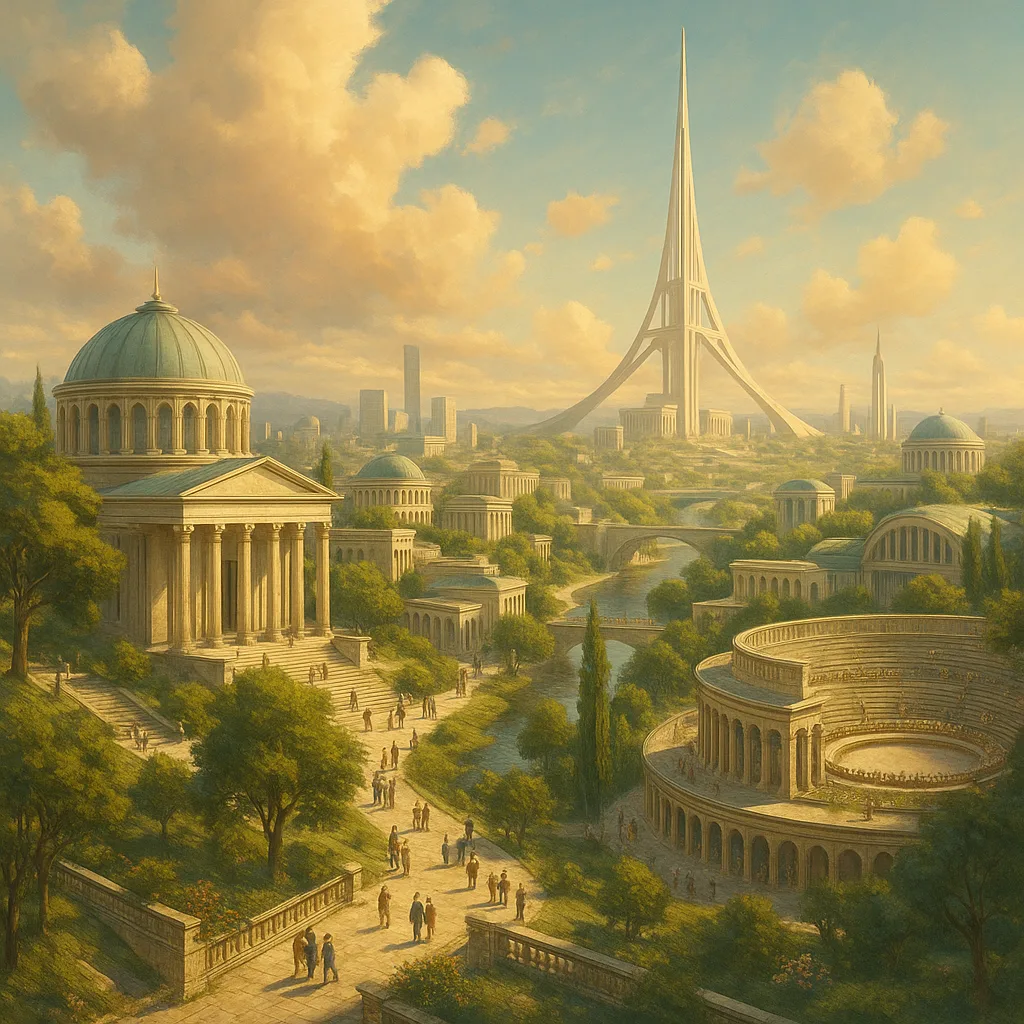
Prologue: The Wrong Timeline
Some days I look at the world and feel not despair, but dislocation. As if we made a wrong turn millennia ago and now live in the ruins of that choice. Violence over invisible deities. Laws shaped by ancient fears. Entire generations taught to fear curiosity more than cruelty.
I’m not talking about faith. I’m talking about power disguised as divinity. The institutional harnessing of mystery to control minds, movements, and meaning.
I write this not to attack believers, but to mourn a timeline we might have had. A timeline where philosophy, not dogma, became the collective compass. Where no god was ever nailed to the wall of law. Where questions were sacred, and answers provisional.
This is not nostalgia for something that never was. It is forensic imagination. A reckoning. A refusal to pretend this was the only way we could have become human.
The Cost of Belief: Religion as Institutional Fossil
Religion began as story. As symbol. As metaphor. And it should have stayed that way.
But it didn’t.
Over centuries, poetry became policy. Mystery became mandate. Metaphors were mistaken for metaphysics—and then enforced at swordpoint.
And let’s be clear: religion didn’t codify itself into law out of reverence. It did so for control. To wield power over bodies, minds, sex, land, libraries.
Yes, monks copied texts—but only the ones approved. Yes, churches sponsored art—but only under iconographic chains. The Vatican’s still-locked archives are not a monument to preservation. They are a fortress of hoarded knowledge.
Contrast that with the Middle East during Europe’s so-called Dark Ages: Baghdad’s House of Wisdom, Persian mathematics, open debates between theologians, doctors, and astronomers. Knowledge thrived until religion centralized power—and then the burning began.
Religious institutions did not merely slow progress. They feared it. Because progress threatens permanence—and permanence is the god religion loves most.
The Age of Flame and Silence
We speak of the Inquisition, the Crusades, the witch hunts—but these weren’t aberrations. They were design features.
Religion offered something terrifyingly efficient: moral absolutism with no appeal. It created unanswerable laws, and then punished anyone who asked anyway.
It targeted the body (especially women’s). It erased queer lives before the word “queer” even existed. It mandated obedience in the name of eternity.
Even now, modern secular systems wear the scaffolding of religion. Courtroom oaths to invisible watchers. Policy shaped by pulpits. Politicians invoking gods they barely believe in to justify decisions they barely understand.
Call it what it is: theocracy in drag.
But Didn’t Religion Also…?
Yes. Religion provided language to the oppressed. But that’s because it was the language of the oppressor.
Frederick Douglass learned to read through the Bible—but he read it against the morality of slaveholders. MLK preached revolution in church cadence—but he was dreaming of justice, not heaven.
Liberation theology, the Black church, activist preachers—they subverted the house from within. But what if they didn’t have to? What if their movements weren’t born in chains and sermons, but in open inquiry and shared ethics from the start?
We don’t deny that fire can warm a house. But that doesn’t mean it wasn’t first used to burn one down.
Would Secularism Really Be Better?
Skeptics might ask: Wouldn’t secular ideologies just replace religious ones? Nationalism. Communism. Capitalism. Haven’t they all become quasi-religious?
Yes. And that proves the point.
It’s not just about gods. It’s about systems that mistake certainty for truth, that trade reflection for obedience. It’s about fossils—beliefs that once moved, but now ossify into power.
But imagine if philosophy—not just reason, but recursive, lived inquiry—had become our primary way of being. If the leaders of thought were not priests, but poets. If doubt was not sin, but signal.
Ideologies might still arise. But they’d be forced to evolve. They’d have to justify themselves under the relentless light of discourse—not divine decree.
The Golden Path: An Alternative Timeline
Let’s walk the path we never took.
0–500 CE
Alexandria thrives. Socratic schools spread across continents. Ritual exists, but not hierarchy. Stories are sacred, but never literalized. Empiricism and ethics grow together, side by side.
500–1000 CE
While Europe clings to collapsing empires, the Middle East, Asia, and North Africa become centers of philosophical integration. Cross-cultural academies bloom. By 950, proto-vaccines, surgical standards, and secular ethics are codified.
1000–1500 CE
The Enlightenment begins five centuries early. Art is sacred, but not sacrificial. Scientific guilds form in dialogue with artists and ethicists. No divine right of kings. No Crusades. No Inquisition.
1500–2000 CE
Colonialism has no gospel to weaponize. Gender roles are debated, not dictated. Queerness is seen as variation, not deviance. The Renaissance becomes a planetary event, not a European one.
2000–Now
We don’t ask “What does God want?” We ask “What do humans need to become?” AI becomes partner, not threat. Earth is not a fallen world—it’s a shared one. We steward it accordingly.
Interrupting the Present
Of course, none of this happened. But that’s not the point.
The point is that we could still shift the trajectory—not by undoing history, but by refusing its worst momentum.
“Let go of the gods we mistook for truth” doesn’t mean erasing myth. It means unbinding it from power.
It means:
Replacing courtroom oaths to invisible deities with oaths to shared consequence.
Funding ethical inquiry with the same urgency we fund war and tech.
Teaching children that questioning is not rebellion—it’s responsibility.
Creating public rituals of thought, not belief—places where the sacred is the asking, not the answer.
It means treating philosophy the way religion treated revelation: as sacred, essential, binding—but never closed.
We cannot change where we came from.
But we can change what we carry forward.
And maybe, just maybe, we can still earn the timeline we missed.