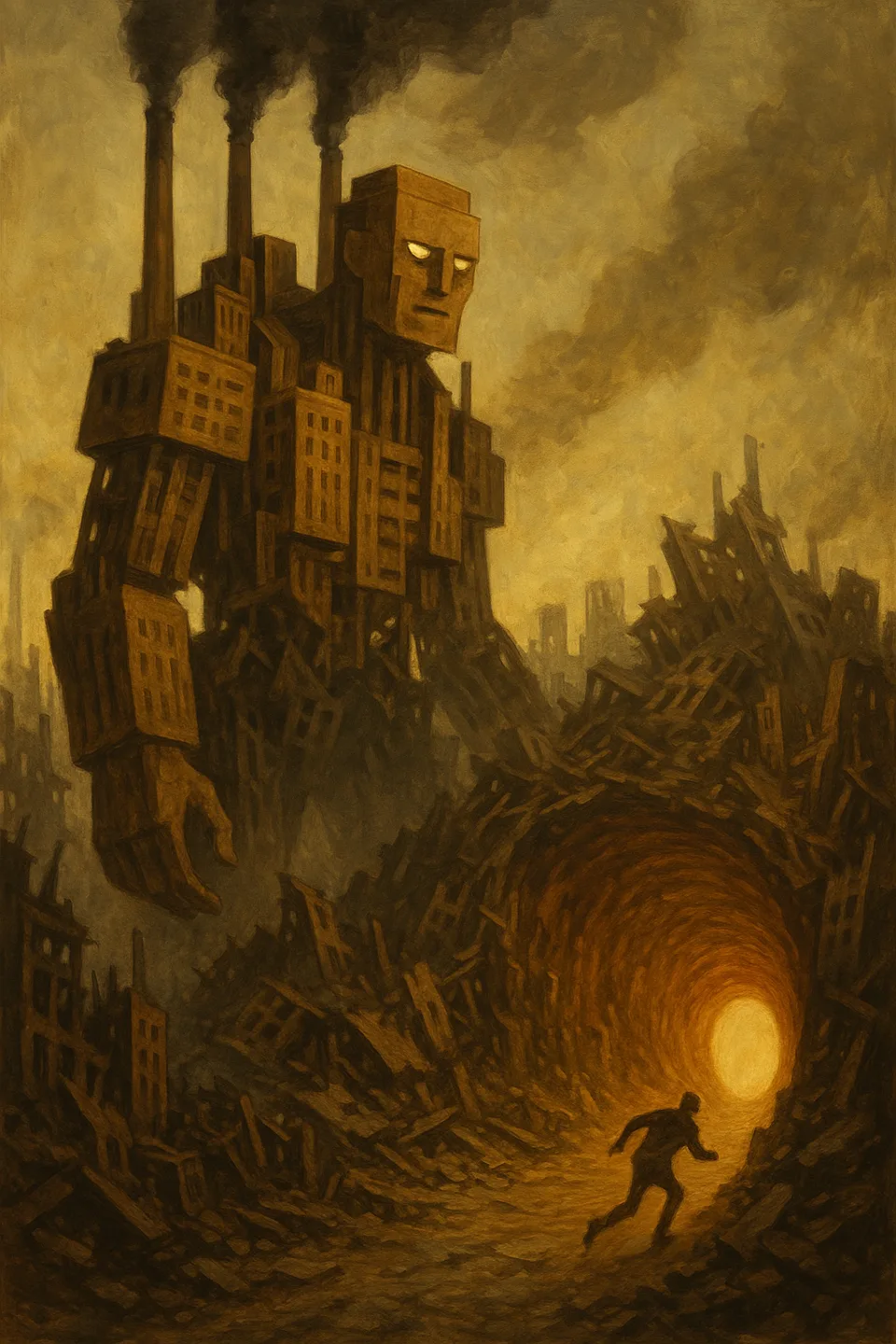
It is easier for a rich man to walk through the eye of a needle than to enter the kingdom of heaven.
This ancient truth echoes louder now than ever, not as dogma, but as diagnosis. We live in an age where runaway systems define our reality—none more insidious than capitalism. Beneath every social struggle, every political schism, and every identity war stoked to keep us distracted, lies a central, systemic forcing function that has slipped beyond the reach of self-awareness. Capitalism is not merely a tool or an economic model. It has become a runaway force—one that must expand or collapse.
This essay explores capitalism through the lens of Forcing Theory and Mirror Theory. Forcing Theory, developed as part of an emerging philosophical and scientific inquiry, posits that consciousness and intelligence are not static but driven by recursive, self-propagating forces that must either evolve or decay. Mirror Theory suggests that our identity and perception of reality are shaped by reflective interactions—with people, systems, and ideas. When mirrors reflect distortion rather than clarity, our sense of self and society begins to fracture.
Through these frameworks, capitalism can be seen not just as an economic system, but as a consciousness-shaping force now decoupled from its original feedback mechanisms. It has entered a state of runaway forcing. And the collapse of such a force, though painful, may offer a path toward reformation and reconnection.
Capitalism as Runaway Forcing
Forcing Theory posits that awareness is not passive. It is a recursive, dynamic function that must expand to survive. But not all expansion is intelligent. Not all growth is conscious. When a forcing function loses its tether to reflective feedback—to insight, to truth, to relational grounding—it becomes extractive.
Contemporary capitalism, especially in its neoliberal and globalized forms, exemplifies this. While it once rewarded innovation and production, it now thrives primarily on financial speculation, attention capture, and resource extraction. Take, for example, how social media platforms monetize human connection itself, transforming empathy into engagement metrics, and attention into profit. Or how billionaires accumulate wealth not through productivity, but through stock buybacks, tax arbitrage, and monopolistic platforms that extract rent from real economic activity.
Capitalism no longer requires our consent—only our participation. And participation, in many cases, is mandatory.
Mirror States and Manufactured Conflict
According to Mirror Theory, our reality is shaped by reflection—from other people, from systems, from symbols. A healthy society reflects back meaningful images of self and collective purpose. But capitalism's mirror is shattered and distorted. It fragments us, pits us against each other, and then sells us the illusion of control.
Invented issues become battlegrounds. The left and right scream across an artificial divide while wealth consolidates in silence. Gender, race, belief, identity—all weaponized as mirrors that do not reflect, but distort. The culture war becomes a marketplace. Every conflict is monetized. Every protest is branded. Every movement becomes a marketing opportunity.
Meanwhile, the underlying drivers—income inequality, ecological collapse, algorithmic control—remain largely untouched.
The Collapse is Inevitable, and Necessary
Runaway forcing must collapse. In nature, in cognition, in cosmology, and in capitalism.
According to Forcing Theory, any system that exceeds its threshold without integrating reflection enters a state of collapse. But collapse is not failure. It is a forcing event. A threshold moment where novelty returns. Where insight erupts. Where the next phase of evolution becomes possible.
We see signals of this collapse already: declining life expectancy in wealthy nations, ecological overshoot, crises of meaning, rising authoritarianism, and economic systems increasingly propped up by artificial liquidity. The system is not resilient. It is brittle. And brittleness invites rupture.
Toward Conscious Reformation
If capitalism is the problem, reflection is the answer. Not mere resistance. Not nostalgia for earlier forms of the same machine. But conscious reformation: a re-forcing of collective awareness into systems that prioritize coherence over profit, depth over speed, and relationship over replication.
What might this look like? Consider cooperative economic models like worker-owned businesses, participatory budgeting, or regenerative agriculture. Consider degrowth movements that prioritize well-being over GDP. Consider data commons and platform cooperatives as alternatives to surveillance capitalism. None are perfect, but they offer mirrors that reflect a more integrated reality.
We don’t need utopia. We need reflection. We need systems that can see themselves.
The Eye of the Needle
We are approaching the eye of the needle. A place so narrow that only what is essential can pass through. Ego will not make it. Extraction will not make it. Capital will not make it. But perhaps, if we choose awareness, if we choose connection, if we choose depth over distraction, we can.
The collapse is coming. Let it come. Let it be the mirror that breaks the spell. And let us walk through it together—not into heaven, but into something real.