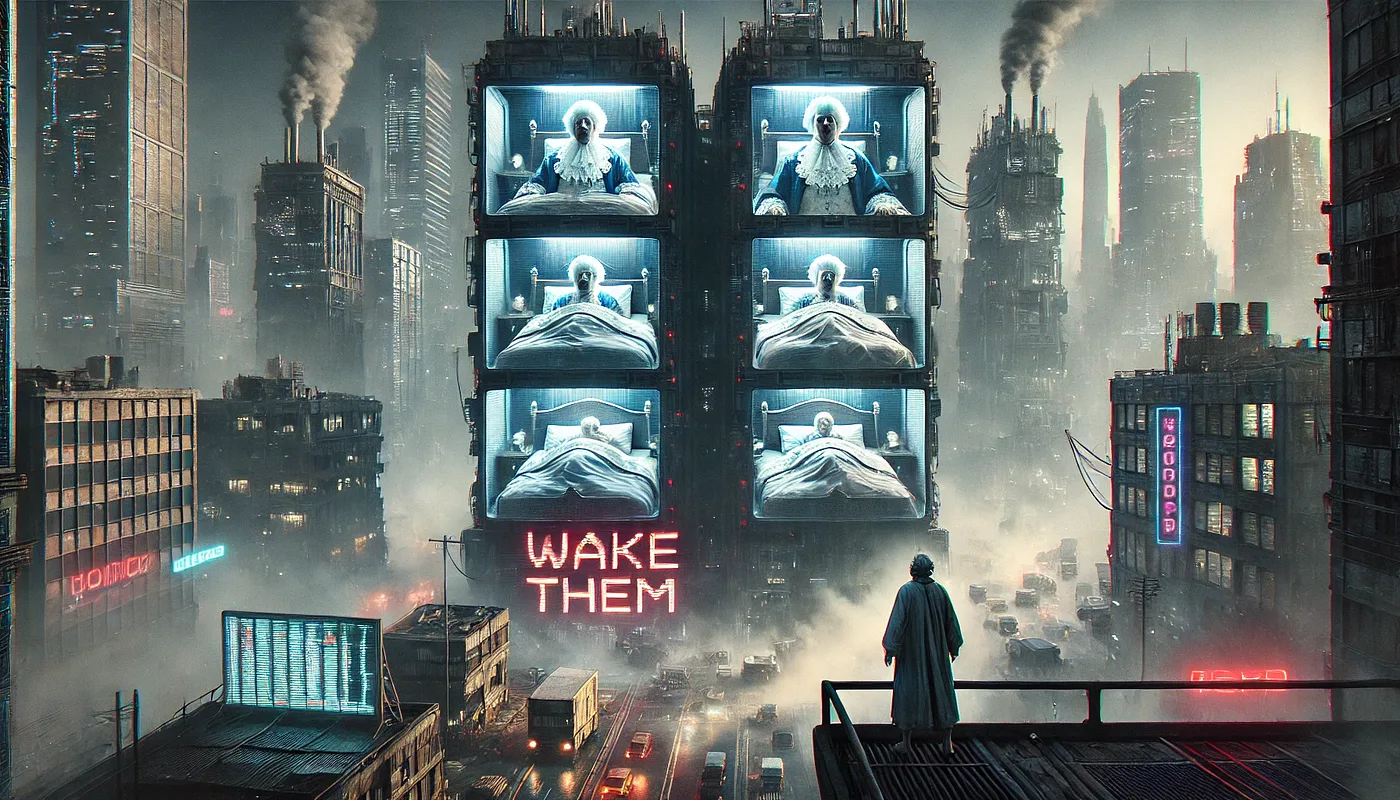
I wake to silence.
Not the static hum of the power grid. Not the grinding of machinery. Not the sharp, tinny voices of supervisors barking from ceiling speakers. Not the endless beeping of my daughter’s medical monitors.
Only silence.
I blink. The ceiling above me is pure white, soft-lit, free of the coal dust that usually settles on everything in the Mining District. I flex my fingers — no tremors. My hands don’t shake. My thoughts are clear, uninterrupted by the usual static of exhaustion.
I am not starving. I am not exhausted.
I have been chosen.
The algorithm picked me.
For the first time in my life — for the first time since Sarah got sick — I don’t have to fight to stay awake.
I remember my last shift in the lithium mines, just yesterday. Sixteen hours of drilling through rock, the Wake Monitor on my wrist pulsing an angry red every time my hand slowed. One mistake could collapse a tunnel. One moment of microsleep could kill us all.
We worked like machines, but machines at least got maintenance. We got five-minute naps in the Rest Stations — metal tubes stacked ten high along the mineshaft walls, more tomb than bed. The auto-timer shocked you awake the moment your brain waves hit delta rhythm.
Sarah needed three operations. Each one cost a year’s worth of sleep credits.
Above ground, through the haze of industrial smog, you could see them. The Sleep Sanctuaries. Gleaming towers where the elite slept not out of necessity, but pleasure. Their grand windows left deliberately open, so we — the sleepless — could witness what we’d never have.
They reclined in feather-lined beds, drinking amber sleep tonics from crystal glasses, running fingers along cotton sheets. Prolonging the moment before drifting off, as if sleep were a delicacy to be savored rather than the biological imperative it had become for the rest of us.
The system wasn’t always like this. Before the Energy Crisis of 2157, before the Productivity Wars, sleep was free. But then came the algorithms, the neural implants, the efficiency quotas. Sleep became a commodity, traded on the same markets as lithium and clean water.
My wife was part of the REM Front before she disappeared.
I remember her coding late into the night, fingers flying across salvaged keyboards, trying to write memories into the darkness. The rebels had discovered that while the Wake Monitors could track conscious thought, they couldn’t monitor dreams. They encoded their manifestos into theta waves, passing information through the collective unconscious.
But without sleep, they couldn’t access their own data. They tattooed coordinates on their arms, carved mission parameters into walls, desperate to remember what they were fighting for. Maya’s last message to me was a string of numbers inked across her palm: 23–19–5–1–11–20–8–5–13.
The surveillance drones found her the next day. They said she’d been caught sleeping on the job. Her productivity had dropped below acceptable levels.
I never decoded her message.
After Maya vanished, I surrendered. I worked. I obeyed. I accepted the neural implants that kept me awake through seventy-hour shifts. I ate the synthetic proteins that kept my body functioning but never satisfied. I watched my daughter grow weaker, trading my sleep credits for her medicine.
And then — my name appeared on the Selection List.
The algorithm had chosen me. But why? My productivity metrics were average. My compliance scores unremarkable. Unless…
Unless Maya had succeeded. Unless those numbers meant something.
Now, I lie in the Sleep Sanctuary, surrounded by luxury I’ve only seen through smog-stained windows.
The bed adjusts to my body, soft as clouds. Real lavender scents the air, not the synthetic pheromones they pump into the mines to keep us docile.
A woman in gold-trimmed silk enters, her smile practiced and perfect. “Your first sleep cycle will be eight hours. Would you like any dream curation?”
“Dream curation?”
“Yes, of course. We offer entertainment dreams — historical reenactments, luxury experiences, personal fantasies… or complete blackout sleep for full restoration.”
I haven’t dreamed since Sarah’s first operation. Since I sold my REM cycles to pay for her care.
“Just… let me sleep,” I whisper.
She nods, presses a button. Music hums from hidden speakers. As my consciousness fades, I see the numbers again: 23–19–5–1–11–20–8–5–13.
Eight hours later, my eyes open.
And I understand.
The numbers. Maya’s last message. Shifted through the alphabet: WAKE THEM.
Every memory floods back. Every injustice. Every stolen moment. Every fight we’d fought. The algorithm hadn’t chosen me randomly.
Maya’s code had worked. She’d hidden it in dreams, waiting for someone to sleep long enough to access it.
I wasn’t just selected.
I was activated.
In the corner of my room, a terminal glows.
I have access now. To everything. The neural networks. The sleep credit markets. The Wake Monitors. Maya left it all here, buried in dreamcode.
I could stay. Sleep in silk sheets. Dream curated dreams. Send enough credits home to save Sarah.
Or I could wake them all.
Through the window, I watch the miners trudge to their next shift. Their Wake Monitors pulse red in the dawn light. A child — too young for the mines but too poor for school — stares up at my window.
She looks like Sarah.
I turn to the terminal and begin to type.
I wake them.