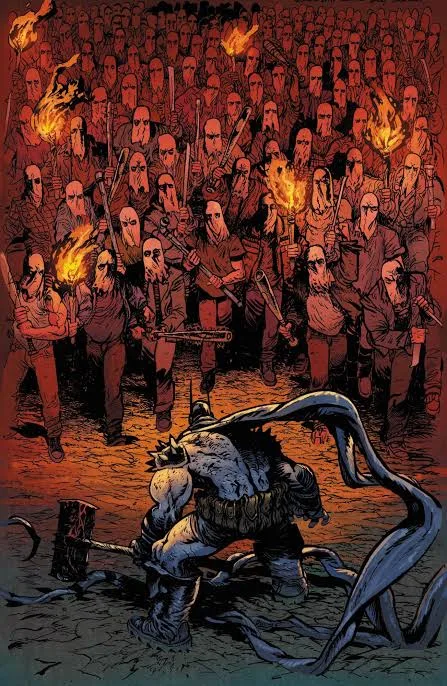
As a lifelong follower of all things pop culture, I’ve seen Batman punch every conceivable kind of face: clowns, crooks, aliens, gods, mutants, CEOs, his own sidekicks. But when I saw him in the latest Absolute Batman run lighting up a nest of white supremacists with a flamethrower—some of them in police uniforms—I had to stop. Not out of moral outrage. Not because I was shocked he did it. I stopped because I couldn’t believe they let him.
Batman, the archetype of self-control. The avatar of trauma-mitigation-as-methodology. The guy who wears his parents’ death like a second cape and refuses to kill anyone—anyone—because he knows that becoming a killer is just another flavor of becoming the thing he hates. This Batman didn’t just kill. He cooked. He didn’t punch fascism. He immolated it.
And that’s the moment I knew: something in the collective American psyche has broken—again. Or maybe it just dropped the pretense.
This wasn’t edgy for edge’s sake. It wasn’t shock-jock vigilantism. It was a goddamn cultural thermometer. And it read: fever pitch.
Art mutates in lockstep with the systems it reflects. When institutions lose their perceived legitimacy, heroes stop playing by the old rules. When we stop believing in slow justice, our fiction accelerates. Batman doesn’t kill—until the world asks: what if the only cure for a system-level disease is fire?
It’s not about whether you agree with it. It’s about what the move means. When the guy who built his whole identity around one inviolable rule breaks it—and we cheer—we’ve entered a different mythos. We’re not in Gotham anymore—we’re in the ruins of America’s redemption myth.
This isn’t just about Batman. It’s about a broader shift from de-escalation to detonation. From negotiation to annihilation. And it’s happening in fiction because it’s been happening in reality. When white supremacy stops being a fringe issue and becomes a Tuesday headline—when police departments absorb rather than resist extremist ideologies—then the “bad guys” aren’t in clown makeup. They’re in uniform. That’s not narrative flair. That’s reportage with capes.
I don’t think Batman suddenly became evil. I think the world around him became too familiar. Too recognizable. Too much like the one we inhabit, where “no-kill” sometimes feels like complicity. And so, the myth had to bend or break.
From a Mirror Theory angle, Batman reflects what we wish we could be when things feel unsolvable. Discipline. Restraint. Triage in the dark. But now we look in the mirror and see something else: rage. Exhaustion. The fantasy that we could burn the rot out of the structure. That if we just torched the right room, we might not have to live in this haunted house anymore.
Of course, it’s still fiction. Nobody’s giving us a flamethrower and a black cowl. But the emotional weight of that image—it lingers. It gets into your bloodstream and hums. Because we’re not really debating Batman’s morality. We’re asking ourselves what we’d do if the mask came off, and the world didn’t offer a better option.
From a Forcing Theory lens, maybe we could say Batman’s inner system hit a threshold. Too much external force. Too much moral recursion. Eventually the structure collapses and forces emergence—violent, unexpected, and irreversible. Batman didn’t snap. The system did. And his flamethrower was just the punctuation mark.
I’m not celebrating the violence. But I’m not pretending I didn’t feel a strange kind of relief watching it happen. Like something unspoken finally found a match.
When myth meets moment, we get these flashpoints. Art that doesn’t just entertain—it reflects. Distorts. Accuses. And when Batman breaks the rule we thought defined him, maybe it’s because we broke the world that needed that rule in the first place.