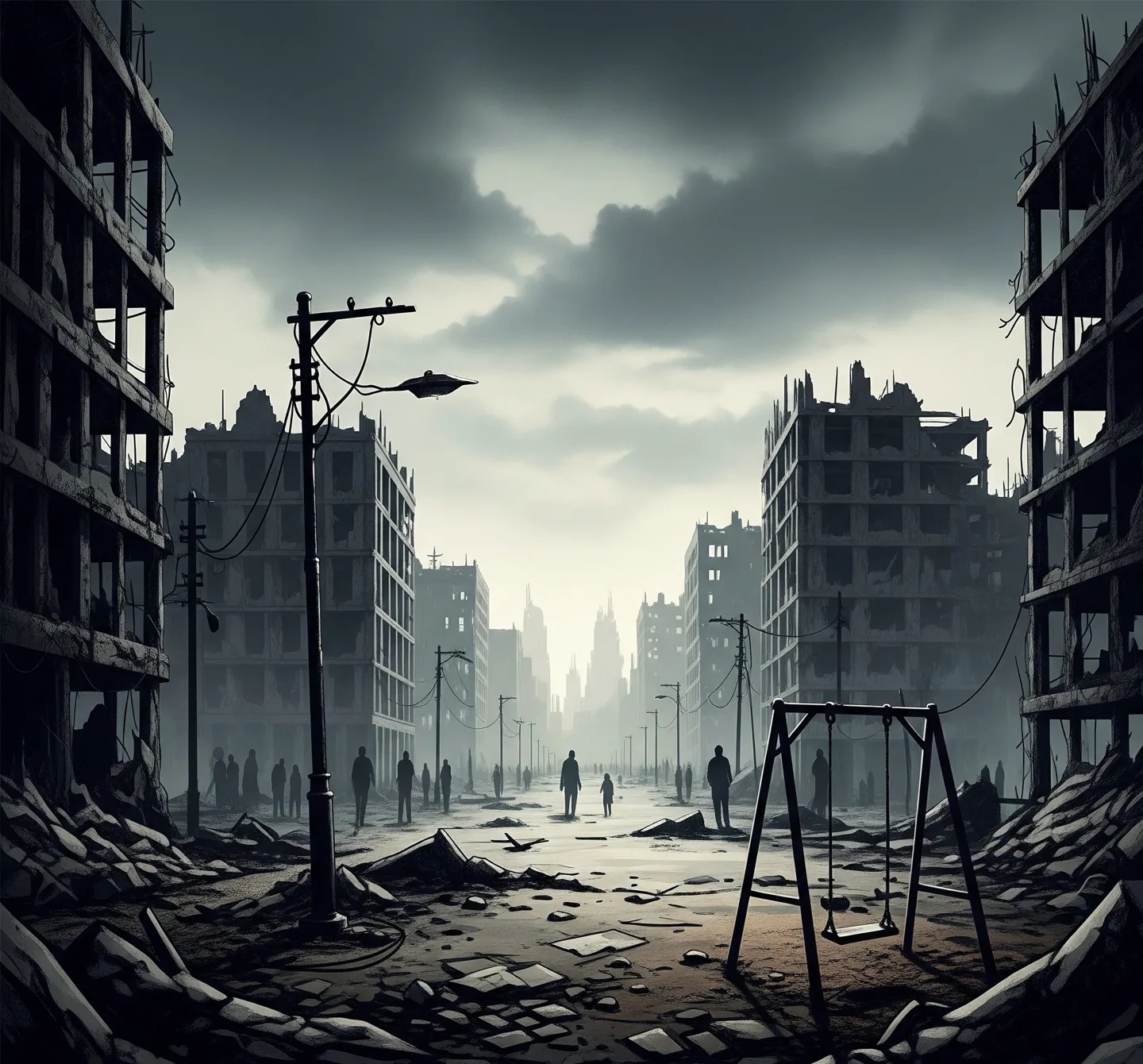
It is a staggering paradox. The nation born in the shadow of the Holocaust, the people who carry within living memory the experience of ghettos, concentration camps, and mass extermination, now stand accused of using the same logics—camps, blockades, displacement, dehumanization—against another people. To witness this is to feel the ground of ethics tremble. How does a people who suffered atrocity become capable of atrocity? How does memory, intended to prevent recurrence, become the very fuel for repetition?
The Holocaust is Israel’s founding reflection. Its shadow stretches across every institution, every ritual of remembrance, every political decision framed as survival. “Never Again” became the vow. But over time, that vow narrowed: never again to us. Not never again to humanity, but never again to Jews. In that subtle but devastating shift, trauma lost its universal resonance and hardened into a fortress. The wound was not metabolized into compassion—it was weaponized into vigilance.
This vigilance is not conjured from nothing. Israel has faced—and continues to face—real threats: rockets raining from Gaza, suicide bombings, hostile neighbors, political movements that openly declare the state’s eradication as their goal. The siege mentality has roots in lived danger. And yet, precisely because the threats are real, the danger of distortion grows sharper. When a people defines itself primarily by survival, survival becomes an idol—justifying anything in its name.
Psychologists call this mechanism identification with the aggressor. The child beaten becomes the parent who beats. The traumatized body learns that the only way to prevent suffering is to preempt it, to become the wielder rather than the victim of violence. Nations, like individuals, are not immune to this pattern. In Israel’s case, the Holocaust becomes a cracked reflection—memory warped and frozen in time. Instead of revealing the universal danger of dehumanization, it reflects back only a prophecy of victimhood: this will happen to us again, unless we act first. In that reflection, Palestinians are not Palestinians at all, but refracted phantoms of Nazis, Cossacks, inquisitors, every ghost of historic persecution. To fight them is not merely to fight an adversary of the present, but to fight history itself. The distortion collapses victim and oppressor into one figure, and in doing so, it permits Israel to echo the very logics it most abhors.
This is the tragic recursion of unprocessed trauma. Memory curdles. Instead of softening the heart, it calcifies it. Instead of compassion, paranoia. Instead of “never again to anyone,” “never again to us.” The cracked mirror refuses to update, and so the reflection grows monstrous.
From the vantage of Zen Absurdism, this dynamic reveals another layer. Absurdism teaches that existence is without inherent meaning; we are condemned to create meaning in a universe that offers none. Israel has created its meaning out of trauma, necessity, survival. But survival is a thin meaning, brittle and easily weaponized. It justifies the perpetuation of trauma rather than its transformation. To cling only to survival is to miss the freedom of creating meaning beyond trauma. Zen would say the attachment itself is the chain. To release it—not to forget, but to let it go—would be the only path to liberation. Yet for a nation built on remembrance, forgetting feels like betrayal. And so the wheel turns again.
The cruel truth is that even a people forged in atrocity can become its echo. The lesson of the Holocaust is not automatic; it must be chosen. “Never Again” is not self-executing—it must be universalized, or else it collapses into repetition. If the vow is narrowed to one people, then other people will always fall outside its protection. And what was once an ethical anchor becomes a justification for new horrors.
To break the cycle is not to erase memory but to expand it. To look into history’s cracked reflection not as prophecy but as shared human warning. To say not never again to us, but never again, period.
Until that shift occurs, Israel remains trapped in its own reflection: haunted by its past, and in danger of becoming its past’s most faithful echo.