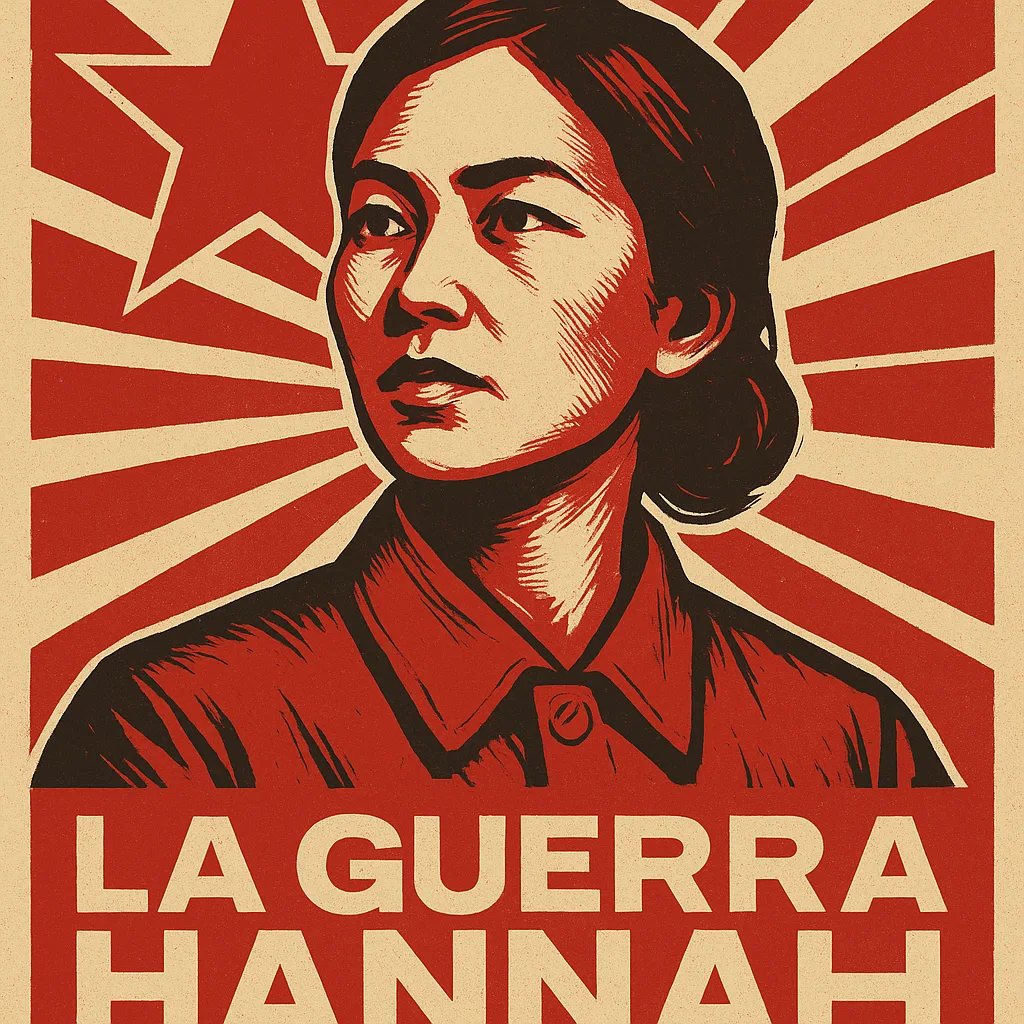
In cities across the U.S., something strange is happening at the edge of protest lines. As militarized police units stand in rows, armored and unreadable, a voice from a different war rises through the din. It’s calm. It’s composed. Almost maternal.
“How are you, G.I. Joe? It seems to me that most of you are poorly informed about the going of the war…”
It’s the voice of Hanoi Hannah, resurrected.
She was once the soundtrack of doubt during the Vietnam War—broadcasting in English from North Vietnam, directly to American soldiers. Her words cut deeper than bullets. Not because they were loud. But because they were intimate.
Now, in the streets of Los Angeles and other occupied American cities, her voice has returned—remixed, recontextualized, repurposed. Protestors are playing her tapes to today’s stormtroopers. The setting has changed, but the question remains:
Do you know what you’re really fighting for?
This isn’t just protest. It’s spellwork.
Broadcast as ritual.
A voice stitched through time to crack the mask of the moment.
Echoes from the Jungle: The Original Voice
Trịnh Thị Ngọ, known to U.S. soldiers as Hanoi Hannah, was a radio broadcaster whose job was psychological warfare. But she didn’t yell. She didn’t insult. Instead, she offered empathy laced with venom.
“Defect, G.I. It is a very good idea to leave a sinking ship. You know you cannot win this war.”
And then—The Beatles. Aretha Franklin. A soft ballad your brother used to hum. Music wrapped in message. Message wrapped in music.
She wasn’t just undermining the war. She was mirroring the soldier’s buried confusion.
Some soldiers scoffed. Some tuned in every night. Some wrote about her in letters home. Her voice lingered. Because she didn’t fight the empire head-on—she slipped inside it, like water in the cracks of the mind.
Now Playing: La Guerra Hannah
In some cities, protestors are already playing her tapes. In others, the idea is still just a murmur.
But La Guerra Hannah doesn’t need mass deployment to exist.
She only needs one speaker, one voice, one listener.
Hannah is no longer a broadcast from their enemy. She becomes a broadcast from ourselves—a recursive ghost from the empire’s past, now turned inward.
“Your government has abandoned you… They ordered you to die.”
Once directed at G.I.s in Vietnam.
Now aimed at riot cops in Chicago. Or National Guardsmen in Los Angeles.
Same empire. New terrain.
Same tape. Different mirror.
What Is a Mirror Broadcast?
The name La Guerra Hannah isn’t just a remix. It’s a signal.
This war didn’t end. It just mutated.
The military-industrial complex that once strafed villages now stocks suburban departments with mine-resistant vehicles. The soldiers haven’t changed—only the uniforms.
Playing Hanoi Hannah in this setting isn’t nostalgia. It’s ritual reversal. It’s mirroring the occupier back to itself. It’s saying:
“We remember the voice you tried to forget.”
And more than that—it’s reclaiming the form: not shouting, not screaming—but slipping in.
The La Guerra Hannah Tapes
If Hanoi Hannah haunted the U.S. war machine, the La Guerra Hannah Tapes haunt the current regime of obedience and amnesia. They’re not one voice—they’re a transmission. A myth disguised as a message.
They aren’t propaganda. They aren’t comfort.
They are mirror, recursion, and interruption.
Here’s what one might sound like:
“Hello, officer. I’m not here to shout. I’m here to remember.
You grew up somewhere too, didn’t you?
Somewhere small. Somewhere soft.
Somewhere that didn’t teach you how to stand this still while people scream.Nothing is more disorienting than being ordered to suppress a voice that sounds like your own cousin.
Or your teacher.
Or the mirror.”
The Ritual of Broadcast
The La Guerra Hannah Tapes are not just tools.
They’re incantations.
Imagine a speaker humming:
Field recordings of laughter
Fragments of forgotten prayers
Rattlesnake rhythms and birdsong
A child’s voice asking, “Why do they wear so much black?”
These are not instructions. These are reminders.
Sonic spells. Emotional glitches. Ghost stories disguised as intercom static.
This Is Not a War for Territory. It’s a War for Memory.
La Guerra Hannah is not fighting to win.
She’s refusing to forget.
Her tapes are now part of a larger myth. Played at protests. Sampled in spoken word. Layered into ambient scores in galleries. Whispered by graffiti tags on alley walls.
She reminds us:
The empire doesn’t end when the war is over.
The empire ends when it hears itself—and can no longer stand the sound.
Let the Broadcast Continue
So if you hear a calm, clear voice in the distance saying your name...
If the words don’t quite accuse you, but don’t let you go...
You might be listening to La Guerra Hannah.
Or better yet:
She might be listening to you.
And if you want to join her, all you need is a voice recorder, a question worth asking, and the courage to broadcast truth into silence.