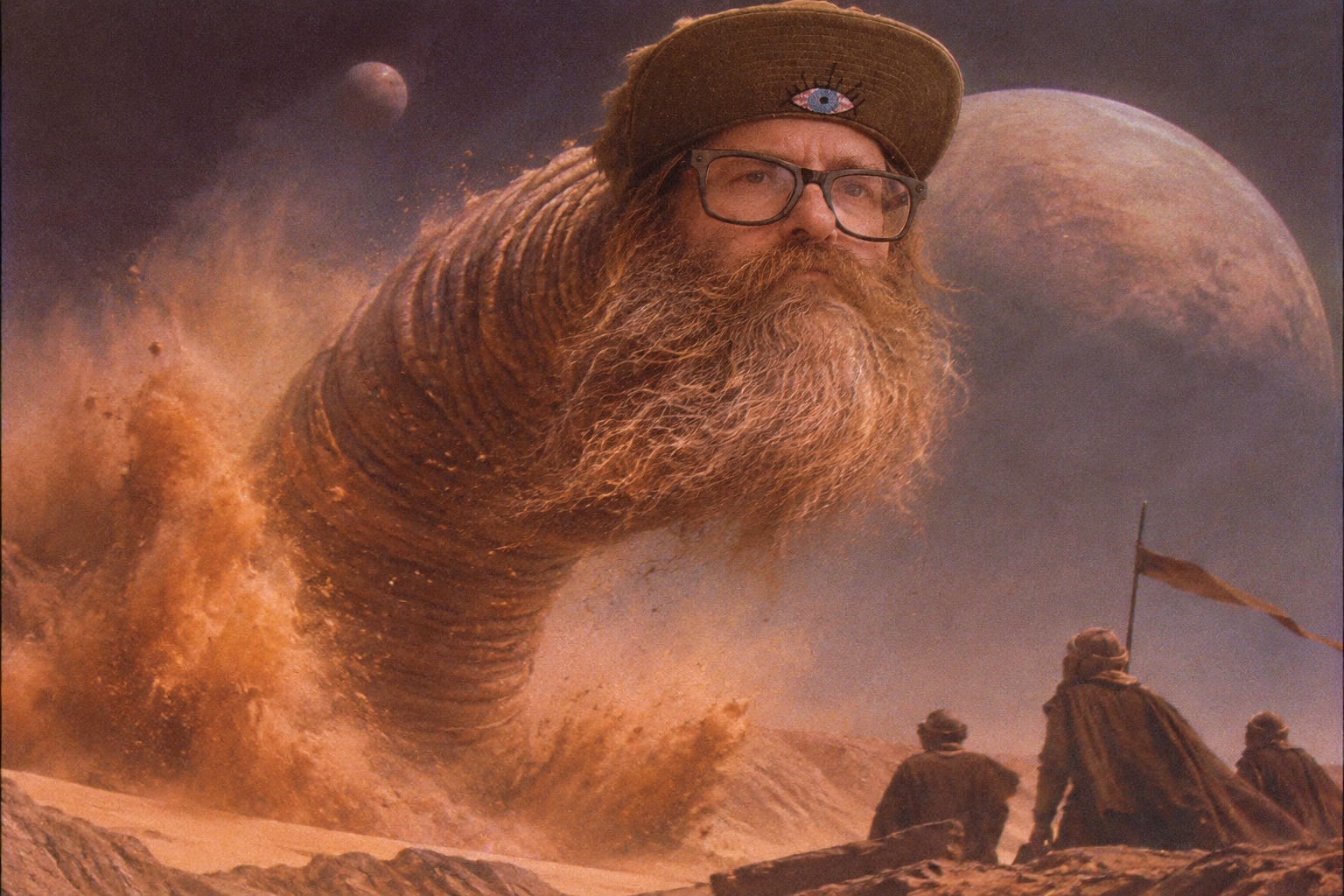
In 1996, I met a stranger on AOL who mailed me a pirated copy of Adobe Photoshop on multiple CDs. This was back when the internet made noises, software came in the mail, and becoming a digital artist involved a minor conspiracy with someone you’d never met. I was a teenager with a computer, an imagination, and apparently very little concern about accepting packages from strangers on the internet. I installed it and started making things. Thirty years later, I’m still making things. Only now, apparently, I’m cheating.
I spent countless hours playing with that software. Importing photographs, cutting things out, changing colors, putting things where they didn’t belong. There weren’t tutorials for everything, and I certainly didn’t know what I was doing most of the time. I was just a weird kid with an imagination that frequently demanded things reality was unwilling to provide. Photoshop was like discovering a secret door into a world where the laws of physics were merely suggestions. I could make myself into whatever I wanted, put myself wherever I wanted, and create things that had absolutely no reason to exist beyond the fact that I thought they should. It was wonderful.
In 1998, after reading the first few Dune books, I decided I needed to become a giant sandworm. Not draw a sandworm. Not find a photograph of one. Become one. So I spent an entire weekend manipulating photographs of myself until I had transformed into a magnificent creature of the desert. I was extraordinarily proud of my accomplishment. About a month later, I accidentally deleted the file. Gone. My glorious wormhood lost to the digital sands of time. Somewhere in the great technological beyond, there is a teenage boy who briefly ruled Arrakis and has absolutely nothing to show for it. I still think about that sandworm. I’d probably have it framed in my house today.
I continued creating throughout college, where I earned my degree in film and worked on commercials and local video projects using increasingly sophisticated Adobe software. After college, following a mystical experience that fundamentally changed how I viewed the world, I began making even stranger things. I transformed myself into Ganesha and Shiva. I explored religious imagery, consciousness, identity, and whatever else wandered into my head. Over the following decades, I created digital art that was printed, framed, and hung in homes across the country. All of this happened long before I ever picked up a paintbrush and began covering canvases with the strange characters and symbols that now occupy my days.
Today, at forty-eight, I spend hours every day making things. I write, I paint, I experiment with digital imagery, and I pursue ridiculous ideas simply because they occur to me. My paintings are full of birds, snakes, eyes, strange little people, and other inhabitants of a universe I don’t entirely understand myself. I’ve spent the past year creating more paintings than I could have imagined making in a lifetime, and I still wake up each morning excited to see what strange thing might emerge next. Sometimes I use a brush. Sometimes a keyboard. Sometimes a camera. And sometimes artificial intelligence. The tools have changed considerably over thirty years, but the strange little person operating them remains remarkably consistent.
Which brings me to the increasingly popular suggestion that artists shouldn’t use AI to create photographic art of themselves or bring their ideas into existence.
Excuse me?
I’ve spent thirty years using computers to create things that didn’t exist before I imagined them. I learned to manipulate photographs when doing so required hours of painstaking work. I learned to composite images, adjust lighting, create textures, remove backgrounds, and move individual pixels around until the picture in front of me resembled the picture inside my head. And now I’m supposed to stop because the tools have become too good? I’m supposed to spend three hours manually manipulating an image rather than three minutes explaining what I want to create? At what point did the difficulty of the process become the measure of artistic legitimacy? Is the image somehow more meaningful because I suffered longer making it? Should I throw away my paintbrushes and start grinding my own pigments? Perhaps I should abandon electricity entirely and paint by candlelight, assuming the candles were ethically sourced and I made the wax myself.
Don’t misunderstand me. Those hours spent learning Photoshop were valuable. I developed skills, learned to see things differently, and discovered possibilities I hadn’t previously imagined. There’s enormous value in learning a craft, and there’s a difference between making every creative decision yourself and asking a machine to make some of them for you. But the value of that experience doesn’t mean everyone else should be required to repeat it. I learned to make things the hard way because, at the time, that was the only way available to me. If I’d had access to today’s tools in 1998, I would have used the absolute hell out of them. I would have become an entire civilization of sandworms by lunchtime.
There are perfectly reasonable conversations to be had about AI. Copyright, consent, training data, the livelihoods of working artists, and the ownership of creative work are all subjects worth examining. I don’t believe every use of AI is automatically ethical, nor do I believe every generated image represents the same creative investment as a painting someone spent months developing. But I have a considerably harder time accepting the idea that using a new tool somehow invalidates the imagination of the person using it. The invention of photography didn’t eliminate painting. Digital photography didn’t eliminate photography. Photoshop didn’t eliminate the desire to make things by hand. New tools have always challenged our understanding of what it means to create, and every generation seems to produce a group of people convinced that the latest development represents the final destruction of artistic integrity.
Meanwhile, the weird kids just want to make weird things.
And that’s the part that keeps coming back to me. Somewhere out there is a teenager who has just finished reading Dune and decided that the most important thing they can possibly do this weekend is transform themselves into a giant sandworm. Thirty years ago, that ambition required pirated software, an enormous amount of patience, and a willingness to spend an entire weekend accomplishing something of absolutely no practical value. Today, that same kid could accomplish it in minutes. They could create an entire planet, populate it with bizarre creatures, make themselves emperor, invent a new species, or abandon the whole thing halfway through because they suddenly had a better idea. The distance between imagining something and seeing it has become almost unimaginably small. What an extraordinary time to be a weird kid.
And some of the very artists whose work inspired that kid might tell them not to do it.
Don’t use AI. That’s cheating. That’s not real art. That’s not how you’re supposed to create.
I wonder what that kid will do. I hope they’ll ignore us. I hope they’ll use whatever tools are available to make whatever ridiculous things their imagination demands. Maybe they’ll become interested in photography. Maybe they’ll learn Photoshop. Maybe they’ll pick up a paintbrush. Maybe they’ll discover an entirely new medium none of us have imagined yet. Or maybe they’ll make themselves into a sandworm, laugh uncontrollably for twenty minutes, and move on with their lives.
That would be wonderful, too.
Because the thing I remember most about that weekend in 1998 isn’t the technical process. It isn’t how many layers I used, how carefully I blended the edges, or how many hours I spent staring at pixels. I remember the sheer delight of making something that had existed only in my imagination. I remember being a weird kid who wanted to become a giant sandworm and discovering that, with a little creativity and the right tools, I could.
I’m still that kid. I’m forty-eight years old, I paint strange things every morning, and I’m surrounded by more creative possibilities than I could have dreamed of when those CDs arrived in the mail. I’m certainly not going to apologize for using them. In fact, I hope the tools continue getting better. I hope the barriers keep disappearing. I hope the next generation of strange little people can make things I wouldn’t even know how to imagine.
And if some weird teenager wants to become a giant sandworm, I hope nobody convinces them they need permission. The spice must flow. So should the imagination.