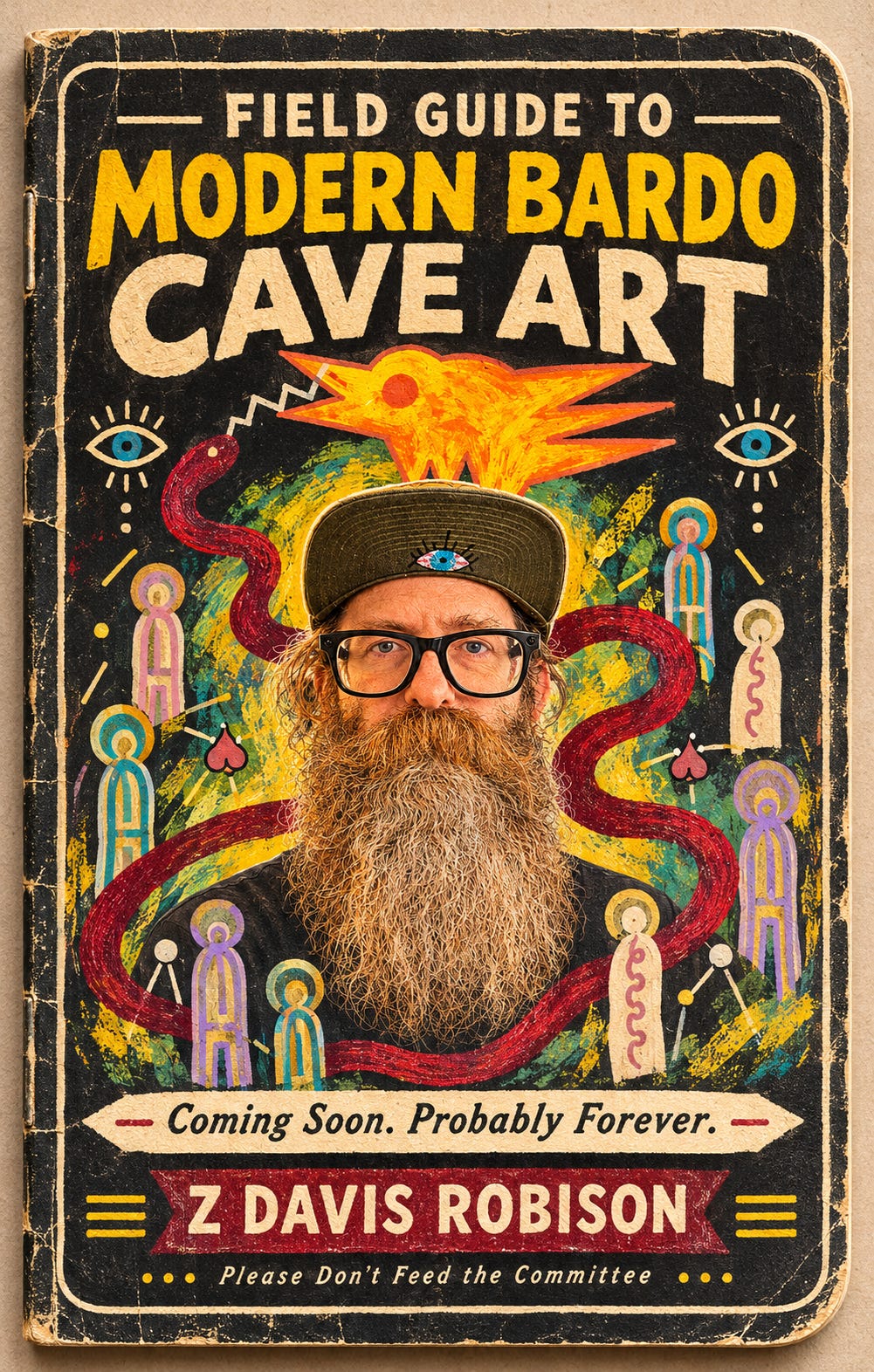
I’ve decided to create a field guide to Modern Bardo Cave Art, the peculiar little universe that has emerged across more than 150 of my paintings. I imagine something resembling those wonderful old naturalist guides, complete with illustrations, descriptions of the local wildlife, notes on their behavior, and perhaps the occasional warning about creatures best observed from a safe distance. Mine will document the birds, snakes, flowers, hearts, and strange little people who have spent the better part of two years inhabiting my canvases. Eventually, I’d love to produce a small physical booklet that people could pick up at an art show, take home, and use to explore the relationships between the paintings. A guide to the inhabitants of a world that exists somewhere between my unconscious mind and several gallons of acrylic paint. A perfectly reasonable undertaking, I thought, until I began considering what, exactly, I was going to write.
Let’s start with the Committee. They’re probably the most recognizable inhabitants of my paintings, appearing as simplified little figures gathered in groups, standing alone, occupying compartments, or occasionally dangling from the branches of a Christmas tree. Easy enough. The Committee represents the internal chorus of selves that constitutes my experience of being alive. There isn’t one little captain sitting behind my eyes directing the operation. There are competing voices, impulses, memories, fears, desires, and perspectives, all participating in an ongoing conversation that somehow produces what I experience as a singular identity. The Committee is the visual representation of those many selves. Excellent. First entry practically finished.
Except that’s not quite right.
Some members seem to represent particular aspects of myself, while others behave more like witnesses to the whole affair. Sometimes they’re working together. Sometimes they’re isolated. Occasionally one seems to be leading while the others stand around observing, and I’m not entirely convinced the one doing the leading is the same individual from one painting to the next. Perhaps the Committee isn’t simply a collection of selves but the process through which those selves temporarily become something resembling a person. Or maybe it’s the person observing that process. Wonderful. I’ve barely begun the first entry, and the Committee is already arguing about its own existence. I’ll make a note to revisit this section once they’ve reached a consensus.
Moving on to the snakes, which should be considerably easier.
The snakes frequently represent Kundalini, the energy associated with spiritual awakening and transformation. They wind through my paintings as symbols of forces that can be feared, confronted, mastered, or, as I prefer to think of it, befriended. Wonderful. A clear description with a recognizable philosophical foundation. I might even include a little illustration of one curled around a branch.
Except the snake in one painting is protecting something. In another, it appears to be offering something. Sometimes it communicates through a zigzag tongue that also appears in my artist’s signature. Occasionally it seems to be delivering a warning, while elsewhere it looks perfectly content to observe the proceedings. And then there’s the rather inconvenient matter of the heads. Some snakes have one. Others have two. Are the two heads opposing forces, complementary perspectives, or the same energy looking in different directions? Is the snake guarding the figures, threatening them, or inviting them into a relationship? Perhaps it’s doing all three. Perhaps those aren’t contradictory activities. I should probably return to this section once the snakes have stopped changing their minds. And heads.
The birds, thankfully, should be straightforward.
They appear throughout my work as messengers. Sometimes they’re shouting warnings. Sometimes they’re singing praises. Occasionally they’re heralding the arrival of something, although whether that something is a revelation, a disaster, or another bird remains unclear. They chatter into the heads of other figures, confront serpents, drink from impossible flowers, and occasionally occupy positions of considerable importance, such as replacing the star atop a Christmas tree. They appear to know things. Or at least they behave as though they do. Perhaps they’re communicating between different parts of the self, bringing news from outside, announcing transitions, or celebrating discoveries. Perhaps they’re simply making noise because birds are birds, and expecting every bird to deliver a profound message seems like an unreasonable burden to place on wildlife. I’ll leave this entry open for further observation.
Then there are the Watchers.
The Watchers stand watching. That much seems relatively certain. They observe the spiritual development of the lead figure, witnessing changes and transformations while apparently ignoring much of the surrounding commotion. Except are they ignoring it, or have they simply recognized that it doesn’t require their attention? Are they watching the lead develop, or are they the awareness through which that development becomes recognizable? And who, precisely, is the lead? Is it the same figure throughout the paintings, or does that role move among the Committee? Are the Watchers separate from the process they’re observing, or are they participating simply by watching?
I seem to have created a field guide in which the entry for “things that watch” cannot establish who is watching whom.
And I haven’t even gotten to the flowers.
The flowers have their own peculiar botanical system, occasionally producing things that don’t resemble anything a sensible plant should produce. Hearts appear in places suggesting affection, vulnerability, connection, or perhaps simply the ongoing business of being alive. Eyes emerge where eyes have no business emerging. Prime numbers hide among the imagery. Familiar shapes return in unfamiliar arrangements, and symbols that seemed perfectly content serving one purpose suddenly take on another. Even the little zigzag line that appears in my signature occasionally escapes its administrative responsibilities and becomes part of the action. At this point, I’m not entirely sure whether I’m signing the paintings or the paintings are signing themselves.
I’m beginning to suspect this field guide may have some organizational challenges.
I’ve been painting in a style I call Modern Bardo Cave Art, deliberately allowing my conscious, evaluating mind to step aside while shapes, colors, and relationships emerge without much advance planning. I don’t begin with a detailed sketch or a narrative I’m trying to illustrate. I make a mark, respond to it, and continue until something that didn’t exist before has decided to exist. Over time, the same inhabitants have returned, bringing familiar qualities into new situations. They’ve developed relationships, recognizable behaviors, and what occasionally looks suspiciously like a society. I didn’t sit down to invent a mythology. I just kept painting until one appeared.
Now that the unconscious has apparently established an entire civilization, the conscious mind has returned wearing a safari hat and carrying a clipboard, determined to identify its inhabitants and organize them into categories. Unfortunately, the wildlife refuses to hold still.
It’s like chasing shadows with a flashlight. You notice an interesting shape in the darkness and move closer to investigate. You shine the light directly at it, hoping for a better look, and the shadow disappears. Move the flashlight and another shadow forms somewhere else. Before long, you’re wandering around illuminating things that were perfectly happy being mysterious, increasingly convinced that the darkness is doing this on purpose.
And perhaps there’s something wonderful about that.
I’ve spent much of my adult life exploring consciousness, particularly the possibility that the self isn’t a fixed, singular thing but an ongoing collection of processes and experiences. We construct identities around our memories, beliefs, and behaviors, then spend enormous amounts of energy defending those constructions as though they were permanent. Yet the person doing the defending is changing throughout the process. The moment I attempt to define myself, I’ve already become someone with the additional experience of having attempted that definition. Even the observer is part of what is being observed.
Why should my paintings behave any differently?
The Committee doesn’t represent one permanent configuration of myself because there isn’t one. The snake doesn’t always mean the same thing because my relationship with the forces it represents continues to change. The bird can warn, celebrate, announce, or simply make noise because communication itself depends on circumstances. A symbol can carry a familiar meaning without being imprisoned by it. And whatever interpretation I arrive at today may look entirely different when I encounter the same painting six months from now. The canvas hasn’t changed, but the person looking at it certainly has.
This makes writing a definitive field guide somewhat ridiculous. But it also makes me want to create one even more.
I imagine a small, beautifully peculiar booklet filled with reproductions of paintings, illustrations of their inhabitants, observations about recurring symbols, and descriptions of relationships I’ve noticed along the way. Something people could take home from a gallery and discover that the odd little figure they enjoyed looking at has been wandering through other canvases for months. Perhaps they’d recognize a familiar bird in an entirely different setting or discover that the snake they’ve been admiring has another head somewhere else. Perhaps they’d notice relationships I’ve completely overlooked.
That’s the part that excites me most. The guide wouldn’t be a key to unlocking the correct interpretation of my paintings. It would be an invitation to explore a world that even its creator is still discovering.
Someone might look at one of my paintings and see an elaborate representation of consciousness, transformation, and the relationship between the many selves. Someone else might see a funny bird yelling at a snake. Both are welcome. I don’t want to stand beside my work explaining what every little figure means, and I certainly don’t want to follow gallery visitors around correcting their interpretations. Imagine spending years learning to quiet the internal critic while painting, only to put that same critic in charge of supervising everyone who looks at the finished work. That doesn’t sound particularly Zen, and I doubt it would help gallery attendance.
But I do want people who are curious to have somewhere to go. I want them to discover that these aren’t isolated pictures populated by unrelated characters. There’s a larger world here, one that has developed through hundreds of mornings spent allowing something to emerge without demanding that I understand it first. If someone wants to explore that world, I’d love to welcome them into it. And if they simply enjoy the colors, the shapes, or the general absurdity of a two-headed snake having a conversation with a bird, that’s enough, too. Not every encounter needs to become an intellectual exercise. Sometimes something can touch us without ever becoming a thought we consciously recognize.
So consider this the official announcement of the forthcoming Field Guide to Modern Bardo Cave Art.
I have no idea when it will be finished.
In fact, I’m increasingly convinced that it never will be, at least not in any permanent sense. I might eventually produce a first edition, followed by another as new inhabitants arrive and familiar ones reveal unexpected behaviors. Some entries may grow. Others may need rewriting. Entire categories might disappear because a snake has decided to become something else, or because the Committee has voted to reorganize itself without consulting management.
And perhaps that’s exactly how a field guide to consciousness ought to work. Not as a final inventory of what exists, but as a record of what someone noticed while wandering through an ever-changing wilderness. A collection of observations from a particular moment, made by someone who was changing even as he made them.
The guide may always be coming soon because the universe it’s attempting to document will always be becoming something else.
In the meantime, I’ll keep painting, discovering new relationships, and occasionally returning to an unfinished entry with the increasingly unreasonable hope that its subject has remained the same.
The field guide is coming soon. Probably forever.