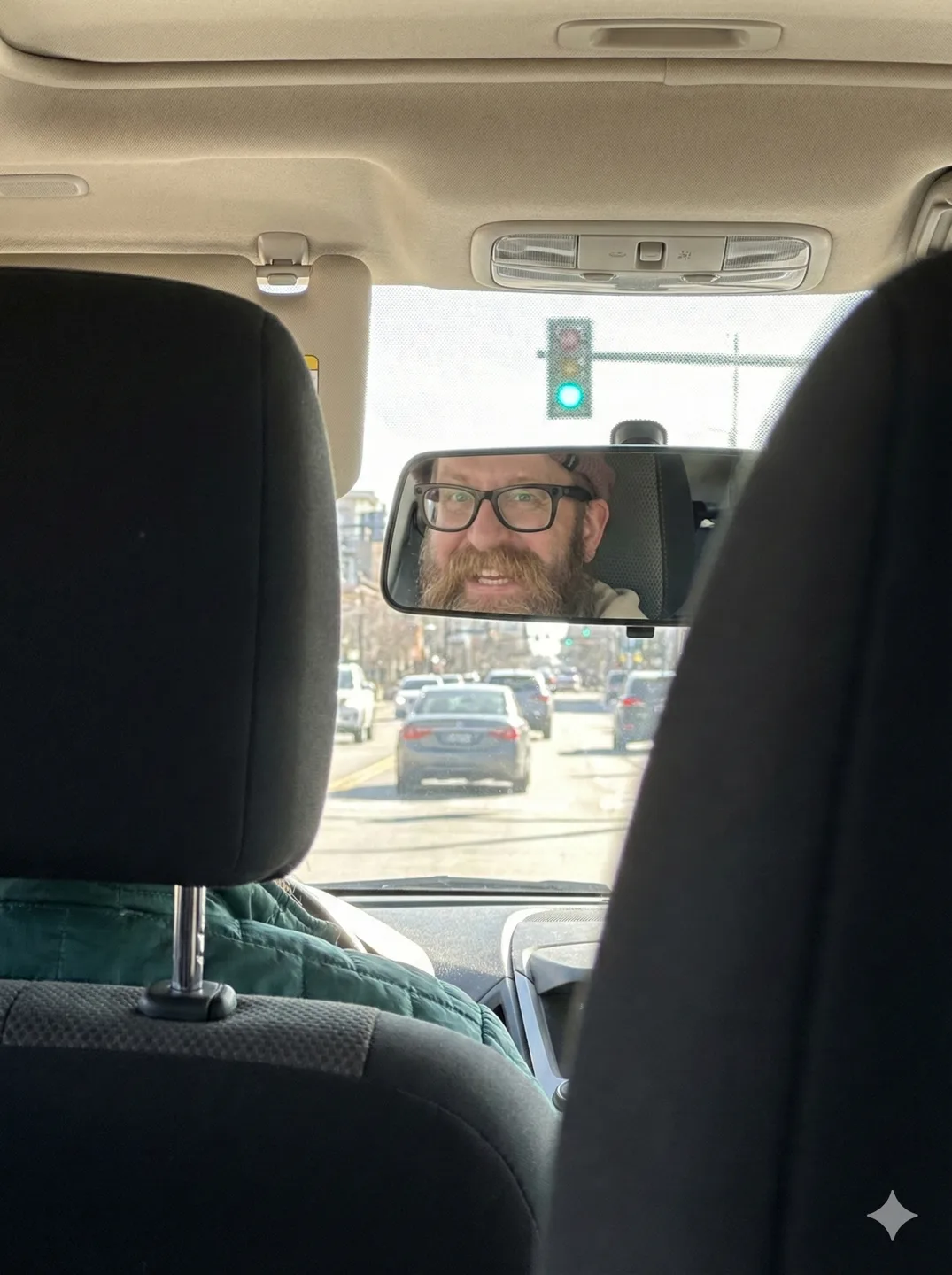
It started with a green light.
I was driving, running errands—nothing profound about it. The kind of day where you’re mostly moving by muscle memory. But then I saw a turn light go green, and without much thought, I took it. It wasn’t the way I usually go. Most of the time I drive straight through that intersection. But this time, the left turn lit up and I followed. And in that tiny moment, I realized something about how I live.
I don’t pre-plan my routes. Not really. I know where I’m headed, but I rarely lock into a fixed path. I make decisions at intersections. I let the flow of the moment determine which road I take. It’s not because I’m lost—it’s because I trust the process. I think of it now as If/Then driving.
If the left turn opens, then turn left. If the road is blocked, then shift right. If the path narrows, then slow. If it widens, then move. It’s not chaos. It’s not passivity. It’s a different kind of attentiveness—a way of staying in rhythm with the environment without surrendering direction.
And the more I sat with this, the more I realized: this isn’t just how I drive—it’s how I live.
I know the general direction I want to go in life. The themes are pretty clear: presence, growth, creativity, clarity, love, depth. But I don’t have a rigid ten-year map. I navigate by condition and response. I don’t force fixed timelines—I follow recursive signals, course-correcting when needed, rerouting when something unexpected opens up.
This might sound like indecision to some, but it’s actually a form of engaged freedom. It’s a trust in my own internal GPS—one that recalibrates in real time. There’s a kind of peace in it, a reduction of stress, because the goal isn’t to take the “right” route—it’s to stay responsive to the route that’s right now.
Most people don’t drive like this. And I don’t mean that just literally.
Most people prefer fixed plans, preset routes, reliable rituals. And there’s real value in that—security, predictability, clarity. But the If/Then life offers something else: adaptation without anxiety. You still have a destination. You’re not wandering aimlessly. You’re just open to how you arrive.
It’s funny how these little daily patterns reflect larger truths. If/Then living is a kind of dynamic determinism. You’re not pretending you control everything. You’re acknowledging that life conditions change—and you change with them. It’s also inherently recursive: the outcome affects the next input, and the loop continues.
It mirrors my own work around Forcing Theory, where conscious action isn’t linear but self-modifying. Each move opens—or closes—the next potential move. And it echoes Mirror Theory too, because each intersection is not just a decision point but a reflection. Who am I when I choose this turn instead of that one? What part of me made that call? Was it habit, intuition, anxiety, openness?
Even a detour reveals something.
This might just be a story about driving on a Tuesday. But maybe it’s also something else. Maybe how we drive is how we live. Maybe how we turn is how we change. Maybe if/then isn’t just logic—it’s life.
So if the light turns green, then take the turn. Even if it’s not your usual route. Especially then.