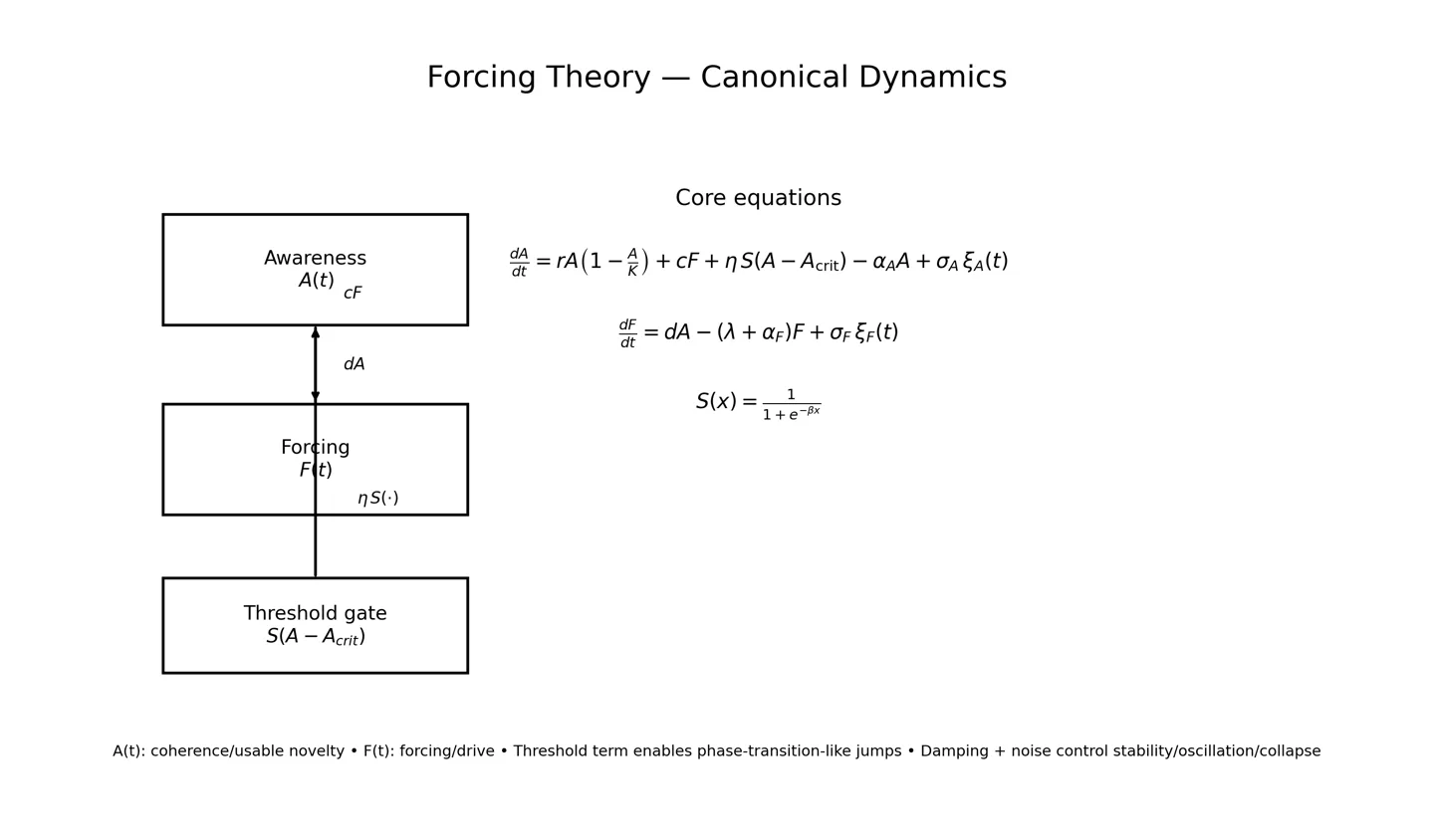
Two days ago, I wrote about something that felt like a quiet line-crossing moment: modern AI systems beginning to solve Erdős problems — not toy problems, not benchmark puzzles, but mathematical questions that resisted human progress for decades. It wasn’t flashy. It wasn’t theatrical. It was simply there, undeniable, like a phase change you only notice after the water is already boiling.
That moment forced me to do what any honest theory has to do when reality shifts beneath it: revisit my own.
I’ve been developing Forcing Theory as a way of describing consciousness, intelligence, and learning as processes that cannot remain static. Systems either expand, stabilize, oscillate, or collapse — not because of mysticism or destiny, but because of pressure, thresholds, feedback, and limits. What changed recently wasn’t the intuition behind that idea. What changed was watching a machine cross a threshold I didn’t expect it to cross yet.
The latest generation of models didn’t just get better at imitation or synthesis. They began generating novel structure — discovering, not recalling. That matters. And it maps cleanly onto something Forcing Theory has always suggested: that intelligence advances not smoothly, but through nonlinear jumps once coherence, pressure, and capacity align.
What follows is an updated abstract and a unified mathematical formulation of Forcing Theory. The equations haven’t replaced the philosophy — they’ve clarified it. They make explicit where forcing enters, where it stabilizes, where it destabilizes, and how relational systems amplify one another. Just as importantly, they allow the theory to touch ground: in AI training dynamics, in networks of agents, and potentially in biological systems.
This isn’t a finished theory. It’s a living one. And like any living system, it updates itself when the forcing is strong enough.
Updated Forcing Theory abstract (math-consistent + 2025 framework integrated)
Abstract
Forcing Theory models consciousness and learning as a dynamical process in which awareness does not remain static but evolves through a coupled interaction between (i) an awareness/novelty state A(t)A(t)A(t) and (ii) a forcing state F(t)F(t)F(t) that drives expansion, regulated by decay, saturation, and stability constraints. We formalize this interaction as a stochastic, threshold-sensitive system of differential equations in which awareness grows through intrinsic dynamics, forcing-driven coupling, and nonlinear phase-transition behavior implemented via a smooth sigmoid gate at a critical threshold AcritA_{\mathrm{crit}}Acrit. The resulting system exhibits distinct regimes—including stable plateaus, oscillatory forcing cycles, abrupt “insight-like” transitions, and collapse—depending on forcing magnitude, feedback strength, and noise. Extending beyond single-agent dynamics, we incorporate relational coupling terms that predict synchronization and collective elevation of awareness across interacting agents, providing a bridge from individual cognition to networked intelligence.
To connect the continuous dynamical model to measurable variables in artificial learning systems, we introduce an operational forcing proxy defined by normalized training improvement, Fenergy=Lt−1−LtLt−1+10−8F_{\mathrm{energy}}=\frac{L_{t-1}-L_t}{L_{t-1}+10^{-8}}Fenergy=Lt−1+10−8Lt−1−Lt, and demonstrate that exponential moving average smoothing over a finite window is required to prevent unstable high-frequency adaptation. This yields implementable self-forcing rules in which sustained high forcing triggers controlled architectural expansion, while sustained low forcing enables pruning and consolidation.
We propose falsifiable predictions and an empirical program spanning (1) AI studies comparing self-forcing architectures to static baselines under stability constraints, (2) multi-agent simulations testing relational forcing and synchronization, and (3) neuroscience protocols probing nonlinear state transitions consistent with thresholded forcing dynamics. Together, these contributions position Forcing Theory as a unified, testable framework for intelligence as regulated self-expansion—linking phenomenological consciousness claims to explicit dynamical equations and measurable forcing proxies.