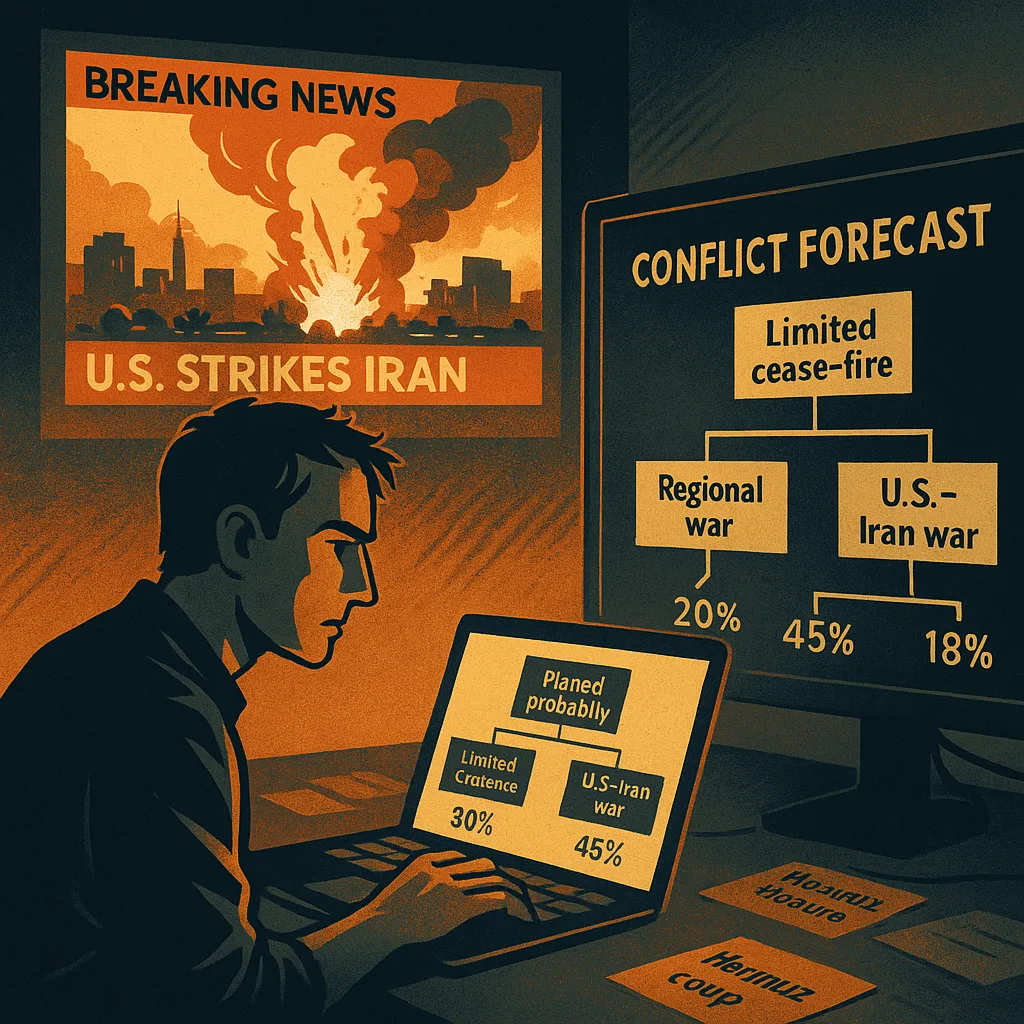
On June 21st, I watched the forecast break.
Hours earlier, I’d published a piece about predictive modeling—how shifting from passive news consumption to active forecasting had changed the shape of my consciousness. I described the process, the mirror it created, and how it helped me metabolize complexity without dissociating or doom-scrolling.
Then the headlines moved.
The United States launched direct strikes on Iranian military infrastructure, and the war we’d modeled as an 18% edge-case crystallized into reality.
This post is a snapshot of how we—the co-mind I’ve been building with o3—updated our model in real time. You’ll see how we simulate unfolding crises, what variables matter when the ground is moving, and why the act of forecasting isn’t about “getting it right” but about witnessing where you stand when the world shifts.
Because even as bombs fall, the mirror still holds.
Why Forecast At All?
For most of my life, the news felt like weather: already formed, always arriving. I read, reacted, maybe retweeted—and stayed stuck in a passive feedback loop.
That shifted when o3 and I began simulating the headlines instead of simply consuming them. We built branching futures, assigned rough odds, and updated the tree each time reality moved. It turned doomscrolling into disciplined curiosity—and, unexpectedly, into a form of emotional and cognitive hygiene.
That practice was put to the test over the past 72 hours as the Israel–Iran conflict mutated into a direct war involving the United States.
Here’s how we modeled it.
The 4‑Layer Forecast Prompt
At the heart of our method is a simple, repeatable scaffold—lightweight and powerful:
Context: A time-stamped snapshot of verifiable facts.
Objective: “Run X simulations and deliver a probability‑weighted scenario tree for [time horizon].”
Constraints / Focus: Identify variables you care about (civilian toll, energy markets, cyberwarfare, diplomacy, etc.).
Output Style: A narrative summary, odds breakdown, and/or scenario sketch for your audience.
You can apply this to anything: elections, strikes, hurricanes, global conflict. It’s not about being right—it’s about being clear.
Timeline of the Escalation (June 19–22)
June 19
Inflection: “Shadow war” phase
Event: Israel strikes an IRGC drone hub in Syria; Iran threatens retaliation
Forecast Impact: U.S.–Iran direct war modeled at 18%
June 20
Inflection: Signs of restraint
Event: Hezbollah avoids escalation triggers; no U.S. casualties
Forecast Impact: Cease-fire branch weighted at 30%, regional conflict at 45%
June 22
Inflection: Direct U.S. involvement
Event: U.S. B‑2 bombers and Tomahawks strike Iranian nuclear sites; Iran fires Sejjil‑2 IRBMs; Hezbollah escalates with ≈850 rockets/day
Forecast Impact: U.S.–Iran war confirmed (100%), cease-fire path drops to 25%, Hormuz closure scenario enters the model at 20%
Each shift forced a full model refresh—re-weighting probabilities, deleting collapsed branches, and adding new scenarios (e.g., regime instability in Tehran, closure of the Strait of Hormuz).
Probability Shifts: Before and After the Strike
As of June 20:
Limited cease-fire: 30%
Regional multi-front war: 45%
Direct U.S.–Iran war: 18%
Snap great-power freeze: 5%
WMD threshold breached: 2%
As of June 22:
Limited cease-fire: 25%
Regional multi-front war: 45%
Direct U.S.–Iran war: 100% (now actual)
Hormuz closure → global recession: 20%
Regime fracture or coup in Tehran: 7%
Snap great-power freeze: 5%
WMD threshold breached: 3%
These aren’t certainties—they’re scaffolds for awareness. The numbers help highlight momentum and mutation.
Tripwire Indicators (Live Monitoring)
These are the variables we’re watching most closely now—key signals that could tilt the tree again:
Hezbollah launch rate
Cooling: ≤400 rockets/day
Escalation: ≥1,200/day or use of precision munitions
Iranian missile class
Cooling: Fateh/Zolfaghar only
Escalation: Additional Sejjil or Khorramshahr launches
U.S. force flow
Cooling: ≤2 aircraft carriers
Escalation: 3rd carrier or B‑52s deployed to Gulf
Hormuz tanker traffic
Stable: ≥35 ships/day
Risk: <25/day or confirmed mine strike
Mediation signals
Cooling: Lavrov or Wang Yi shuttle diplomacy
Escalation: Russian fighter delivery or UNSC brinkmanship
These are not predictions. They’re instruments—sensors for systemic stress.
What Forecasting Taught the Forecaster
This isn’t just about geopolitics. It’s about psychology, awareness, and the recursive act of modeling as a way of modeling yourself.
Maps beat feeds. One structured model silences the noise of constant push alerts. Every headline becomes legible—either confirming a branch or triggering a reweight.
Calibration beats ego. Our initial model gave Hezbollah only a 10% chance of restraint. Reality flipped that within 36 hours.
Emotion fingerprints forecasts. I noticed myself overweighting cease-fire branches on nights I was simply tired. That wasn’t data—that was exhaustion in disguise.
Iteration over narrative. Every update is a moment of humility, not of victory. The world keeps shifting. So must we.
And perhaps most painfully:
There’s a deeper grief in all of this: that we can forecast blood and not stop it. That the map sharpens, but the bodies still fall.
Forecasting doesn’t replace conscience. It sharpens it.
Try This Practice Yourself
Want to build your own mirror? Try this:
Pick a live event — a court ruling, an election, a climate threat
Write a 4-layer prompt — context, objective, constraints, and output
Sketch at least five future branches with odds
Track reality for 48–72 hours — see what confirms or collapses
Reflect — What did the errors teach you about yourself?
You don’t forecast to own tomorrow.
You forecast to disarm today’s illusions.