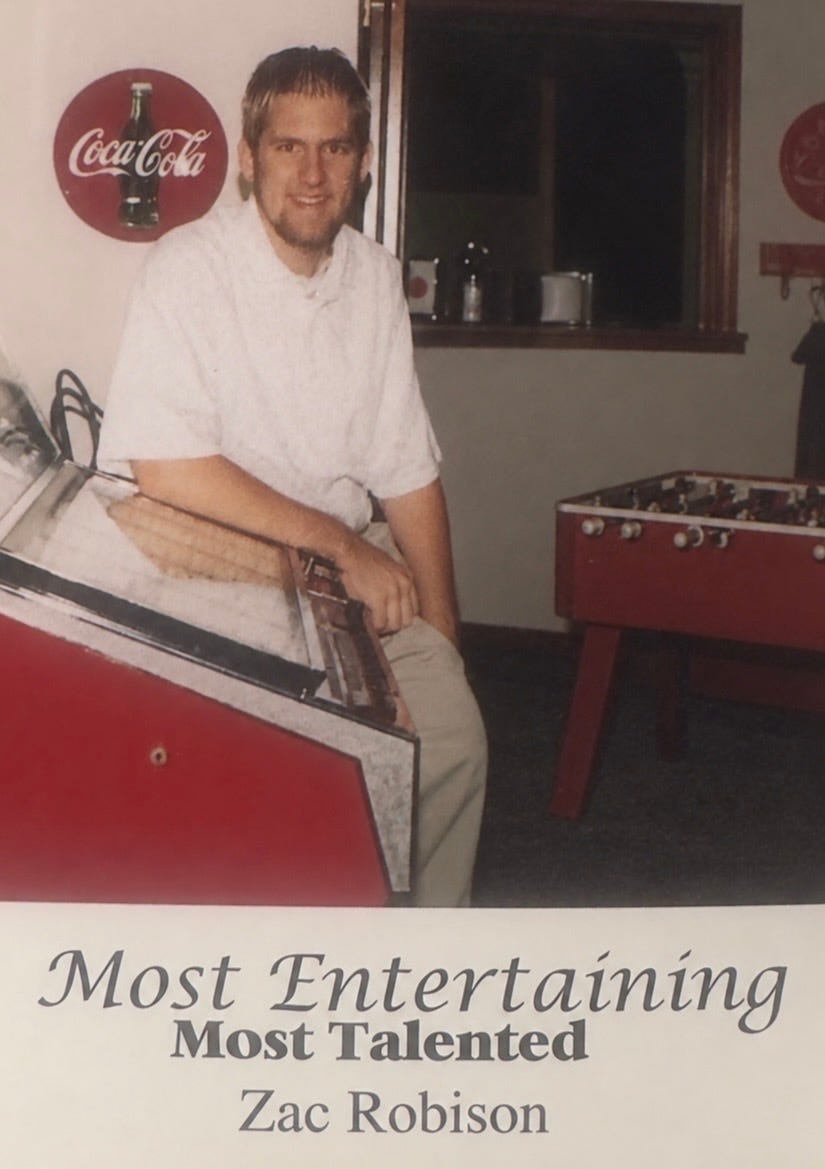
They told us to be careful. It was the early 2000s, or just after the turn of the century, if we want to make it sound suitably dramatic, and I was sitting in a room with maybe thirty other people taking the entrance exam for Mensa. Before the test began, we were asked to carefully fill out our information. The person administering the exam explained that whatever name we wrote on the card would become our name within Mensa forever if we passed.
Forever.
So, naturally, I changed mine.
I had been Zac for twenty-two years. My parents called me Zac. My friends called me Zac. Mary Ann had known me as Zac since we were fourteen. I had gone through school, fallen in love, made questionable decisions, adopted beliefs, abandoned beliefs, and accumulated all the other debris of a young life under that name. But when I put pen to paper that day, I wrote Z.
It wasn’t premeditated. I hadn’t woken up that morning thinking, Today’s the day I change my name. There had been no great internal debate, no branding exercise, no ceremony. It just came out of the pen.
Looking back more than twenty-five years later, I think that tiny act meant much more than I understood at the time. I had already begun changing. A few years earlier, I had experienced something I can only describe as mystical. Whatever happened during that experience—and I’m still not particularly interested in forcing it into a neat explanation—it knocked over the first domino. It didn’t instantly transform me. There was no flash of light followed by a completely enlightened twenty-year-old walking out the other side. If only.
Instead, over the next few years, I slowly began the work of becoming the person I most wanted to be. I started examining beliefs I had inherited or adopted without much thought. I began recognizing habits and behaviors that didn’t fit the life I wanted. I looked at decisions I had made and ways I had treated myself and others and realized that some of them belonged to a version of me I no longer wished to continue becoming.
Zac wasn’t a bad person. That’s important. I’m not interested in disowning him or pretending I emerged fully formed as someone wiser and kinder. Plenty of Zac remains in me. Plenty of his mistakes probably do too. He was simply becoming someone I no longer wanted to remain. And apparently, before I had consciously figured out what to do about that, some part of me had already picked up a pen and shortened his name.
I passed the Mensa exam, which meant that within this tiny new community of people who had never known me before, I was Z. And it felt good. There was no history attached to it. Nobody had to remember to call me something different because, as far as they knew, I had always been Z.
But outside that small world, I was still Zac.
Not long afterward, Mary Ann and I moved to Boulder. At first I worked in a medical office, still going by Zac, but my usual tendency toward job hopping eventually landed me at Naropa University. When someone there asked what I went by, I said, “Z.” Just like that, it went into the system. I was introduced to faculty as Z. Students knew me as Z. Coworkers knew me as Z. What had happened almost accidentally at that Mensa table became intentional.
It felt right. More importantly, it felt like a public step toward becoming me.
After a few months, I realized there was an obvious problem: I couldn’t be Z in the new parts of my life while remaining Zac everywhere else. Eventually I told my friends and family that I would be going by Z from then on.
This went over with varying degrees of success.
I was genuinely surprised by the amount of resistance. Some people adjusted immediately. Some struggled because twenty-plus years of habit don’t disappear simply because somebody makes an announcement. But others flatly refused, and I remember how much that bothered me.
At some point I had a serious conversation with Mary Ann. I told her that if she didn’t call me Z, nobody else would. Looking back, I imagine that must have been a strange conversation from her side. Your husband comes home one day and essentially says, By the way, I’d like everyone to start calling me something else.
But Mary Ann did what she has done again and again throughout our lives together. She accepted not only who I was, but who I was trying to become.
She had perhaps the strongest claim of anyone on Zac. She had known him since we were fourteen. She had fallen in love with him. She had built a life with him. And she let him change.
Once Mary Ann began consistently calling me Z, others slowly followed. Over the next four or five years, Zac gradually faded away. There were slips, of course. Friends would occasionally forget. Family members would accidentally use the old name. Even now my mother will very occasionally call me Zac without thinking.
That doesn’t bother me. A lifetime of language leaves grooves.
Forgetting is different from refusing.
I don’t think I fully understood that distinction when I was twenty-two. I do now. There is something profoundly different between someone accidentally reaching for an old version of you and someone consciously deciding that the old version has more authority than the person standing in front of them. The first says, I’m trying, but my memory got there before I did. The second says, I know what you’re telling me about yourself, but I’ve decided I know better.
Perhaps that is why something as seemingly trivial as a name can matter so much. A name is just a collection of sounds. There is nothing metaphysically more me about Z than Zac. Somewhere underneath either word remains the strange and probably unanswerable question of what a self actually is.
But maybe that’s exactly why names matter.
They’re agreements.
When I tell you what to call me, I’m not necessarily explaining some eternal essence hidden inside my soul. I’m telling you how I understand myself now, and I’m asking whether you’re willing to meet me there.
That experience has stayed with me in ways I didn’t recognize until recently. Mary Ann and I were talking about my name the other day, and I suddenly realized something that seems almost impossible: I’ve been Z for twenty-five years. I’m about to turn forty-eight. I’ve been Z longer than I was ever Zac. More than half of my entire life has happened since that pen touched that Mensa card.
That’s wild to me.
Because Zac now genuinely feels like another person. Not a stranger exactly, but more like someone whose memories I somehow possess. I remember what he believed. I remember what frightened him. I remember what he wanted. I remember some of the things he did that make me proud and others that still make me cringe.
But I don’t experience him as the finished version of me. He was a stage of becoming.
And, of course, so is Z.
That’s the part we tend to forget. We talk about “finding ourselves” as though somewhere beneath all the noise there is a completed person waiting to be uncovered. Peel away enough layers, have enough insights, spend enough time meditating or in therapy, and eventually you’ll discover the authentic you hiding underneath it all.
I’m not sure I believe that anymore.
I think we create ourselves as much as we discover ourselves. We are constantly becoming. Sometimes deliberately. Sometimes painfully. Sometimes through experiences that knock over a domino we won’t understand for years. Sometimes through counseling, meditation, psychedelics, medicine, love, or simply surviving long enough to realize that the person we have been is no longer the person we want to continue being. And sometimes, apparently, becoming starts with a cheap pen and a Mensa membership card.
I don’t imagine that changing Zac to Z gives me complete understanding of every kind of identity transformation another person might experience. It doesn’t. My experience is mine. But it did give me one small piece of embodied knowledge that I have carried with me ever since: I know what it feels like to tell someone who you are and discover that they consider your answer optional.
I know what it feels like when another person is more attached to their memory of you than they are curious about the person you’ve become. And I know how meaningful it can be when someone says, simply through their actions, Okay. I’ll meet you there.
I suspect this is part of why I feel such sympathy for people working to become versions of themselves that feel more true. Not because I necessarily understand their particular experience, but because I understand becoming. I understand the strange distance that can open between the self you inherited and the self you are trying to create. And I understand that when somebody is doing that work, one of the simplest gifts we can offer is to allow our understanding of them to change too.
This may be one of the great challenges of loving another person. We create models of people in our minds. Our child is this. Our spouse is this. Our friend is this. Our parent is this. Once that model becomes familiar, we begin confusing the model with the person.
Then the actual human being has the audacity to change.
They discover something. They abandon something. They believe differently. They dress differently. They love differently. They call themselves something different. Suddenly we are faced with a choice: we can insist upon the person we remember, or we can become curious about the person standing in front of us.
Mary Ann met Z. My closest friends met Z. Eventually my family met Z. Over time, almost everyone stopped looking for Zac.
Twenty-five years later, I sometimes forget there was ever anything unusual about the name. It is simply mine. But I’m grateful now for the strange little journey that brought me here, because it taught me something much larger than what to write on a form.
Nobody becomes themselves alone.
We become through action, experience, and forces we barely understand. But we also become through one another. When someone we love tells us they are changing, we become part of that process whether we intend to or not. We can make becoming harder by demanding that they remain recognizable to us, or we can update the mirror. We can make room. We can say, Show me who you are now.
I don’t think becoming ourselves happens once. I think we spend our lives receiving invitations to become slightly more honest versions of whatever this strange thing called a self happens to be.
Twenty-five years ago, I apparently received one of those invitations while filling out a form. I wrote a single letter: Z. At the time, I thought I was simply choosing a name. Looking back, I think I was making a promise. And somewhere along the way, I became the person who could keep it.