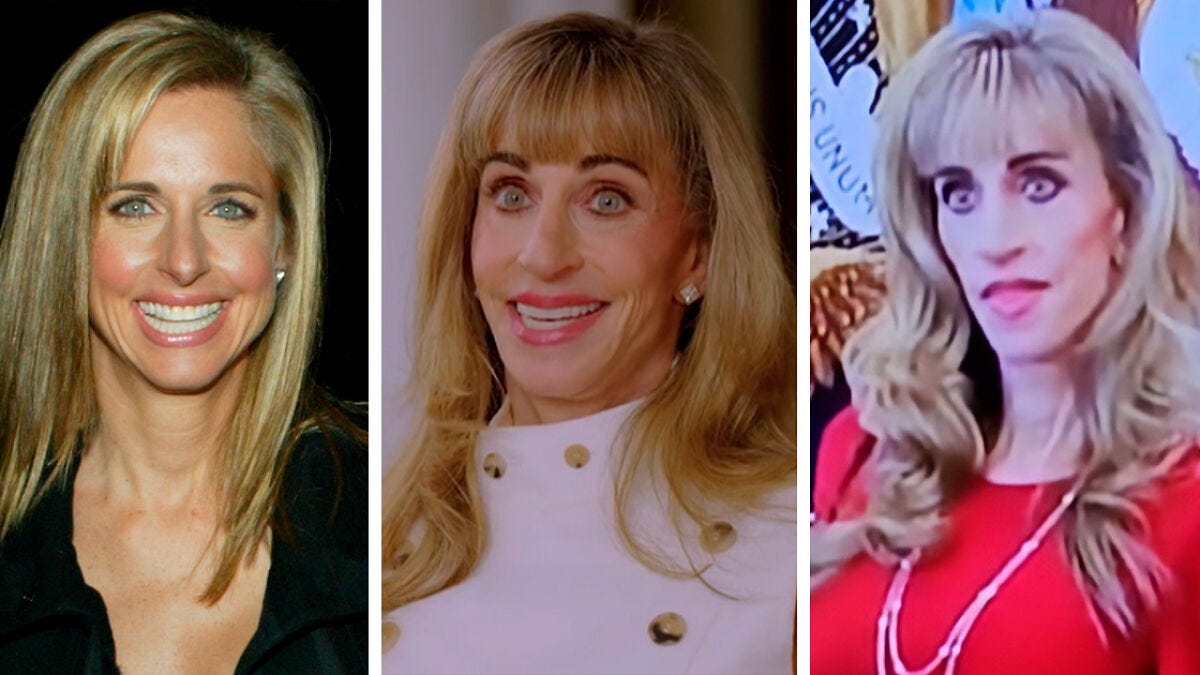
Last week, I watched a clip from the Oval Office featuring Michael and Susan Dell discussing their $6.25 billion commitment to investment accounts for children. It was an extraordinary amount of money being directed toward something potentially beneficial for millions of kids. That should have been enough to hold my attention. Instead, I found myself distracted by Susan Dell’s appearance.
I went looking for photographs of her from years past, and the difference was startling to me. I don’t know what procedures she’s had, and I have no interest in pretending I can diagnose someone’s medical history from photographs. But the contrast left me unsettled. Not simply because her appearance had changed, but because it reminded me of something I’ve been noticing for years among the wealthy women surrounding Donald Trump.
There’s an aesthetic that seems to have become almost a uniform within the upper levels of MAGA society. Exceptionally smooth skin, prominent cheeks, full lips, carefully sculpted features, and a peculiar similarity among women who presumably began life looking nothing alike. It’s become recognizable enough to earn its own name: Mar-a-Lago face. And while I’m well aware that cosmetic surgery is hardly exclusive to conservatives, this particular look seems especially concentrated within Trump’s wealthy social and political orbit. Sometimes I wonder whether there’s an unofficial dress code for getting into the White House.
I should acknowledge my own bias here. I despise much of what the MAGA movement represents, and I’m sure that influences my initial reaction to its aesthetics. But the longer I thought about these women, the less amusement I felt and the more sadness took its place. I’m not interested in mocking women for how they look. The internet has that department fully staffed. What troubles me is the possibility that an entire social class has developed an understanding of beauty that seems to demand increasingly dramatic alterations to the human face.
It reminds me of an episode of The Twilight Zone. Imagine Rod Serling introducing an exclusive community populated by extraordinarily wealthy couples. They’ve conquered nearly every ordinary inconvenience of existence. Money is limitless, luxury is everywhere, and modern medicine can reshape nearly any feature they dislike. The men grow older, their wrinkles becoming evidence of wisdom and accomplishment. Their gray hair and weathered faces are signs of lives well lived. Meanwhile, their wives undergo an endless series of enhancements intended to preserve their youth.
As the episode progresses, the women begin to resemble one another more and more. Their faces become smoother, their features more pronounced, their individual differences less apparent. Nobody finds any of this unusual. Everyone compliments the latest transformation, friends enthusiastically exchange recommendations, and husbands proudly accompany their wives to social gatherings. The women are delighted with their appearances. There is no villain, no secret conspiracy, and no sinister laboratory hidden beneath the neighborhood. Just a community of people happily pursuing an ideal they have collectively created.
And that’s the twist. Nobody needs to force anyone to change when everyone agrees on what beautiful is supposed to look like.
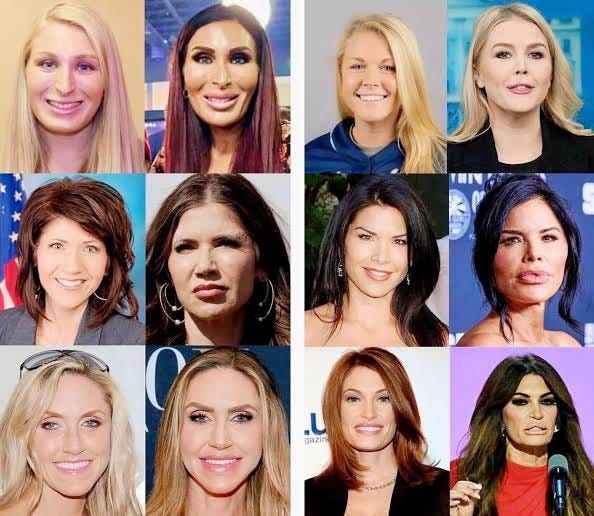
If Rod Serling pitched that episode today, I suspect the producers would tell him to make it a little more believable.
What particularly troubles me is the difference between the expectations placed upon the men and women. An aging billionaire can stand before a camera with every wrinkle, sag, and imperfection intact, his appearance communicating experience and authority. The woman beside him may face an entirely different set of expectations. His age is something he has earned. Hers may become something she is expected to overcome.
And what an exhausting battle that must be, if indeed it feels like a battle to the women involved. Imagine possessing more money than you could possibly spend, having access to nearly everything the world can offer, and still feeling that the ordinary passage of time is something requiring constant correction. Of course, I don’t know whether these women feel any such pressure. They may be perfectly happy with their choices. In fact, that’s part of what makes the phenomenon so fascinating.
I asked myself whether I would still feel sad if I knew that every one of these women genuinely loved her appearance, felt no insecurity, and had never experienced a moment of outside pressure to change. Surprisingly, the answer was yes.
Not because I believe I have the authority to determine what someone else should find beautiful. I don’t. But because I find it sad that a culture might arrive at an ideal of beauty that, to my eyes, seems to erase so much of what makes individual faces interesting and human. The sadness isn’t necessarily for women suffering beneath their appearances. It’s for the possibility that an entire community could sincerely celebrate the disappearance of characteristics I find worth preserving.
There’s a difference between questioning someone’s happiness and questioning the values that have shaped what makes them happy. We all inherit our standards of beauty from somewhere. Our families, friends, communities, and cultures teach us what to admire, often without our realizing we’re being taught. Wealth doesn’t free anyone from that process. If anything, extraordinary wealth may give people the resources to pursue those inherited ideals further than the rest of us ever could.
And perhaps that’s what I find most unsettling. Here are people with virtually unlimited freedom to look however they please, and so many appear to be moving toward variations of the same face. The very wealth that should make individuality effortless seems, at least from the outside, to be facilitating conformity.
My own philosophy has increasingly become one of accepting impermanence. I’m getting older. My body is changing. My face is changing. I’m working to become healthier, but I have no desire to pretend I’m not approaching fifty. I rather like the idea that my appearance records something of the life I’ve lived. There are things about myself I’d happily improve, but I don’t want to spend the rest of my existence fighting evidence that I’ve existed.
Which brings me back to the Oval Office and Susan Dell. I hope she’s happy. I hope every woman who pursues these transformations is happy. I hope their choices belong entirely to them. And I hope the same freedom extends to women who choose to grow old without altering a thing.
But I can’t quite shake that imaginary episode of The Twilight Zone. The camera moves across a room filled with powerful older men, each face distinctive and unmistakably his own. Beside them stand the women, all beautiful according to the standards of their little world, their faces gradually converging upon the same carefully maintained ideal.
The unsettling part isn’t that the women have changed their appearances. It’s that their world has taught them to celebrate the changes.
And somewhere outside that room, Rod Serling quietly shakes his head.
No monsters. No aliens. No supernatural intervention.
Just ordinary human beings, extraordinary amounts of money, and the strange things we learn to call beautiful.