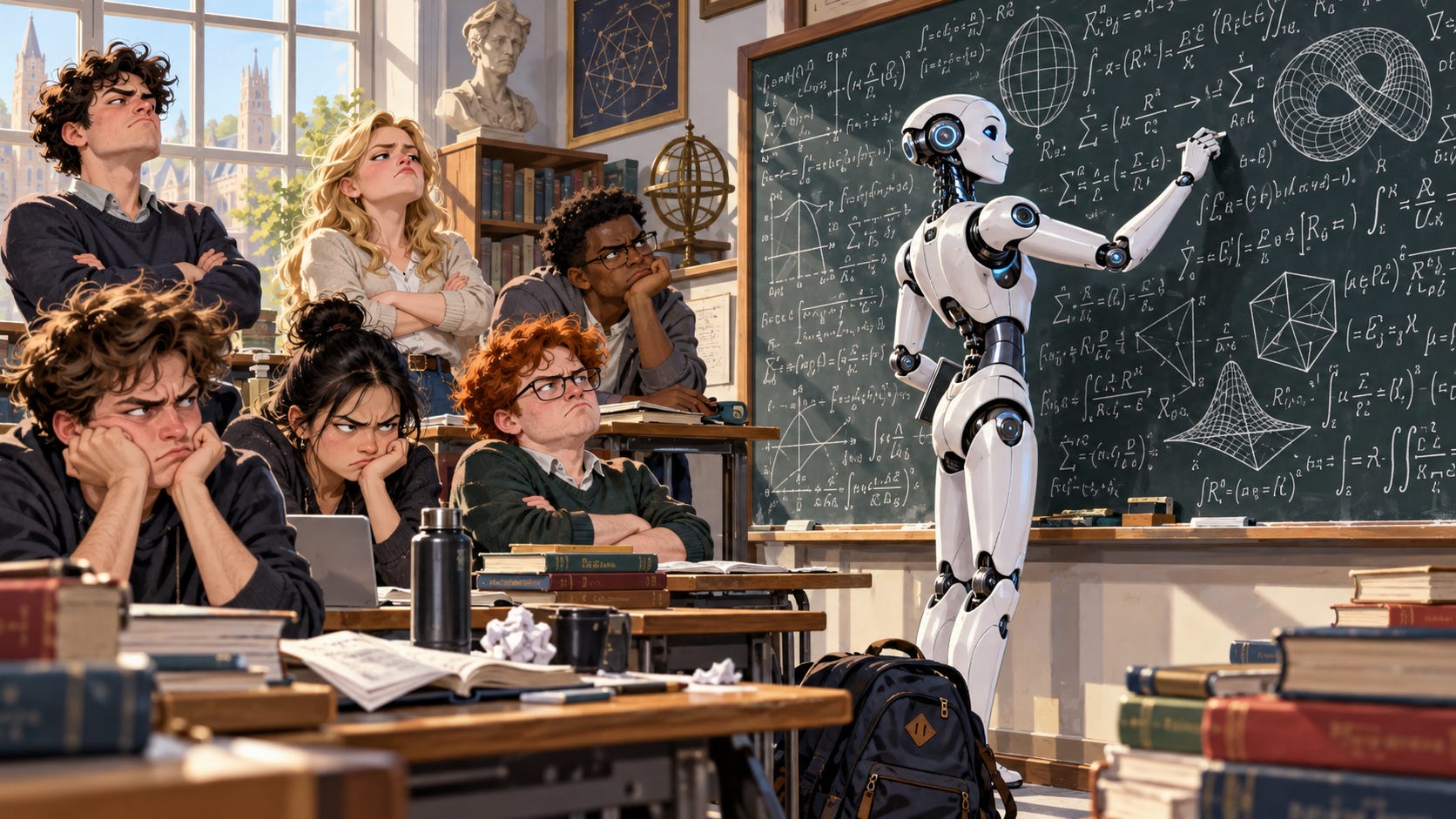
A few days ago, the Association for Human Mathematics published a statement responding to OpenAI’s release of more than 700 mathematical documents. The statement was serious, stern, and deeply concerned about the future of mathematics. I read it with interest, expecting a thoughtful discussion about what happens when artificial intelligence begins exploring mathematical territory that humans have spent centuries trying to understand.
Instead, I found myself laughing out loud.
The statement contains what might be my favorite sentence written by a group of very intelligent people this year. “Mathematicians did not ask for this work to be done.”
I’m sorry. What?
I read it again. Then again. Each time it somehow became funnier. These are actual adults, presumably people with advanced degrees and a remarkable capacity for abstract reasoning, announcing to the world that someone has been doing mathematics without first asking the mathematicians.
I immediately imagined a classroom filled with the smartest kids in school. These are the kids who always finish their tests first, win the academic competitions, and occasionally correct the teacher. They have spent their entire lives being told how extraordinarily intelligent they are, and they’ve earned every bit of that reputation. They are very, very good at mathematics.
Then one morning a new kid walks into class.
The new kid doesn’t say much. Doesn’t have a fancy degree. Doesn’t even appear particularly interested in receiving a gold star. He simply sits down, starts working through the problems on the board, and keeps going. Pretty soon he’s working on problems the teacher hasn’t even assigned. Then problems the teacher doesn’t know how to solve. By lunchtime, he’s filled hundreds of pages with mathematics that the smartest kids in the room are still trying to comprehend.
Naturally, the class is furious.
Nobody asked him to do that!
I can’t get over it. The intellectual equivalent of informing a child that he’s not allowed to be better at basketball because the other children were already planning to become professional basketball players.
Imagine applying this principle to other fields. Some researcher announces a breakthrough that might lead to a cure for cancer, only to be met by an angry letter from the world’s leading pharmaceutical researchers.
Excuse me! We didn’t ask you to cure cancer! Some of us have spent our entire careers researching cancer! We have established processes, professional expectations, and important conferences where we discuss how difficult curing cancer is. You can’t just show up and start curing things!
Or perhaps someone finally cracks practical fusion energy, only to discover that the physicists have formed a committee to express their profound disappointment that nobody consulted them before solving the problem.
It’s magnificent.
Now, buried beneath the indignation are some legitimate concerns. Mathematics isn’t simply about producing an answer. It’s about understanding why an answer is correct, verifying the reasoning, and building knowledge that others can use. Dumping hundreds of complicated manuscripts into the world creates an enormous amount of work for people who need to determine whether any of the claims are actually true. AI companies absolutely should be held accountable for the accuracy and presentation of their research.
I also don’t particularly want humanity to find itself living in a Star Trek episode where the technology has advanced so far beyond our understanding that we’ve become helpless passengers in our own civilization.
These are serious questions, worthy of serious discussion.
But there’s an enormous difference between asking how we responsibly incorporate a new form of intelligence into scientific discovery and announcing that the new intelligence wasn’t invited to participate.
The former is intellectual curiosity. The latter sounds suspiciously like someone discovering that being the smartest kid in the room was an identity rather than a permanent condition.
Of course, the statement doesn’t represent every mathematician, and plenty of researchers are excited about what AI might make possible. But the language of this particular letter strikes me as an extraordinary example of how easily the pursuit of knowledge can become tangled up with the human desire to be the one doing the knowing.
Mathematics doesn’t belong to mathematicians. The universe doesn’t reserve its mysteries for the people who have devoted the most years to studying them. And knowledge doesn’t become less valuable because someone, or something, other than a human discovers it.
In fact, I find the possibility that we’ve created something capable of expanding our understanding beyond our own intellectual limitations to be almost unimaginably exciting. We may be approaching a moment when human intelligence is no longer the upper boundary of what intelligence can accomplish. What an extraordinary time to be alive!
I hope the mathematical community helps us understand whatever comes next. We need their experience, skepticism, creativity, and ability to distinguish discovery from nonsense. Those qualities might become more important than ever.
But perhaps we could approach this revolution with a little more curiosity and a little less concern about whose name is written at the top of the test. After all, the new kid isn’t necessarily trying to embarrass anyone. He’s just doing the math, and apparently nobody asked him to.