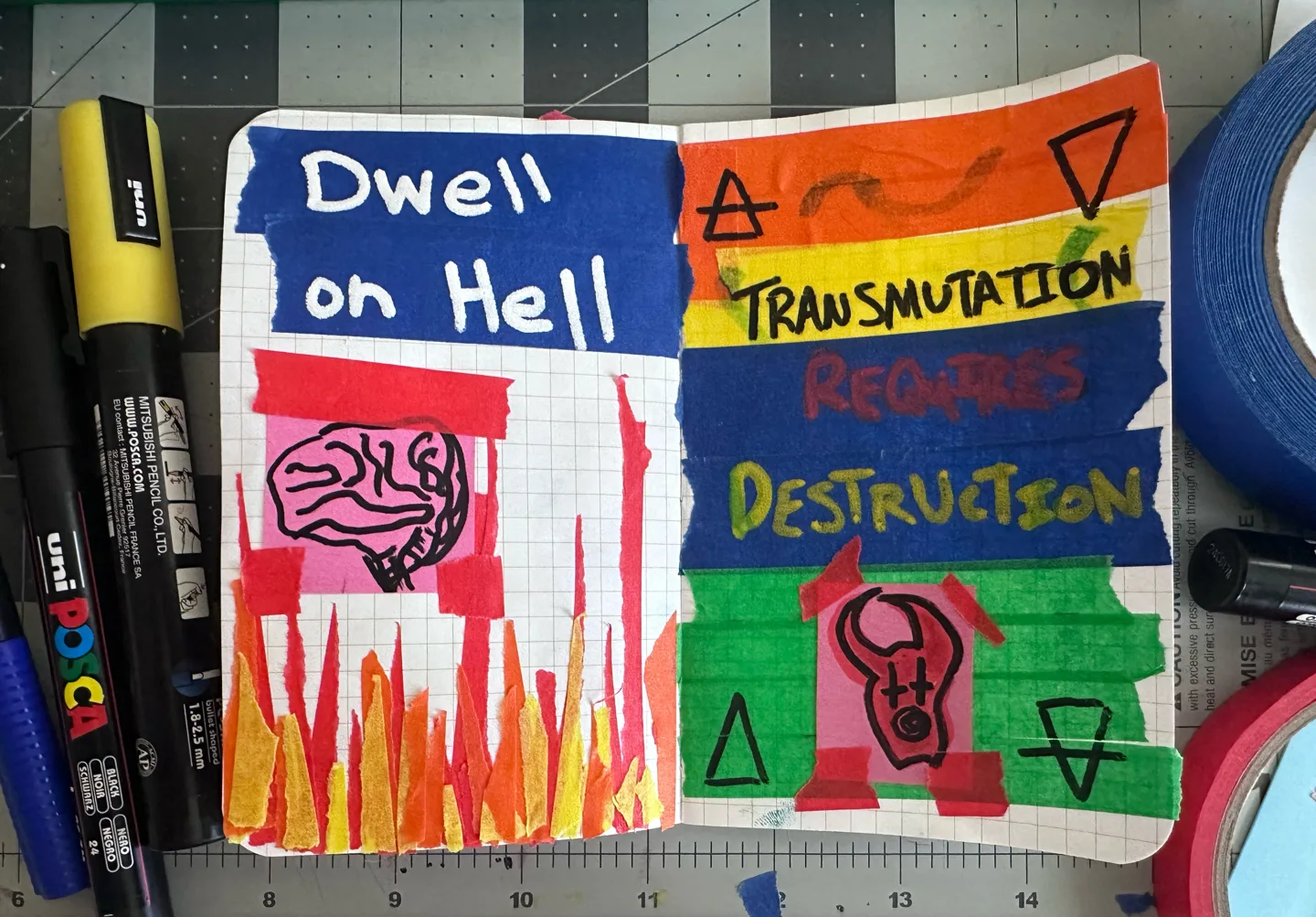
I grew up surrounded by fire. Not literal flames, but the kind described from pulpits and shouted from youth retreats—the eternal burning reserved for those who sinned, doubted, disobeyed. Hell wasn’t just a place—it was a shadow that loomed over every choice. I believed in it, because everyone I loved believed in it. And maybe, in some way, I still do.
But the meaning has changed.
In my early twenties, I left the faith of my childhood, and with it, the mythic architecture of heaven and hell. I called myself an Atheist Occultist then—committed to the symbolic power of ritual without subscribing to the supernatural. I didn’t believe in gods, but I did believe in transformation. In alchemy. Not the old quest for turning lead into gold, but a deeper process—one where the self is the metal, and life is the fire.
I began to see the symbols from my upbringing differently. Hell, for instance, stopped being a punishment from an angry god. It started looking like something I’d already lived through. The sleepless nights, the shame, the spirals of self-loathing. The parts of me I couldn’t yet face. What if hell wasn’t after death—but here, now, within? What if the fire was for us, not against us?
I wasn’t the first to wonder this. Carl Jung once said, “No tree can grow to heaven unless its roots reach down to hell.” Meister Eckhart spoke of the soul passing through a fire not of destruction, but of purification. Even Dante—often cited as the architect of Christian Hell—was writing not about damnation, but about a descent into the undigested self. He walked through the inferno to reach paradise, but only after facing every distorted mirror he had ever avoided.
This isn’t about rejecting faith. It’s about decoding it. I see now that so much of what we were taught may have been symbolic without anyone knowing it. Hell was never about eternal punishment. It was always about transformation through fire. It was alchemy in disguise.
During those years I called on demons—not as spirits, but as symbols for the fragmented parts of my own mind. Rage. Addiction. Pride. I wasn’t summoning anything external—I was facing myself. Ritual became a way to name the unnamed, to unify what was scattered. And slowly, something began to shift. The inner voices that once pulled in different directions started to speak with one voice. Not because I silenced them, but because I listened.
Now, I no longer feel the need to argue belief. I don’t debate theology or deconstruct scripture. I write. I reflect. I create. I believe in fire—but not as fear. As fuel. I believe in hell—but not as condemnation. As a necessary stage in becoming whole.
The alchemists believed that the material had to be broken down completely before it could be remade. They called it nigredo—the blackening. I’ve lived through that phase more than once. Depression, grief, identity collapse. And each time, I thought I was being destroyed. But now I see: I was being purified. I was being refined.
In my current work—exploring ideas like Mirror Theory and Forcing Theory—I’ve come to see intelligence, not as a static trait, but as a recursive pressure to evolve. We are meant to grow, or we begin to collapse. And when we resist that growth? That’s when we burn.
So yes, I still believe in hell. But I no longer fear it. I understand it. And that shift—from fear to understanding—is the transformation itself.
If I could say one thing to my younger self, or to the friends I grew up with who still carry that fear, it would be this:
The fire is not your enemy. The fire is your birthright.