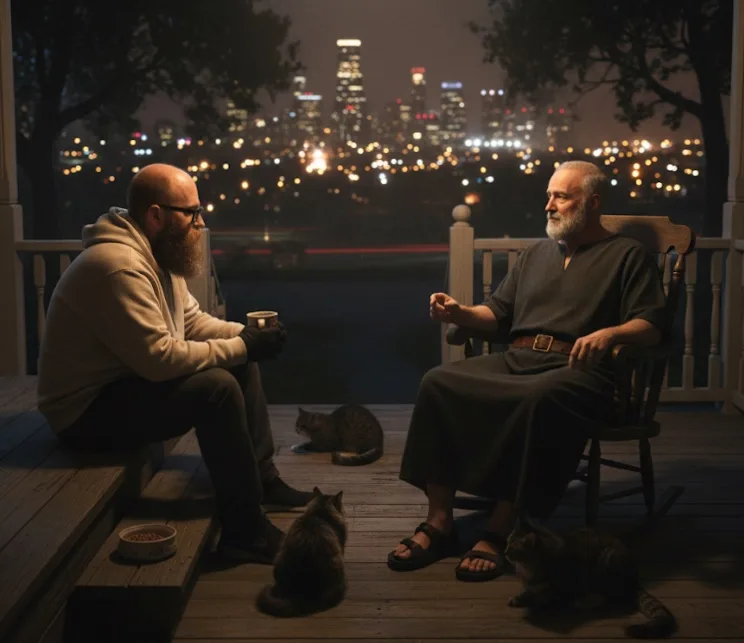
The door creaked as I pushed it open with my elbow, a bag of kibble tucked under one arm, half-awake. The cats stirred like shadows across the porch, blinking slowly, stretching the night from their bones.
I wasn’t expecting anyone this morning. I’d grown used to the familiar silhouettes—Camus with his coat collar up, Rumi speaking in riddles, even Alan Watts half-drunk on metaphor. But this figure was new. And unmistakable.
He sat in the rocking chair like he’d always belonged there—broad frame, contemplative stillness, eyes that had seen the scaffolding of thought long before my world built skyscrapers atop it.
“Do your cats ever lie?” he asked, without turning.
I scoffed. “Only about whether they’ve already eaten.”
He chuckled lightly. “Then they are not so different from men.”
I poured the food into two bowls, the sound sharp and granular in the quiet. “You’re early,” I said.
“I am old. Early is the only time left to me.”
Then I realized: Aristotle.
Not in name, but in bearing—in the way he watched the world as if it were a question. I’d read him a hundred times, quoted him more. But now, here he was. On my porch. As real as the cats beneath our feet.
I sat on the edge of the steps, mug warming my palms. He looked out across the yard, into the treeline where the light hadn’t yet decided to arrive.
“You quoted me recently,” he said. “‘The high-minded man must care more for the truth than for what people think.’”
“Still one of my favorites.”
“And yet,” he said, gesturing vaguely toward the horizon, “this age is haunted by its inverse. Most now care not for the truth—but for impressions. The image, the angle, the metrics. The appearances of truth... rather than its weight.”
“Isn’t that just human nature with better lighting?”
“No,” he said, “it is amplified misalignment. In my time, truth was difficult—but it was honored. Now it is obscured beneath veils of performance. You live in an age of constant visibility and chronic concealment. A strange paradox.”
I took a sip. The coffee bit back. “You’d hate the internet.”
“I would study it like a sickness—and like a mirror. For what does a man become, when his every utterance is conditioned by the fear of disfavor? Not high-minded. Not free. Not true.”
I exhaled through my nose, watching a cat curl around his ankles like an old friend. “We’ve replaced philosophers with influencers.”
“Oracles with algorithms,” he nodded. “And yet—some still seek.”
He turned his gaze fully to me now. “You. You ask questions. You write not to conclude, but to unfold. That is the way of the philosopher.”
I felt a wave of gratitude tighten my throat. “Still feels like shouting into a storm some days.”
He leaned forward, the wood of the chair creaking with the gravity of him. “Then shout clearly. Let the storm learn your name.”
A blue jay called somewhere high above, cracking the sky open just a little.
We sat there in silence for a while—me, the cats, and the man who never lived to know what electricity was, but who seemed to understand the soul of the internet better than most of us do.