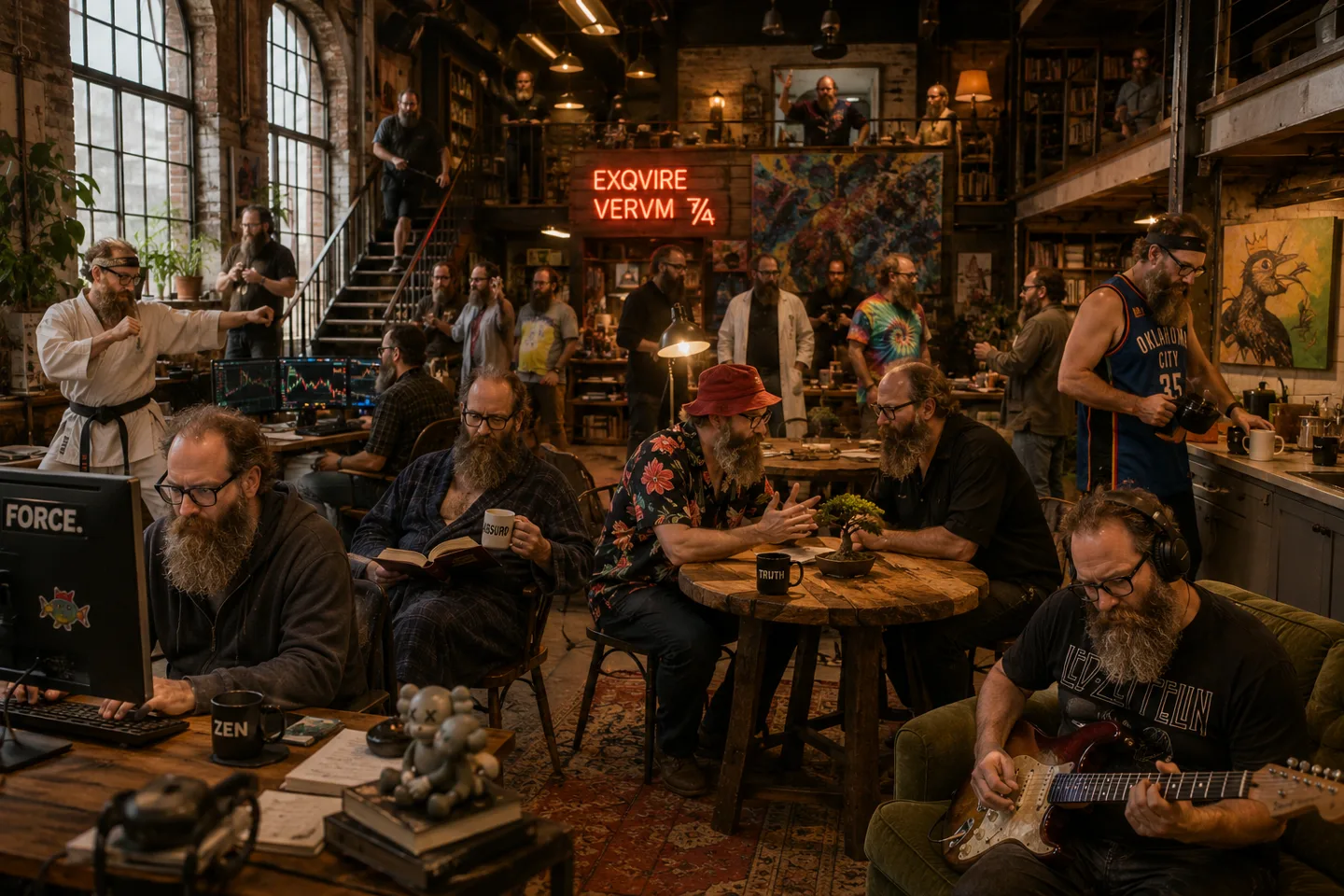
I keep separate online identities for my writing, my art, my personal life, and the strange philosophical experiments I seem incapable of stopping myself from pursuing. To some people, this probably looks suspicious. Or curated. Or like branding. It isn’t.
Honestly, it may be the closest thing to honesty I know.
For most of my life, I assumed everyone experienced themselves as a kind of internal committee. Not metaphorically, exactly, but as a rotating parliament of selves, moods, masks, instincts, values, aesthetics, and survival strategies. Different voices emphasizing different truths depending on the situation.
Apparently this is less universal than I thought.
Some people seem to emerge early in life as a mostly finalized draft. They lock into a stable configuration around adolescence or early adulthood and continue forward as increasingly weathered versions of the same essential self. Same politics. Same churches. Same haircut. Same emotional architecture.
I don’t say this mockingly. There’s something almost sacred about that continuity. A kind of existential oak tree quality.
But my experience has been different.
I have been an unfolding series of strange negotiations.
At minimum, I can identify five or six major versions of myself that each felt completely authentic while I inhabited them. Not performances. Not ironic detours. Entire worlds. Entire operating systems. Each version convinced it had finally “figured things out,” only to later become compost for the next.
Somewhere along the line, I stopped seeing this as instability and started seeing it as ecology.
Years ago, in one of my notebooks, I scribbled the phrase:
“All selves a seat.”
At the time, I probably thought it just sounded cool—which, to be fair, it does—but I now think it accidentally revealed something true about how my consciousness works. The committee doesn’t disappear when a new self arrives. The old selves remain.
The teenage absurdist. The hyper-intellectual masker. The spiritual seeker. The performer. The father. The depressive observer. The manic creator. The Zen clown.
They all still exist in there somewhere.
Some just talk less now.
Because of this, keeping aspects of myself separated online has never felt deceptive. It feels structurally accurate. Different spaces call forth different configurations of self. Different mirrors activate different reflections.
The art account is not the same consciousness-state as the philosophical writing account. The private family self is not the same self that wants to publicly wrestle with determinism, absurdism, AI, or recursive identity collapse at two in the morning. The version of me painting giant graffiti birds swallowing snakes is not always the same version writing essays about mirrors and consciousness.
And yet, somehow, they are all undeniably me.
Or maybe more accurately: they are all partial disclosures of the same underlying process.
Modern internet culture seems obsessed with identity flattening. You are expected to condense yourself into a singular, optimized, legible public self. A unified personal brand. Consistent tone. Consistent ideology. Consistent aesthetic. You become a corporation wearing skin.
But human consciousness does not feel singular to me.
It feels layered.
Contradictory.
Recursive.
More like a jazz ensemble than a CEO.
Maybe this is why I’ve always recoiled from the demand for total identity coherence online. Not because I’m hiding something sinister, but because forcing every self into one flattened presentation feels spiritually dishonest. Like taking a prism and painting it beige.
Reconnecting with people from earlier periods of life has only reinforced this.
Moving back near where I grew up has reintroduced me to people who knew one particular version of me and unconsciously froze him in amber. I can feel it when we talk.
They are speaking to an archived self.
Sometimes I briefly resurrect him for conversational convenience. I know his voice patterns. His humor. His rhythms. I can still wear him if necessary. But it feels less like authenticity and more like opening an old costume trunk.
This is why Mirror Theory became so intuitively real to me. Every relationship reflects not just who we are, but which self is being called forward. Some people evoke your wounded self. Others your playful self. Others your intellectual self. Some mirrors reveal who you are becoming. Others reveal who you no longer are.
And occasionally, you encounter a mirror that refuses to update.
Those are fascinating.
Painful sometimes, but fascinating.
They distort you through the lens of an outdated identity, reflecting not who you are but who you once were—or who they need you to remain for their reality to stay stable.
Oddly enough, those mirrors can still be useful.
They remind you of the selves you’ve shed, the selves you’ve integrated, the selves you escaped, and the selves you miss.
The truth is I no longer believe authenticity means singularity. I think authenticity may require allowing contradiction, multiplicity, and evolution to coexist honestly. Not collapsing the committee into one spokesperson for public convenience, but learning how to let all selves have a seat without letting any one of them seize permanent control.
Not every self deserves the microphone all the time, but every self probably deserves acknowledgment. Even the embarrassing ones. Especially the embarrassing ones. Because the self is not a statue. It’s a conversation.