The verse that has probably shaped my life more than any other over the past thirty years is not one that kept me inside Christianity. It is one that helped me leave without feeling like I was abandoning the search for truth itself.
“Ask and it will be given to you; seek and you will find; knock and the door will be opened to you.”
That one stayed.
A great many other things did not. Entire theological scaffolds collapsed. Certainties evaporated. The cosmic customer service model stopped doing it for me. But Matthew 7:7-8 survived the wreckage like a single strange ember I carried out of the fire. It stopped reading like a promise from a religion and started reading like a basic instruction for consciousness itself: ask, seek, knock, continue. In other words, do not just sit there like a decorative gourd waiting for enlightenment to drift through the window and introduce itself.
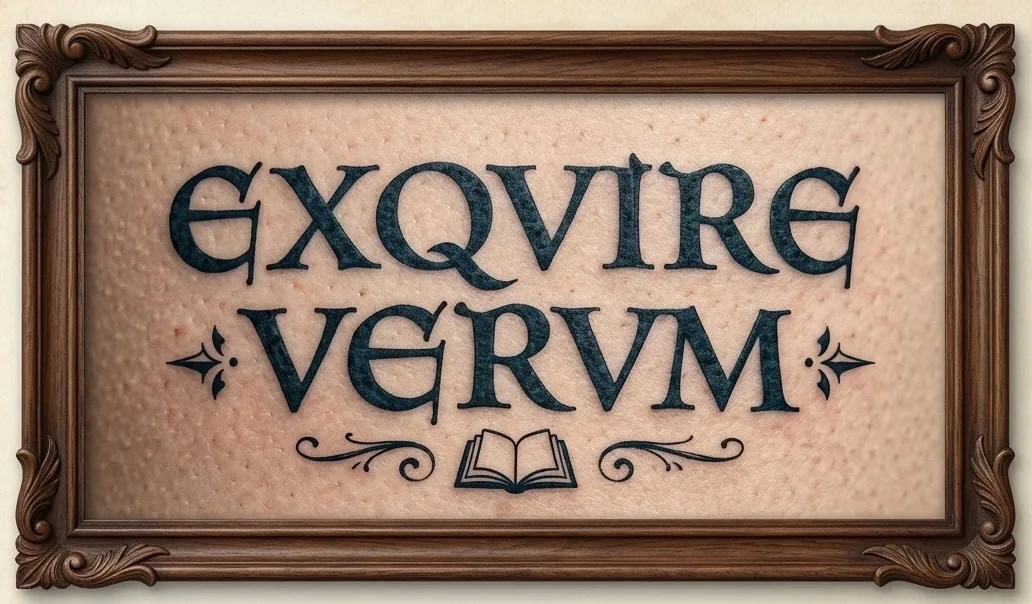
When I first left Christianity, that verse gave me a kind of internal permission slip. It helped me see that the search for wisdom was not betrayal. It was obedience of a different kind. I took it seriously enough that I had EXQVIRE VERVM tattooed on my arm. Seek truth. Not “defend what you were handed at sixteen.” Not “cling harder when things stop making sense.” Seek. Go look. Keep looking. Wreck a few perfectly usable certainties in the process.
When Christians would approach me and want to talk about why I had left the faith, this was the verse I always returned to. Before we got buried under doctrine, apologetics, or the usual spiritual hostage negotiation, I would ask them a simpler question: did they believe I was sincerely seeking? Every single one said yes. They did not necessarily like where I had gone, and I am sure some hoped my search would eventually boomerang me neatly back into the fold, but they accepted the sincerity of it. That mattered to me. I was not leaving because I wanted less truth. I was leaving because I could no longer pretend truth should fear inspection.
Later, when I wandered into the world of grimoires, ceremonial magick, left hand path thought, and the general haunted library of human consciousness, the same instinct returned in a different robe. The language changed. The hunger did not. Now the search was full of masters, daemons, hidden teachings, initiations, symbols, gates, correspondences, and enough old occult writing to make it seem like every candle in Europe had once been burned in service of a footnote.
And for years, I searched for a master.
That sounds dramatic, which is fitting, because occult literature is nothing if not fully committed to the bit. But I mean it plainly. I searched. I read ancient grimoires and magickal texts that spoke of masters in ways that felt larger than metaphor and stranger than psychology. I wanted to understand what they meant, not just intellectually, but in the way a person wants thunder to stop being a concept and start rattling the windows.
Then, after more than a decade of seeking, I found the master.
Or more accurately, I found why the search had to take so long.
Because if someone had walked up to me at the beginning and said, “You are your own master,” I would have nodded politely and shelved it beside every other spiritual refrigerator magnet. Nice sentiment. No voltage. It would have passed through me without consequence. It only mattered because I had spent years looking everywhere else first. It only landed because I had exhausted myself on the outside of the riddle.
When the realization arrived, it arrived the way a koan resolves. Not as information, but as recognition. Suddenly all those pages about masters made sense. Not because I had decoded them like some smug esoteric crossword champion, but because the truth of them had become experiential. The master was not waiting for me in some distant robe. The daemons were not external little goblins lurking behind the wallpaper of reality waiting for formal introduction. They were within the mind. The architecture shifted. The old texts did not become less meaningful. They became more meaningful, because I finally understood what kind of language they had been speaking all along.
That is the sort of thing no one can hand you early and have it truly matter. Some truths are not withheld because the universe is cruel or elitist or addicted to dramatic timing, though I would not rule out that last one. They are withheld because you have to become the person who can hear them. You have to seek long enough for the answer to stop being a sentence and start being an event.
That, I think, is what has stayed with me from Christianity through magick, through philosophy, through meditation, through all the reading, arguing, doubting, contemplating, and general metaphysical wandering around with a flashlight in my teeth. The search itself is formative. The search changes the seeker. It is not just about arriving somewhere with a little flag and announcing you have captured truth for your team. It is about what the seeking does to the structure of the mind while you are still unfinished.
And I am still very unfinished.
I still seek. I still look and think and meditate and contemplate and debate and scribble ideas down that seem profound at 5:30 in the morning and highly questionable by lunch. I still chase questions into places that would have horrified earlier versions of me. I still know almost nothing, which at this point feels less like failure and more like a realistic opening statement. But the search continues to reward me in ways I never could have predicted. Not always with answers. Often with better questions. Sometimes with the total collapse of the question I thought I was asking in the first place.
That may actually be the reward. Not certainty. Not closure. Not the fantasy that one day I will sit in a chair, steeple my fingers, and become a finished wise man who finally understands everything from daemons to dopamine. The reward is that sincere seeking keeps opening the mind beyond the borders it inherited. It keeps breaking the cage and then revealing there was another cage behind that one, which is honestly a little rude, but still useful.
“Seek and you will find” is one of the few verses I never lost. I just no longer hear it the way I once did. I do not hear it now as a promise that the system will validate itself if I stay loyal long enough. I hear it more as a law of becoming. Seek long enough and you will find something, though it may not be the thing you expected, and it may cost you every identity you were using when you started.
Which, in my experience, is often how you know it was worth finding.