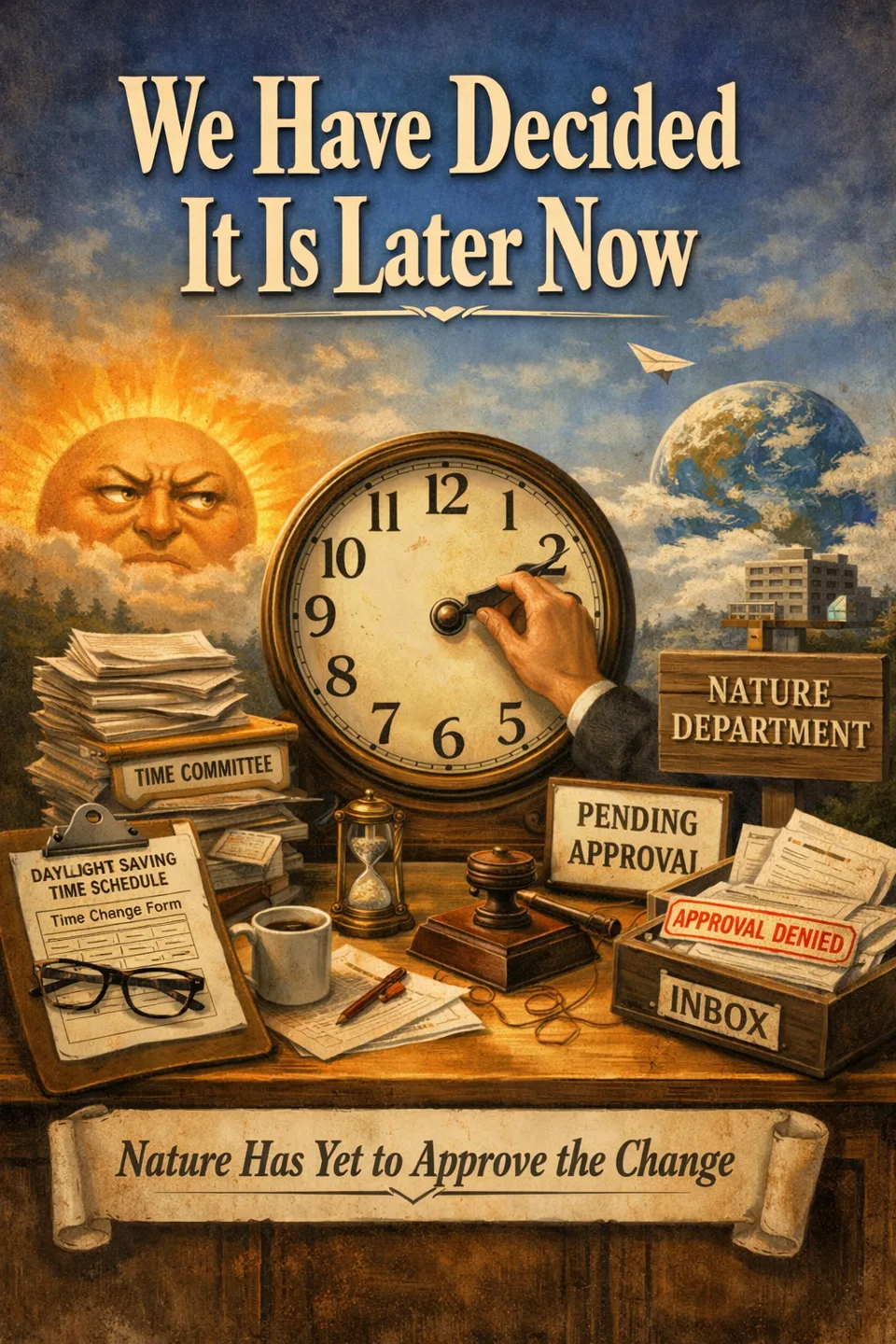
What an incredible system we’ve built.
As a species, we have successfully engineered a global civilization so advanced, so elegant, so finely tuned, that it only needs to be manually disrupted twice a year. That’s efficiency. That’s innovation. That’s the kind of streamlined brilliance you expect from the same creature that invented both the moon landing and the office reply-all.
Consider the genius of it: rather than simply accepting that the sun rises and sets whenever it pleases like some anarchist celestial body, humanity decided to impose order. We took time—already an invisible, abstract construct with no physical existence—and said, “This needs more bureaucracy.”
And not just ordinary bureaucracy. Seasonal bureaucracy.
So now, every year, in a dazzling display of coordination, millions of people collectively agree that 2:00 AM is no longer 2:00 AM. Sometimes it becomes 3:00 AM. Sometimes it becomes 1:00 AM. Why? Because we are serious adults running a serious society.
You have to admire the confidence.
Most systems, when they require biannual tampering to remain functional, are generally considered flawed. But not this one. No, this one is so magnificent that we’ve all agreed the problem is not the system itself, but our failure to appreciate the sacred ritual of changing every clock in the house like medieval peasants resetting the village sundial.
Phones do it automatically now, of course, which somehow makes it even more insulting. Your device quietly updates in the night, and you wake up feeling vaguely cursed, as if your soul has been rescheduled by committee.
And let’s not overlook the historical majesty of the whole thing. At some point, society looked at farming—a profession famously known for obeying wall clocks—and said, “You know what agriculture needs? More administrative whimsy.” Whether or not that was ever the real reason almost doesn’t matter anymore. The beauty is in the myth. The tradition. The inherited nonsense.
This is civilization at its finest: not asking whether a thing makes sense, but preserving it long enough that questioning it starts to feel rude.
And the messaging around it is perfect. We “spring forward,” as though launching into a radiant future of opportunity, productivity, and mildly increased car accidents. We “fall back,” which sounds gentler, but in practice just means the sun sets at lunchtime and your internal organs stop trusting you.
Still, there’s something noble about it. There’s something deeply inspiring in the fact that humanity created an elaborate timekeeping framework, divided the planet into conceptual slices, aligned commerce, labor, school, transit, communication, and sleep around it—and then added a little seasonal twist ending just to keep everyone humble.
Because if there’s one thing modern life was missing, it was a recurring reminder that all of this is made up.
So yes, daylight saving time is absurd. But it is exquisitely absurd. A masterpiece of collective delusion. A monument to administrative overconfidence. A biannual festival in honor of the human ability to invent a problem, institutionalize it, and then congratulate ourselves for managing it with only minor exhaustion.
Truly, an amazing system.
Only needs changed twice a year.