I have loved superheroes for as long as I can remember. Before I knew anything about comic universes, continuity, power scaling, multiverses, or whether Batman could beat Superman with sufficient prep time, there was Christopher Reeve. Superman was the superhero to me. I watched those movies religiously as a kid, probably trailing only Star Wars in the number of times those VHS tapes were subjected to another round. Superman represented the entire idea in its purest form: a person who could do almost anything. He could fly, bend steel, stop bullets, see through walls, and save the day through sheer impossible capability. When you’re a kid, that’s basically the end of the argument. Who could possibly be better than Superman?
Then I grew up and superheroes grew up with me. Iron Man arrived and kicked open a door that has remained open for nearly twenty years. Marvel built its enormous interconnected universe, DC kept expanding its own mythology across movies and television, streaming joined in, and I happily consumed almost all of it. Somewhere along the way I went from simply knowing that Thor had a hammer to learning exactly what the hammer could do, who could lift it, which version of Thor was strongest, and what would happen if he fought Superman. I learned about characters who barely appear onscreen, alternate versions of familiar heroes, cosmic beings who can rewrite reality, gods who kill other gods, people capable of destroying planets, and people capable of destroying the people capable of destroying planets. There is apparently no ceiling. Every time someone becomes impossibly powerful, comic books eventually invent somebody even more impossibly powerful.
Which naturally leads to one of the great pleasures of superhero fandom: arguing about who would win. Superman versus Thor. Hulk versus Doomsday. Batman with prep time versus, apparently, the entire known universe. People have spent staggering amounts of intellectual energy creating imaginary fights between imaginary people and then defending the results with the seriousness of constitutional scholars. Strength gets measured. Speed gets calculated. Previous battles become case law. Someone inevitably points out that a particular feat happened in issue 237 of a discontinued series in 1986 and therefore your entire argument is invalid. I love all of it.
And then there is Squirrel Girl.
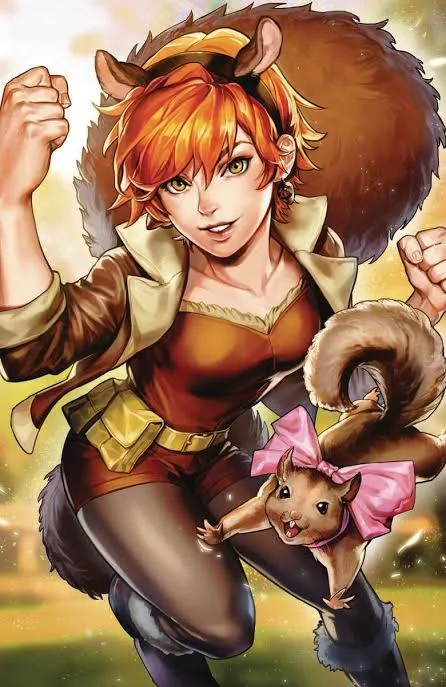
Of everything I’ve learned while wandering deeper into comic-book mythology, Squirrel Girl may be my favorite discovery. Her name is Doreen Green. She has some modest superhero abilities, but nothing remotely approaching the heavy hitters of the Marvel universe. Her defining talent is that she can communicate with squirrels. More importantly—and this is the part I adore—she doesn’t rule them. She doesn’t summon an unwilling squirrel army from the forest and command them into battle. They are her friends. Squirrel Girl makes friends with squirrels, and the squirrels help her out.
And somehow this woman is essentially unbeatable.
Doctor Doom? Squirrel Girl.
Thanos? Squirrel Girl.
Characters who have terrified entire universes have discovered, presumably moments too late, that they are about to have a very bad afternoon involving a cheerful young woman and an unreasonable quantity of rodents.
There is something about this that makes me profoundly happy.
Part of it is obviously the joke. Comic books have spent decades escalating the concept of power to such ridiculous heights that eventually someone had to puncture the whole thing. You can create a character who possesses the Power Cosmic, another who controls reality, another who can destroy galaxies with a thought, but somewhere off to the side is a woman talking to a squirrel named Tippy-Toe who apparently needs to be included in the strategic calculations.
But I think what I really love about Squirrel Girl is that she breaks the equation.
Superhero stories encourage us to imagine power as something quantifiable. More strength equals more power. More speed equals more power. Bigger explosions equal more power. If Character A can destroy a mountain and Character B can destroy a planet, Character B wins. Eventually you wind up with enormous databases of fictional accomplishments designed to determine precisely where everyone belongs on the cosmic organizational chart.
Squirrel Girl strolls into the chart and knocks it over.
She reminds us that power is not always domination. Sometimes power is relationships. Sometimes power is cleverness. Sometimes power is being underestimated. Sometimes power is approaching a problem from such a completely unexpected direction that the person with the giant laser beam doesn’t know what the hell to do with you.
And sometimes power is having a lot of squirrel friends.
There is something wonderfully human hiding inside the absurdity. Superman is aspirational because he possesses nearly unlimited power and chooses kindness. Batman is aspirational because he possesses extraordinary discipline and refuses to quit. Spider-Man is aspirational because he keeps trying to do the right thing even while his personal life collapses around him.
Squirrel Girl offers a stranger possibility.
What if being good at making friends is itself a superpower?
Not networking. Not accumulating followers. Not commanding loyalty. Actually making friends. Understanding others. Treating creatures everyone else considers insignificant as worthy of attention and companionship. And then discovering that the supposedly insignificant things of the world can become extraordinarily powerful when they decide to help one another.
Maybe that’s giving a comic-book joke considerably more philosophical weight than anyone intended.
But this is what my brain does.
I started my superhero life watching Christopher Reeve fly across the screen and believing that Superman represented the absolute limit of what power could look like. Then I spent decades watching Marvel and DC continually raise that ceiling. Stronger heroes. Bigger villains. Larger universes. Higher stakes. Gods fighting gods while planets explode behind them.
And after all of that escalation, one of my favorite superheroes turns out to be a woman whose greatest strategic asset is friendship with the neighborhood wildlife.
There is something almost Zen about that. After nearly a lifetime of superheroes asking, Who is strongest? Squirrel Girl shows up with a handful of nuts and answers: You may be asking the wrong question.