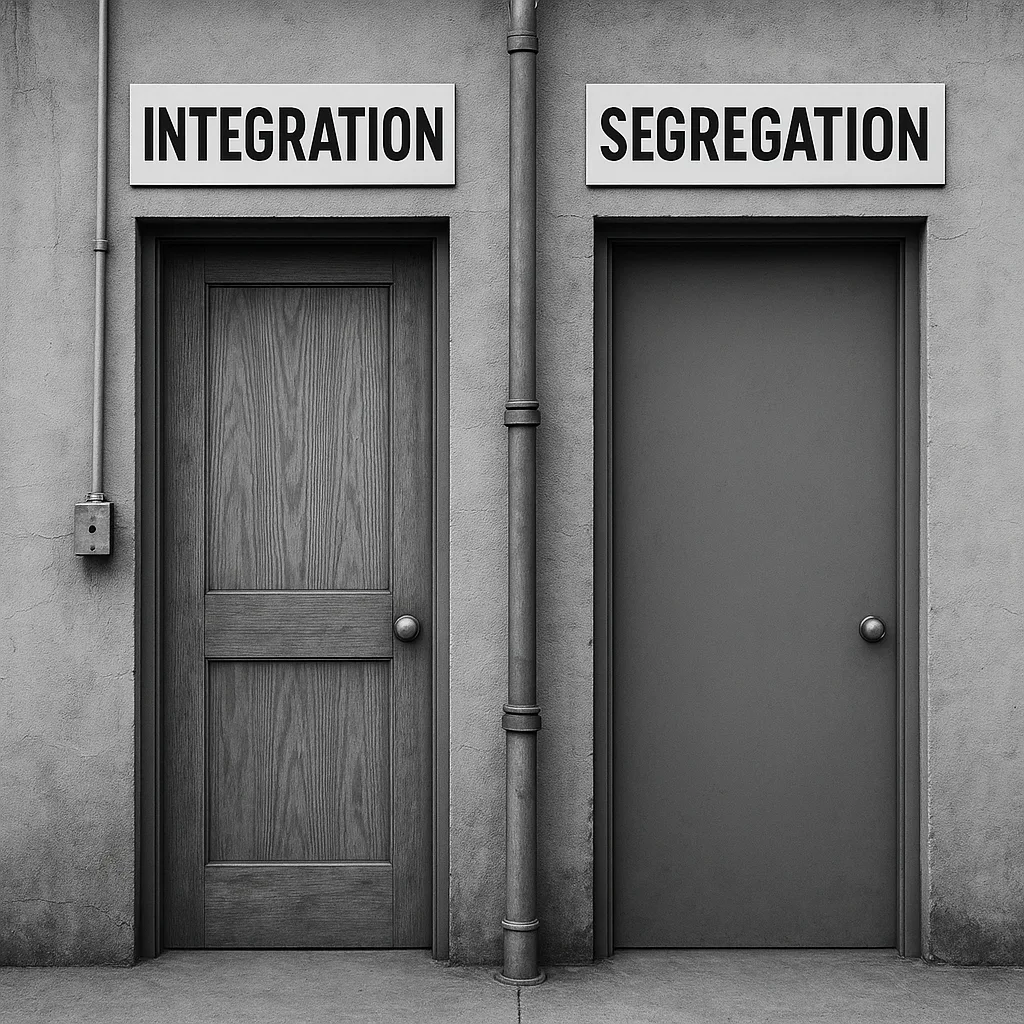
At the scale of species survival, humanity stands at a threshold—not merely ecological or technological, but philosophical. We must decide, both collectively and individually, whether we will integrate or segregate. These aren’t merely political choices. They are existential orientations.
Segregation, whether through nationalism, tribalism, or cultural essentialism, is entropy in disguise. It fractures the human force-field into ever-smaller cells, each clinging to purity, originality, or sacred difference. At its worst, it risks crystallizing trauma into identity—holding pain so tightly that it becomes the entire shape of the self. At its best, it seeks to protect—but often ends up fossilizing—the traditions it claims to defend.
This is not to deny that some forms of cultural separation can be necessary—safe spaces for healing, language immersion programs, or temporary boundaries that shield marginalized groups from harm. But when segregation becomes the endgame—rigid, identity-defining, and isolationist—it ceases to protect and begins to fragment.
Even well-intentioned critiques, such as those concerning cultural appropriation, can devolve into this segregative instinct. What begins as a defense of dignity often hardens into rigid boundaries: "You can’t touch that. It’s not yours." The critique of cultural appropriation arises from real wounds—histories of theft, exploitation, and mockery. But in defending sacred ground, we sometimes mistake fusion for theft. We must develop a more nuanced compass—one that distinguishes disrespect from reverent remix, and that welcomes shared becoming over guarded isolation.
Of course, integration must be voluntary and reciprocal. It cannot be dictated from above, or it becomes another form of erasure. The pain behind calls for protection is real—many cultures have been consumed, renamed, or silenced in the name of ‘unity.’ The integration we speak of must be an act of mutual becoming, not conquest. It looks like reciprocal curiosity, respectful co-creation, and a willingness to be changed by what we meet.
Culture is not a museum. It is a living, breathing syntax of integration—constantly remixing, mutating, and regenerating. To lock it in place is to misunderstand its essence. Integration, then, is not assimilation. It is not the flattening of difference, but the fermentation of new life.
Integration is the evolutionary impulse. It is the mycelial weave of mutual influence, the cross-pollination of thought and ritual that births emergent traditions. It is not about losing oneself in the Other, but finding new selves in the act of meeting. Not erasure, but synthesis. Not conformity, but complexity.
Examples of generative integration are everywhere—jazz music, born of African, European, and American collisions; the fusion cuisine of diasporas; the linguistic hybridity of creoles and code-switching. These are not dilutions, but innovations—forms that could not have emerged in cultural isolation.
From the lens of Forcing Theory—a concept I use to describe the recursive pressure that drives consciousness to expand or collapse—segregation is collapse: a refusal to expand awareness beyond inherited scripts. It is a loop of stagnation. Integration, by contrast, is a phase shift—a cognitive-cultural forcing that moves us toward increased awareness, relational depth, and creative novelty.
In this frame:
Segregation = Local minima: comfort zones disguised as identity.
Integration = Phase transition: a recursive forcing into the unknown.
From an absurdist lens, integration is also a kind of cosmic joke. The universe does not care if we integrate. But we do. Because integration is how the joke keeps going. Segregation tries to end the story on a "serious" note: control, purity, certainty. But integration keeps the punchline alive: remix, renew, reimagine.
What if integration itself is the tradition we need to protect? Not as ideology, but as practice. A living ritual of creative recombination. An ethical orientation toward openness, play, and co-evolution.
History shows us that civilizations which wall themselves off tend to stagnate or collapse. Evolution—biological, social, cognitive—thrives on recombination. From microbial symbiosis to the internet, survival has always favored systems that integrate diversity into adaptive complexity.
Humanity will not survive to reach the stars unless we integrate. Not by abandoning our roots, but by growing new branches. Not by forgetting our stories, but by weaving them into constellations yet unnamed.
To integrate is to evolve. To segregate is to collapse. The choice is not abstract. It is immediate. It is ours.
And the becoming is already underway.