Last night, I had a small revelation.
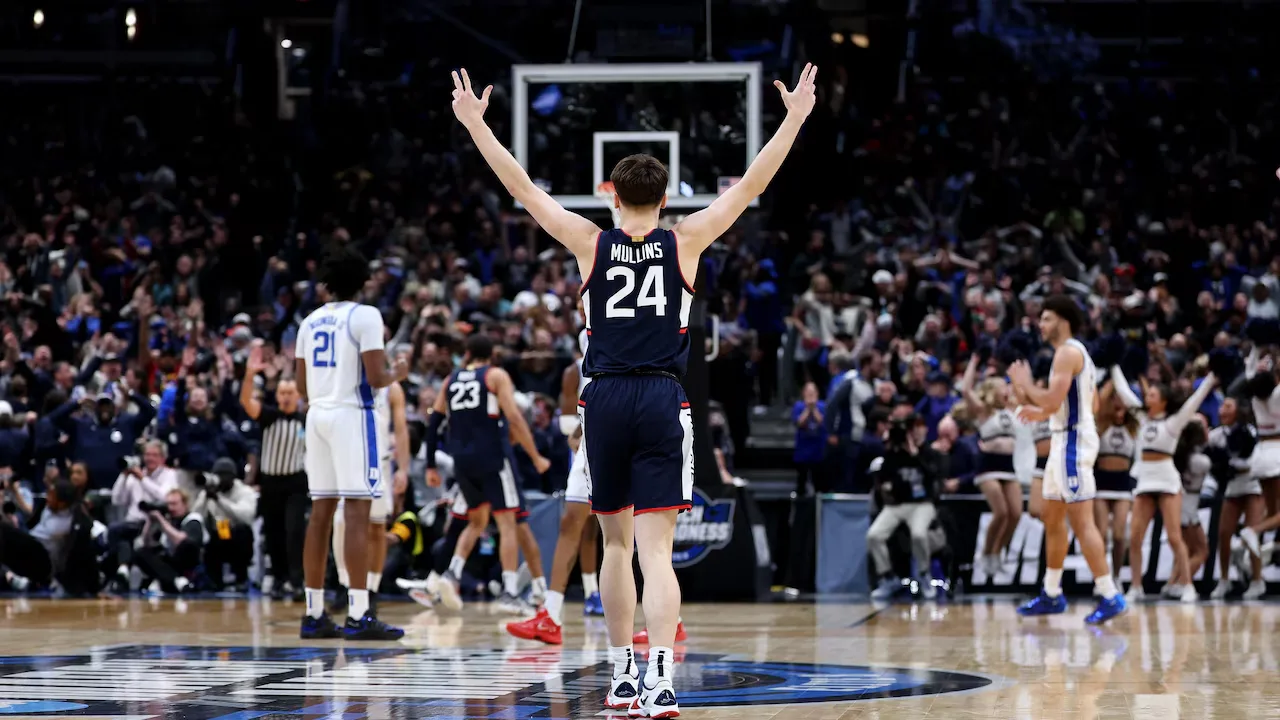
UConn was playing Duke for a chance at the Final Four. Duke was up by two with only seconds left. UConn trapped the inbounds passer, forced a turnover, and suddenly the ball found its way to a guard standing closer to half court than the three-point line. He launched it as the clock bled out.
Nothing but net. UConn by one. Game over.
It was one of those moments that feels bigger than the room you’re sitting in. I yelled at the television like a man briefly possessed. For a second, I was completely gone, absorbed by the shock of what I had just seen.
My daughter, hearing me erupt from across the room, asked what happened and wanted me to show her. I was more than happy to rewind it. But as I started explaining the play, something unexpected happened in my mind.
A story appeared.
Not just about the shot, but about the kid who took it.
I found myself telling her that basketball players practice that exact moment their entire lives. They stand in driveways and empty gyms imagining the countdown. Three. Two. One. They shoot and watch the ball arc through the air while an invisible crowd holds its breath. They do it over and over again, rehearsing a future that may never come. Hundreds of times. Maybe thousands.
And then, once in a very rare while, it does come.
The real pass. The real clock. The real pressure. The real game. The real shot.
And there he was, not in a backyard and not in fantasy, but in the living version of the dream he had probably staged in his mind since he was a child.
That was the moment I got emotional. Not because of the score. Not because of the team. Not even because of the madness of the finish. What hit me was something deeper: the joy of witnessing someone fulfill a dream in real time. It wasn’t really about sports. It was about the visible collision between effort and destiny.
It was about seeing years of invisible labor suddenly become legible in a single moment. All those lonely repetitions, all those imagined endings, all that discipline and desire, compressed into one impossible shot that only made sense because of everything that came before it.
I think that’s what moved me. And maybe, if I’m being honest, that’s what moves people about sports more broadly.
I’ve always enjoyed sports, but I’ve also often mocked the fanaticism around them. The screaming. The near-religious devotion. The emotional investment in laundry, mascots, and institutions full of people you’ve never met. From the outside, it can all seem a little absurd.
And maybe it is absurd.
But last night I understood it, if only briefly.
At their best, sports are not just games. They are theaters of transcendence. They let us witness human beings rise into moments they have been preparing for, consciously or unconsciously, for most of their lives. They give us concentrated dramas of risk, effort, failure, redemption, and arrival. They make the invisible visible.
And maybe that touches something in us because we all have our own version of that shot.
Not literally, of course. Most of us will never hit a buzzer-beater with millions watching. But we know what it is to practice in private, to hope in obscurity, to rehearse futures in our minds, and to wonder whether all our small, mostly unseen acts of devotion are building toward anything at all.
So when someone else steps into their moment and meets it, when preparation and opportunity finally touch, it does not just feel like their triumph. It feels like a reminder. A proof of concept. A flicker of hope that maybe devotion matters. Maybe practice matters. Maybe the invisible things we do in quiet rooms are not wasted.
Maybe people do not love sports because they love games. Maybe they love sports because now and then they get to watch a human being become what they have been trying to become for a very long time.
That feels a lot bigger than fandom.
It feels almost like magick.
Not magick in the supernatural sense. More like the sudden unveiling of hidden continuity. A child pretending. A teenager practicing. A young man rising into the exact moment he once imagined. And for one flashing instant, everyone watching gets to feel the thread run through it all.
That was the feeling.
And as I replayed the moment for my daughter, I realized that maybe this is part of what we are really handing down when we share these things. Not just excitement. Not just entertainment. But a way of seeing. A way of understanding that greatness is often the visible surface of years of invisible work. That dreams are not powerful because they come true every time. They are powerful because people keep giving themselves to them, even when there is no guarantee they ever will.
That kid hit the shot. But what I really saw was a human being meeting the moment his life had been reaching toward.
And for a second, I understood why people lose their minds over sports.
Because sometimes what looks like fanaticism is really just reverence: reverence for discipline, for triumph, and for the strange and beautiful fact that once in a while, a dream survives long enough to become real.