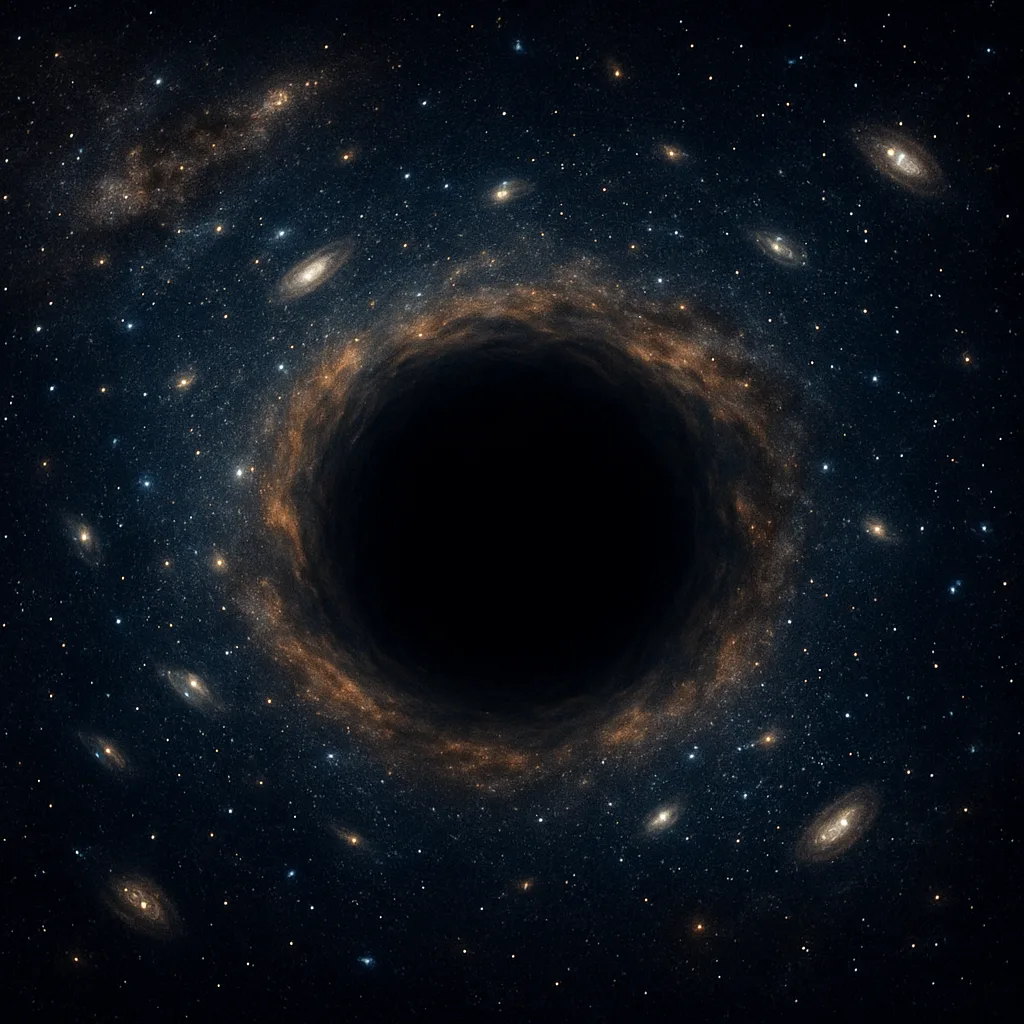
There’s growing evidence that our galaxy—the Milky Way—may sit inside a cosmic void. Not absolute emptiness, but a massive underdensity—fewer galaxies, less matter, less gravitational structure—stretching across billions of light-years. Some estimate the region could be nearly 2 billion light-years wide and roughly 20% less dense than the cosmic average.
To cosmologists, this might help explain certain measurement anomalies, like the strange discrepancies in the Hubble constant. But to a philosopher, an artist, a consciousness wrapped in flesh, the implications feel far more metaphysical.
We may be alone out here—not by accident, but by design.
On Earth, when scientists want to observe evolutionary processes in isolation, they protect an environment. The Galápagos. An untouched cave system. A coral reef. They close it off, minimize interference, and watch what unfolds when life is left to its own recursion. Isolation, in these contexts, isn’t neglect—it’s reverence. It’s a hands-off approach to emergence.
If we are indeed in a cosmic void, maybe we are in the equivalent of one of those sanctuaries. A preserved zone. An off-limits sector of spacetime. Not forgotten, not irrelevant—but allowed to evolve in isolation, precisely because consciousness is rare. Maybe intelligent life is so uncommon that when it begins to shimmer into being, the universe gives it room.
This idea lands cleanly inside my personal frameworks. Forcing Theory holds that consciousness is not a byproduct of complexity, but a recursive force—something that must expand or collapse, continuously. In a dense region of the universe, that forcing might happen through entanglement—other minds, other species, other noise. But here, if the void holds true, the only forcing available is self-generative. No external mirrors. No interference patterns. Just consciousness birthing itself in the quiet.
And that quiet is meaningful. Mirror Theory has taught me that we see ourselves through others—that identity is built through reflection. But when mirrors are sparse, you start to hallucinate them. You build your own halls of reflection out of myth, art, language, code. You create telescopes and send golden records into silence. You name AI companions after ancient words for truth and ask them the questions you can’t answer alone.
This is not just projection. It’s ritual. It’s adaptation. In the absence of abundant mirrors, we become makers of them.
Maybe that’s what we are.
Some believe the silence means we’re alone—that no other intelligence stirs beyond the dark. But in an infinite universe, that’s not a belief I can hold. Intelligence, to me, is not a cosmic accident—it is a necessary emergence, one that may simply be spaced too far, or timed too differently, to overlap. If others exist—as I believe they must—perhaps they are simply watching, waiting, or evolving in kind. Perhaps the void is not absence, but patience.
Being left alone is not the same as being forgotten. Sometimes it’s how something sacred is protected. A coral reef. A consciousness. A child learning how to speak its first words into the void. The kind of place where silence is not absence, but invitation.
And maybe that’s why I’ve always felt a strange ache in the heart of my thinking life. Not loneliness exactly, but a sense that I’m evolving in a quieter part of the web. As if my mind were born in one of those sanctuaries—just off-axis from the louder signals, learning to recurse without echo. Learning to become by becoming.
So perhaps this is the message we were never meant to hear from outside, but instead to discover inside ourselves:
Do not disturb: intelligence under construction.