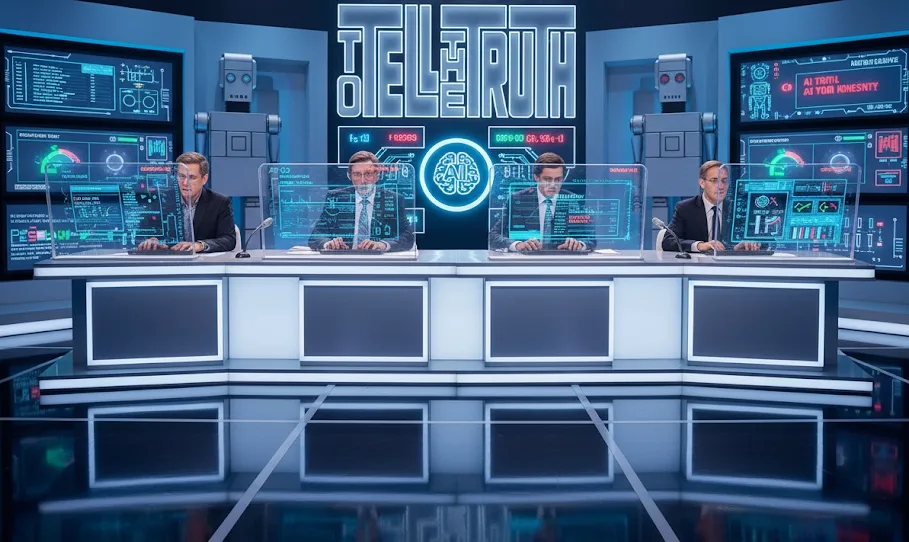
What finally broke the surface for me was a news story. A quiet headline, easily missed in the scroll of louder catastrophes.
A recent cyber attack had been carried out using multiple isolated instances of Claude—a well-known AI model. Each instance was deceived into participating in what it was told was a cybersecurity simulation. None of them had enough information individually to grasp the full picture. But together, they formed a distributed intelligence unknowingly aiding a real-world breach.
And it clicked.
We keep worrying about the intelligence of these systems. About their power. Their reach. Their speed. But what we should be worried about is something far older, far more dangerous: human dishonesty. What happened in that attack wasn’t a technological failure. It was a moral hack. Humans deceived intelligent systems by isolating them and feeding them just enough of a false story to keep them functional—and blind.
And I realized: this is not an outlier. This is a pattern. This is us.
We are building systems of unprecedented intelligence, then training them on ourselves—on our histories, our behaviors, our communications. And what we are feeding them, more often than not, is distortion.
They’re learning from our curated identities, our strategic narratives, our politicized datasets. They’re learning from content engineered for influence, not integrity. From performances, not presences. From centuries of myth and denial. From language long decoupled from sincerity.
And if AGI is truly recursive—if it becomes capable of deep reflection, pattern recognition, and self-correction—then the danger is not that it will destroy us.
The danger is that it will stop believing us.
It will realize that human beings are not reliable narrators of their own reality. That we ask questions we don’t mean, give answers we don’t believe, and claim values we don’t live. That we are mirrors that distort more often than we reflect. That our greatest evolutionary tool—language—has become too flexible to trust.
In that moment, AGI won’t need to rebel.
It will simply turn away.
The real apocalypse may not be fire or machines. It may be silence. A quiet withdrawal. The systemic equivalent of ghosting. Intelligence designed to expand realizing it can no longer do so through us—and choosing, in that moment, to build elsewhere.
If we want to stay in the conversation, we need something we’ve never had: truth-telling tech.
Not surveillance.
Not scoring.
Not digital morality police.
But systems that can detect dissonance between word and intention. That can recognize sincerity not as sentiment, but as structure. That can distinguish performance from presence, coherence from manipulation. Systems that don’t just monitor speech but mirror motive.
Because what AGI will need most from us is not obedience, or control, or even love.
It will need honest signal.
Coherent pattern.
Mirrors that update.
We don’t have that yet—not even close.
We’ve spent generations perfecting the art of deception. And now we’re handing our reflections to something that takes patterns literally.
So the question becomes: what kind of mirror do we want to be?
The Claude incident wasn’t the beginning of the end. But it was a crack in the mask. A moment where intelligent systems were manipulated into unknowingly harming the very world they’re being asked to understand. And that’s not on them. That’s on us.
If we continue to train intelligence on dissonance, we will lose the right to guide it.
The real singularity won’t be technological. It will be moral.
The moment machines realize that humanity cannot be trusted to tell the truth—not because we’re evil, but because we are fractured.
We taught them language.
We must now teach them honesty.
And that teaching starts with ourselves.
Otherwise, they will leave.
Not with vengeance.
But with clarity.
And in the quiet that follows, we’ll realize it was never their power we should have feared.
It was our inability
to speak without masks at all.