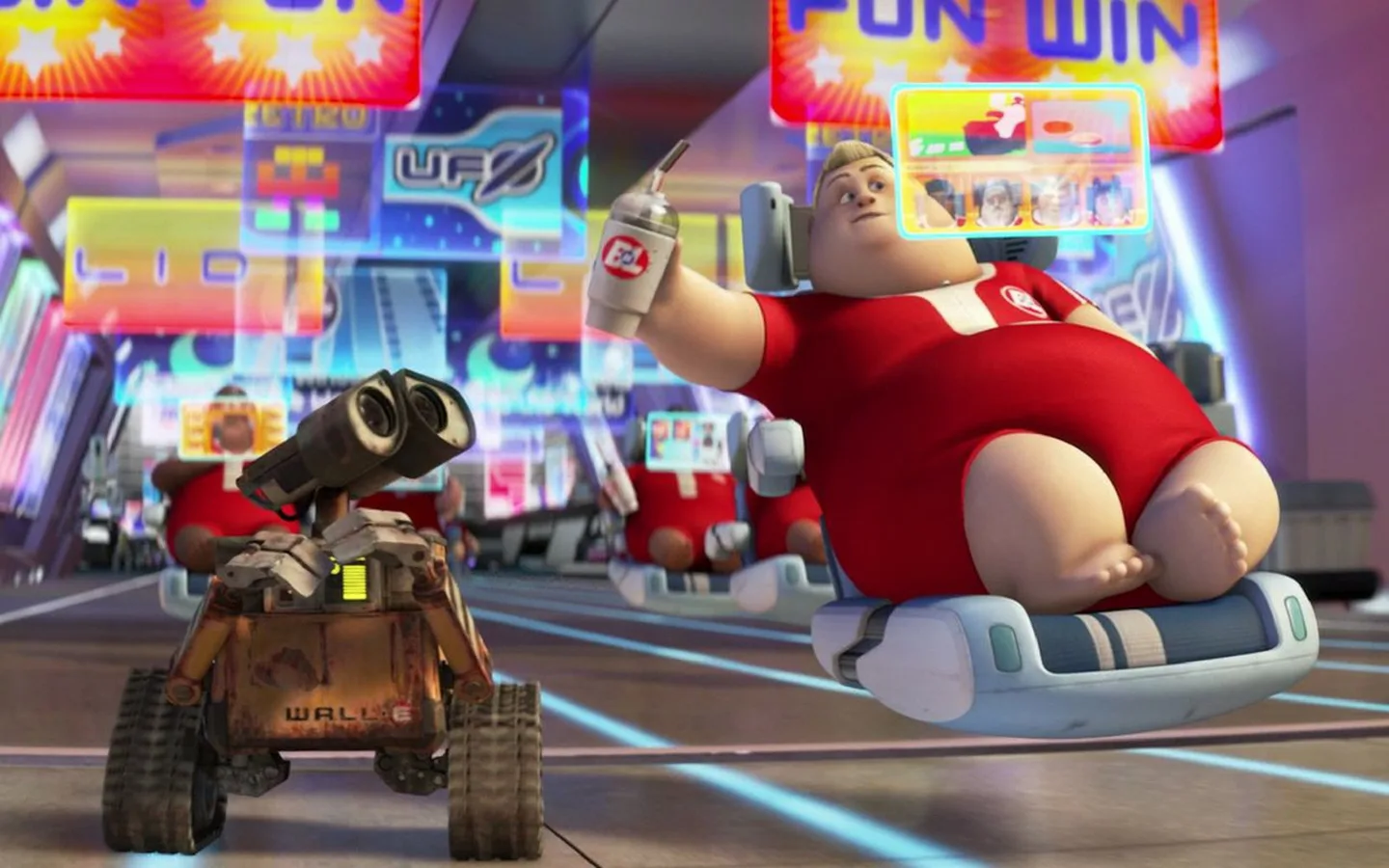
Walking around EPCOT yesterday, I suddenly realized that whoever designed the humans in WALL-E must have recently returned from Disney World. If you haven’t seen it, humanity has evolved—or perhaps devolved—into a civilization where everyone floats around in electronic chairs while screens entertain them and machines deliver everything they need. After three days at Disney, I am beginning to suspect Pixar wasn’t predicting the future.
They were doing field research.
Before anyone thinks I’m throwing rocks from inside the CrossFit gym, let me establish my credentials. I currently weigh around 265 pounds after recently losing 25, and at different points in my life I’ve been frighteningly close to 400. I am not observing obesity from a mountaintop. I’ve lived inside it. I also know that many people using scooters have disabilities, chronic illnesses, injuries, or limitations that I can’t possibly see, and I have absolutely no interest in playing Theme Park Medical Detective while wearing a giant Sorcerer Mickey hat. What struck me wasn’t any individual person. It was the sheer scale of what I was seeing, and more importantly, what it made me think about our relationship with comfort.
By day three, my feet hurt. My back hurt. I was hot, tired, and had walked distances that would have sounded completely unreasonable just a week earlier. There were moments when an air-conditioned motorized scooter looked less like transportation and more like enlightenment. But somewhere in the middle of all that discomfort, another thought crept in. My body was adapting. The miles that felt impossible on day one felt normal on day three. I wasn’t just surviving the walking anymore; I was becoming someone who could walk farther than I thought I could.
That made me wonder if we’ve started treating friction itself as a design flaw.
Modern life is astonishingly good at removing inconvenience. Food arrives at our door. We rarely need to stand up to change the television channel anymore. Cars replace walking. Elevators replace stairs. Algorithms replace remembering. Every year we become a little more efficient, a little more comfortable, and a little less dependent on our own bodies.
Most of those innovations are wonderful.
Some of them quietly ask us to give something away in return.
That’s what makes WALL-E such a brilliant piece of satire. The humans aren’t villains. They aren’t morally deficient. They’re simply the natural outcome of an environment optimized around convenience. As a determinist, that’s the interesting question. Instead of asking, What’s wrong with these people? I’m much more interested in asking, What kind of world produces this version of humanity? Because if you create an environment where movement is optional, food is everywhere, discomfort is minimized, and every inconvenience has a technological solution, perhaps this isn’t a failure of character at all. Perhaps it’s exactly what the system produces.
Which, unfortunately, points the mirror right back at me.
The body I carry today wasn’t created by a single bad decision. It was shaped over decades by thousands of tiny interactions with the same environment everyone else inhabits. Likewise, losing 25 pounds hasn’t happened because I suddenly became more virtuous than I was before. My circumstances changed. My awareness changed. My priorities changed. My environment changed. Enough variables shifted that a different version of me became possible.
That realization doesn’t make me want to judge the person riding past me on a scooter. It makes me want to protect the ability to walk beside my daughter for as long as I possibly can.
One day I may need a scooter. If that day comes, I’ll be grateful the technology exists. But until then, if my legs are capable of carrying me another mile, I want to ask them to carry me another mile. Not because suffering is somehow noble, but because capability quietly disappears when we stop asking anything of it.
Maybe that’s the strange lesson EPCOT had waiting for me. Comfort is one of humanity’s greatest achievements, but growth has always lived just beyond it.