Author’s Note: The Rituals of Ridiculousness
Part of embracing Absurdism is the willingness—no, the duty—to create your own truth. Whether in the grand, spiraling thoughts of consciousness or the smallest, most mundane rituals of daily life, the key is to make meaning where none is prescribed.
For me, this means welcoming ridiculousness with open arms. It means weaving play and absurdity into the lives of my family at every possible opportunity—not as mere entertainment, but as a philosophy. Because in a universe ruled by Determinism, where free will is questionable and chaos is king, the only rational response is to laugh, invent, and participate in the joke.
So, alongside my deeper intellectual pursuits, I want to continue sharing these Rituals of Ridiculousness—the small but sacred practices that make the experience of existence just a little more enjoyable. Because in the end, embracing the Absurd isn’t just an option—it’s the only thing that makes this whole ride worth it.
The first installment introduced Presidential Parking, a sacred geometry of parking space status and privilege. Today, we dive into another absurd but essential practice—one of recognition, camaraderie, and human connection.
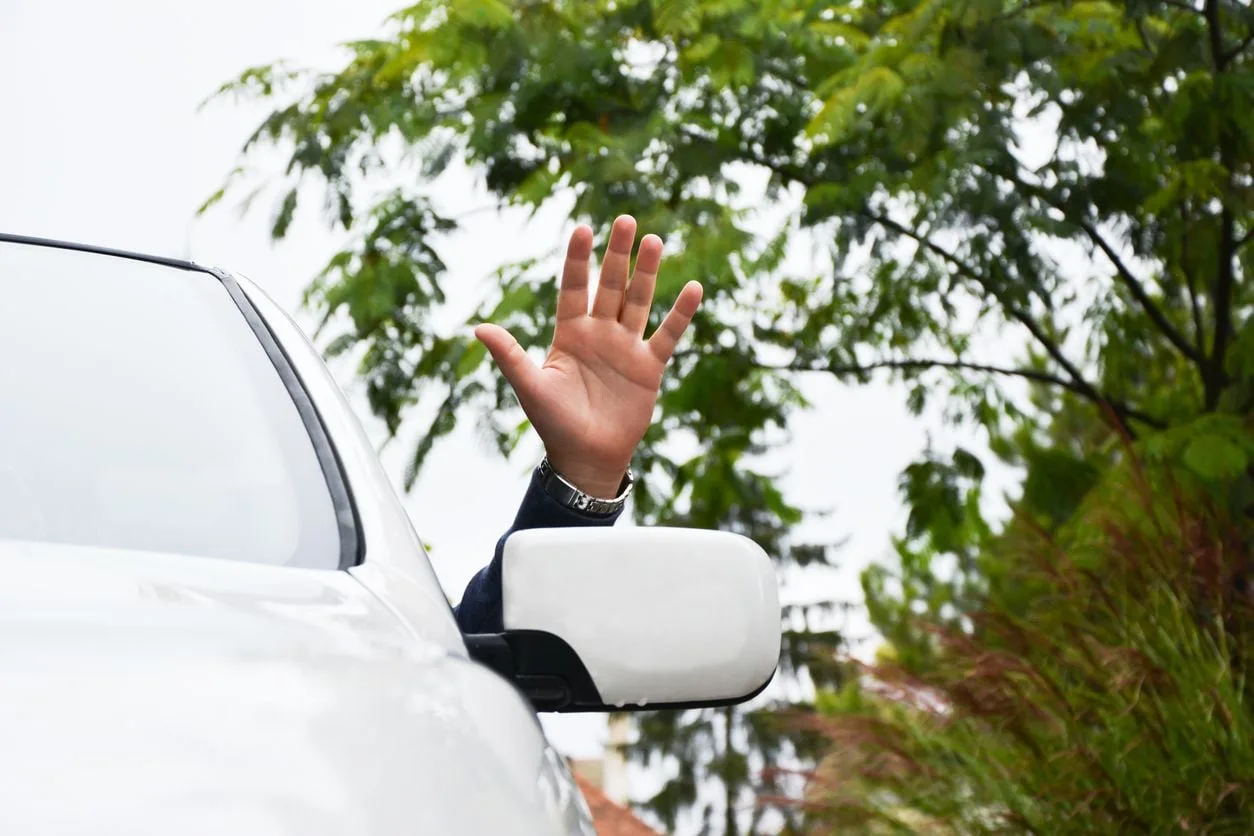
This is the Sacred Art of Waving.
I. The Wave as an Absurd but Necessary Ritual
In a world increasingly dominated by screens, notifications, and the quiet isolation of urban life, there remains one absurdly simple, profoundly human act that refuses to die: the wave.
Some people wave as a polite reflex, a passing acknowledgment of existence. Others do it as a means of communication—"Hey, I see you!" or, perhaps more accurately, "Hey, I see you seeing me!" But for those of us who have truly committed to the craft, waving is no longer just a formality.
It is a ritual. A declaration. A microcosmic rebellion against the anonymity of modern life.
Because here’s the thing: waving is about connection.
II. The Anatomy of a Wave
A proper wave is effortless yet intentional. Too slow, and it looks like a solemn farewell at a train station in the 1800s. Too fast, and you risk entering the realm of emergency signaling. The ideal wave exists in that perfect middle space—a confident flick of the wrist, a smooth arc of acknowledgment.
Beyond technique, there are tiers of waving, just as there are levels to parking. They exist on a sliding scale of familiarity and frequency:
The Obligatory Wave – Used when social contracts demand it. This is the nod-and-wave combo you give to a co-worker in traffic or the wave that acknowledges a neighbor whose name you do not, and will never, know.
The Drive-By Wave – Exclusive to small towns and certain friendly suburban pockets. A simple one- or two-finger raise from the steering wheel, a nod to the fact that you’re both navigating this absurd world together.
The Mutual Recognition Wave – The best of all possible waves. This is the one that establishes a relationship, even if that relationship is founded solely on the act of waving itself.
This last one is where waving relationships are born.
III. The Birth of the Waving Relationship
A waving relationship is a unique and wordless bond between two people who do not know each other yet see each other enough to develop an unspoken agreement: we wave now.
Perhaps it starts casually, an occasional nod. Then, one day, one of you tests the waters—a small wave, a raised hand. The other reciprocates. And just like that, it is done.
From this moment forward, no matter the weather, no matter the mood, the wave is expected. Failure to wave would be a silent betrayal, an existential rupture in the fabric of this absurd and beautiful arrangement.
Some waving relationships grow stronger over time—an escalation of enthusiasm, perhaps even a smile. Others remain distant but loyal, an understated camaraderie built on mutual consistency.
And here’s the best part: the waving relationship transcends all other social barriers. You don’t need to know their name, their job, their politics, or their backstory. It doesn’t matter. The wave is enough.
IV. The Weight of a Wave: Seeing the Unseen
There’s a cruel, silent agreement many people make in cities: to pretend the unhoused are invisible. They walk past without a glance, sit at red lights avoiding eye contact, create an invisible barrier between “us” and “them.” It’s not always out of malice—sometimes it’s guilt, discomfort, or a quiet fear of confronting suffering up close.
But there is a small rebellion against that invisibility.
A wave. A nod. A word.
When you acknowledge someone who has been ignored all day, you break the cycle. You remind them: I see you. I see that you exist. I see that you are human.
I drive with the window down, and if an unhoused person makes eye contact, I always say something—even if it’s just a "Hey, how’s it going?" Because I know that when someone feels unseen, even the smallest act of recognition can be unbelievable.
It costs nothing. And yet, it has weight.
V. The Nod: A Gesture of Mutual Understanding
In some cases, the wave is too much—too performative, too loud for a moment of quiet humanity. In these cases, the head nod becomes its own sacred ritual.
The head nod is a recognition between two people who understand something about the world that doesn’t need to be spoken. It is low-key, intentional, and profoundly powerful.
It can mean:
"I see you."
"I respect you."
"You are still here. That matters."
And sometimes, that’s all a person needs in that moment—to be reminded that they are still part of the human fabric, that they haven’t disappeared, that someone sees them and chooses not to look away.
VI. Acknowledgment as a Ritual of Resistance
We live in a world that tells us to look forward, move fast, and keep our heads down—but what happens when we look up instead? When we wave, when we nod, when we acknowledge the people we are told to ignore?
We create small moments of human solidarity in a system designed to dehumanize.
We break the illusion of separateness.
We make existence less lonely—for ourselves and for others.
Because in the end, what is a wave but proof that we’re all in this together?
So, my friends, wave boldly. Wave freely.
Wave as if your existence depends on it.
Because, in a way, it just might.