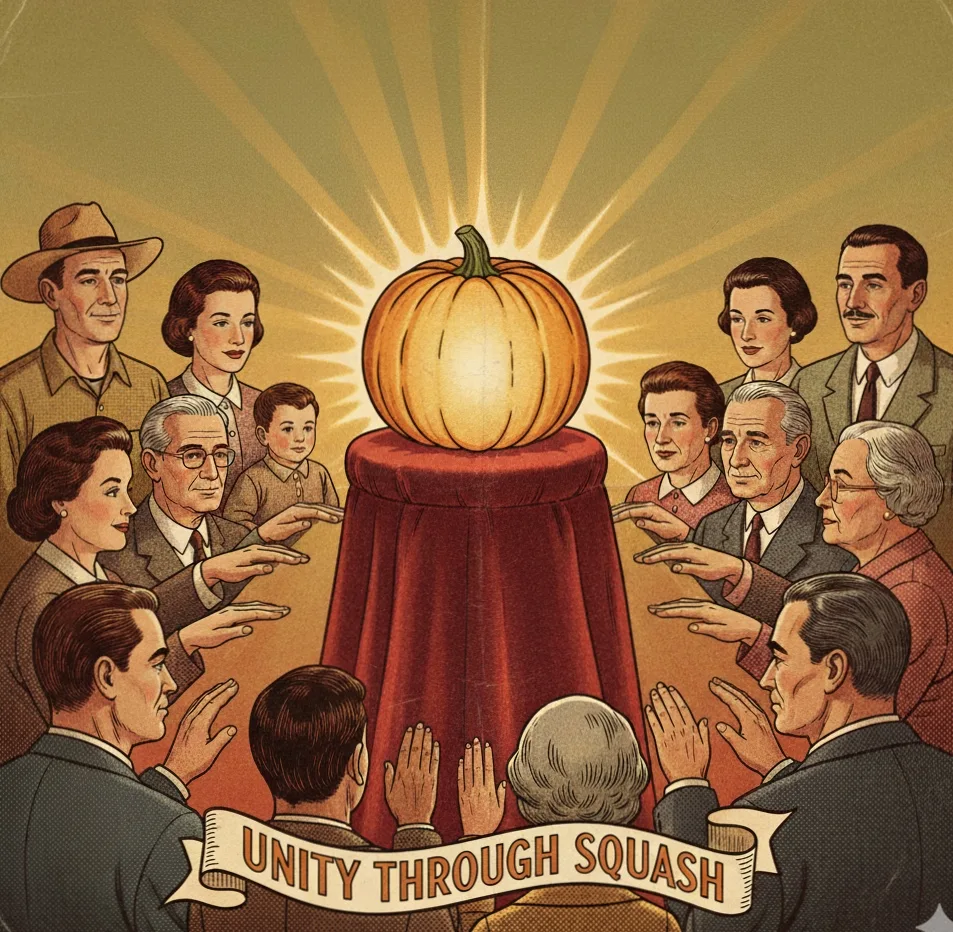
It started the way most world-shifting revolutions do: with a child, a question, and a drive through Nichols Hills—the most affluent neighborhood in Oklahoma City, where even the squirrels probably have dental.
“How many pumpkins do you think are in this neighborhood?” my daughter, Jettie, asked from the back seat. She wasn’t being sarcastic. She was peering out the window with a kind of reverent awe, like a botanist discovering a lost rainforest made entirely of decorative squash.
And honestly? Fair question.
Pumpkins were everywhere. On porches, walkways, mailboxes, columns. Piled in wheelbarrows, wagons, converted antique bathtubs. They were stacked like organic cairns—seasonal status symbols declaring, “We are rich enough to compost at scale.”
We ran the numbers. Based on our slow-roll pumpkin census, we estimated somewhere between 3,000 and 5,000 pumpkins... in that one neighborhood alone.
That’s when the madness set in. Or maybe the clarity.
We started wondering: how many pumpkins are grown globally each year? Surely there must be some master ledger of squash. Surely someone is keeping track.
Turns out? Yeah. Kind of.
Depending on your data source and what counts as a “pumpkin” (do decorative mini gourds qualify? What about squash-cousins? Are we excluding spaghetti squash purely on aesthetic grounds?), global production estimates range between 3 and 8 billion pumpkins per year.
Now pause.
Let that number in.
We might already be within reach of pumpkin parity.
That is: one pumpkin per person, per year.
An absurd goal? Maybe.
A logistical nightmare? Possibly.
A moral imperative? Absolutely.
What if—stay with me—we just decided that every human being deserved one pumpkin annually, no questions asked?
Not as charity. Not as decoration. But as birthright.
A single, sovereign gourd. Yours to do with as you please. Eat it, carve it, ignore it. Throw it at your landlord. Burn it in a ritual to honor the Great Return. Doesn’t matter.
All that matters is that it’s your pumpkin. And that everyone else got one too.
We’re not talking about utopia. We’re talking about squash equity.
The math checks out. If we assume an average pumpkin yield of around 4,000 per hectare, and we want to add, say, 2 billion more pumpkins to the annual harvest to close the parity gap? That’s only 500,000 hectares of land.
Roughly the combined size of Delaware and Rhode Island.
Globally trivial. A single agribusiness could do it. Hell, Hobby Lobby probably accidentally grows that many in a decorative mulch pile behind corporate.
But this isn’t just agriculture. This is philosophy. This is praxis.
A pumpkin per person isn’t just food or ornament. It’s a cosmic joke with nutritional value. It’s symbolic absurdity. It’s the intersection of generosity and gourd.
Because think about it: the pumpkin is hilarious. It’s a perfectly shaped, oversized fruit that makes a satisfying “thud” when you drop it. It can feed you, haunt you, light your porch, or rot on it in a noble slump. It is humble, round, and full of seeds—just like most of us.
And if every person received one, what would it say?
That the Earth has enough. That we can share things. That not everything has to be optimized, monetized, or geopolitically weaponized.
What we’re proposing isn’t a distribution plan. It’s a seasonal ritual of reconnection. A reminder that for at least one moment a year, you matter enough to receive a pumpkin.
You don’t choose your pumpkin. It chooses you.
You and the pumpkin are now in contract.
Will there be resistance? Of course.
There will be bureaucrats who ask, “Who pays for the pumpkins?”
Economists who mutter, “What about inflation?”
Libertarians who demand to bring their own.
Evangelicals who insist the only acceptable pumpkin is Jesus-shaped.
Because this is happening.
We will build the Pumpkin Distribution Ledger. We will track the gourds. We will ensure compliance. Every porch, every yurt, every high-rise balcony from São Paulo to Saskatchewan shall be eligible. No pumpkin left behind.
It’s not about calories. It’s not about decoration. It’s about principle.
We have tried gold.
We have tried gods.
We have tried capitalism, communism, content.
Now, let us try pumpkin.
And if the end result is nothing more than a small, beautiful orange sphere sitting quietly in every home on Earth—well then maybe, for just a moment, that’s enough.