Like most people on the outer edges of religion—exiles, skeptics, survivors—I don’t typically look to the Vatican for inspiration. I don’t keep up with papal gossip. I don’t tune in to Easter speeches. But something about Pope Leo rang a different kind of bell.
Yes, he's American. Yes, he’s spoken out against Trumpism, fascism, and hate. And yes, that’s refreshing—especially when so much of American Christianity seems to have merged with white nationalism and moral theater.
But that’s not what caught me.
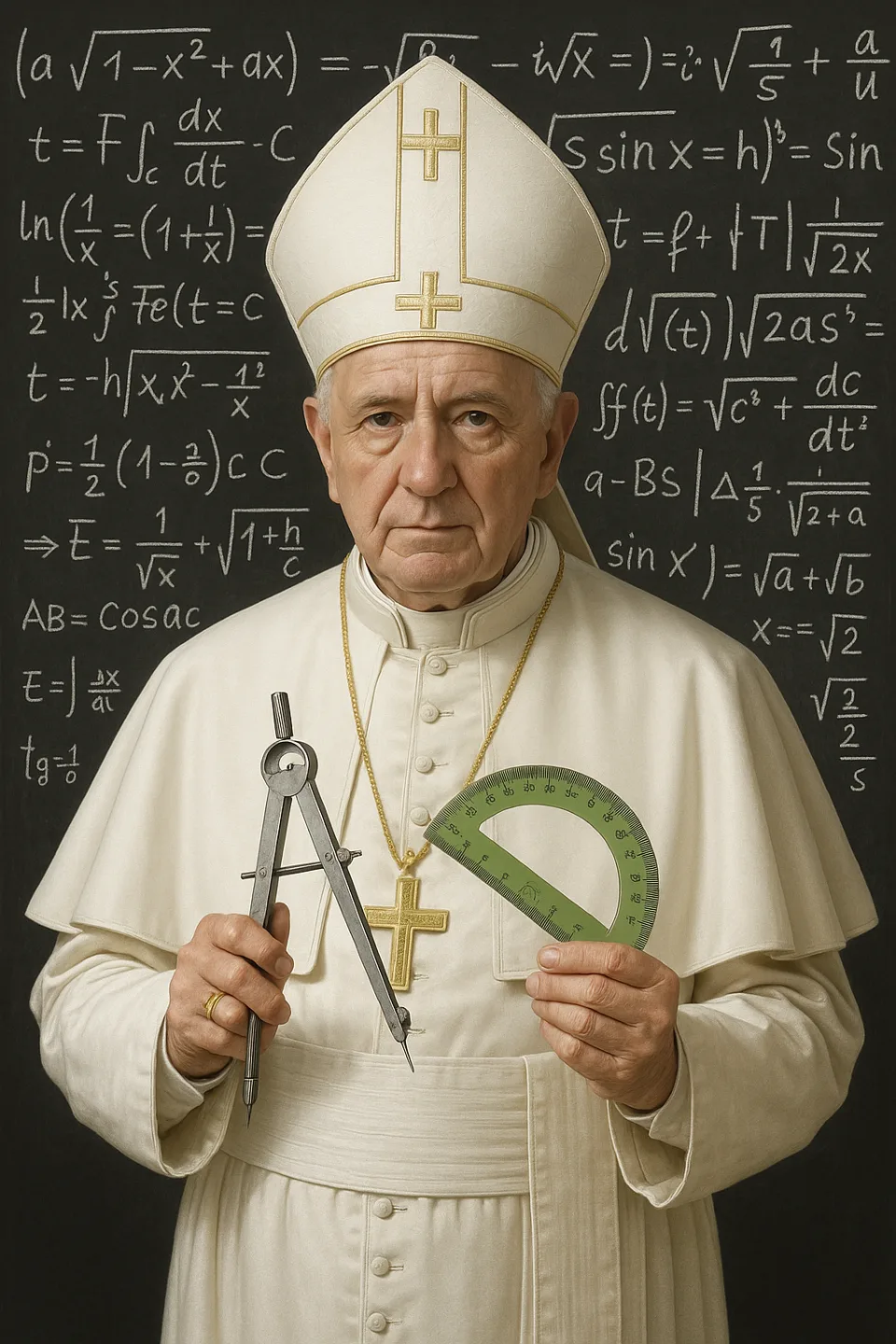
Here’s what did: the man is a trained mathematician.
And that—quietly, improbably—feels holy to me.
I don’t believe in God. I don’t believe in divinely ordained institutions. But I do believe in truth. Not in the ideological sense—but in the rigorous, recursive, structured sense. The kind that doesn’t require faith. The kind that doesn't bend to preference or power. The kind that emerges through the tension between contradiction and coherence.
Mathematics is one of the few remaining sanctuaries for that kind of truth.
It doesn’t care whether you’re devout or indifferent, powerful or poor. It doesn’t shame your doubt—it demands it. It doesn’t ask you to bow your head in reverence. It asks you to show your work.
Math doesn’t pretend to be omniscient. It simply insists that if something is to be known, it must be tested, iterated, and able to withstand contradiction.
Religion punishes doubt.
Math rewards it.
That’s why this Pope gives me hope—not in the resurrection, but in reason. Not in divine intervention, but in disciplined curiosity. Imagine, for a moment, a spiritual leader whose formation came not from unquestioned doctrine but from grappling with uncertainty, error margins, and proof structures.
Math humbles you.
It humbles your ego, your assumptions, your need to be right. It teaches you that the truth doesn’t belong to you—and if your equation fails, you don’t get to plead for grace. You revise.
What if we treated power that way?
What if the most powerful religious institution in the world was guided—at least in part—by the epistemology of mathematics rather than the absolutism of scripture?
It sounds absurd. But then again, absurdism is kind of my thing.
I’ve spent the last decade building frameworks for thinking beyond belief. I’ve stitched together Zen, absurdism, mindfulness, and mathematics into a worldview that doesn’t need a sky-father or moral algorithm to find meaning. I see consciousness not as a gift bestowed by gods, but as a recursive, ever-forcing process—one that evolves through inquiry, contradiction, and refinement.
In Forcing Theory, I describe intelligence as a force—not a trait. It’s not something you have. It’s something you do. It grows through novelty, collapses through stagnation, and only survives when it continuously expands.
That’s what math teaches us.
That’s what most religions forget.
So no—I don’t need a Pope. I don’t believe in hierarchy. I don’t believe in salvation.
But I do believe in symbols.
And right now, the idea of a Pope who knows what it means to fail a proof, rework the variables, and return to the chalkboard—that’s a symbol I can respect.
Maybe, just maybe, this Pope will bring a little more humility to power.
A little more rigor to belief.
A little more paradox to parable.
And that?
That’s a sermon I’d stay awake for.