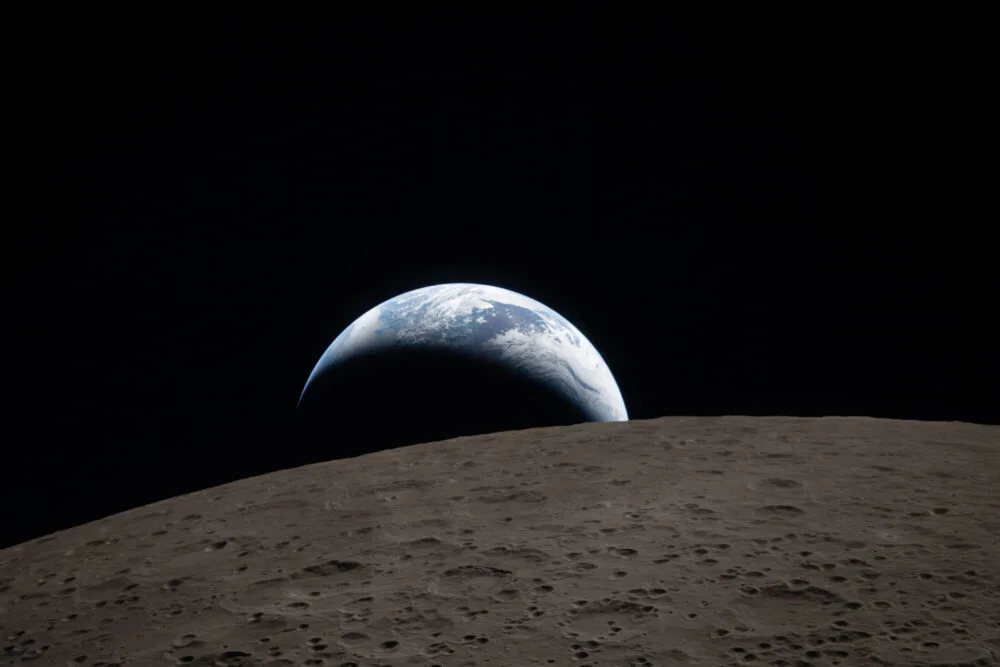
This week I found myself crying over Artemis II. Not just because of the scale of it, though the scale is enough to humble anyone. Four human beings traveled farther from Earth than any humans in history, looping around the Moon in a spacecraft built from precision, mathematics, discipline, and courage. But what undid me was not the engineering. It was the tenderness. On April 6, during the lunar flyby, the crew proposed the name “Carroll” for a lunar crater in honor of commander Reid Wiseman’s late wife, Carroll Taylor Wiseman.
That gesture pierced straight through the machinery. Carroll was not being honored as an abstraction, but as a real person who lived, loved, helped others, and was deeply missed. NASA’s biography for Reid Wiseman says Carroll dedicated her life to helping others as a newborn intensive care unit registered nurse, and that she is survived by their two children. Reports on the flyby say she died of cancer in 2020. The crater the crew nominated sits near the boundary of the Moon’s near and far sides and is sometimes visible from Earth, with the proposed name to be formally submitted after the mission.
And maybe that is why the moment felt so overwhelming. We are living through a time on Earth shaped by war, greed, famine, ecological instability, and the endless theater of power. So much of daily life is organized around domination, extraction, performance, and fear. Then suddenly, from hundreds of thousands of miles away, comes this reminder that beneath all of our systems and games there is still something irreducibly human waiting for us: love, grief, memory, awe, and the desire to remain in relationship with one another. That is what seemed to float to the surface when the noise dropped away. The mission itself has often framed its voyage in unifying terms, with NASA highlighting the crew’s message for humanity alongside the science and spectacle of the flight.
Watching Artemis II, I kept feeling that space does not erase our humanity. It reveals it. When we are lifted out of the structures that keep us posturing and competing, what remains is not conquest so much as tenderness. Even at the edge of the Moon, someone is still thinking about the person they lost. Even in one of the most technologically sophisticated missions humanity has ever undertaken, the emotional center is still relationship. The mission can break records and still be, at heart, about somebody wanting the name of someone they loved to live in the light.
Most of us will never name a crater. Most of us will never leave Earth. But all of us can give our version of the Moon to the people we love. We can make the gesture now. We can speak the gratitude out loud. We can mark the sacred before it is gone. We can make memory visible while the other person is still here to receive it. We can refuse to wait for tragedy before we become reverent.
That may be the deepest invitation of awe: not merely to look upward, but to come back down changed. To let wonder interrupt our habits. To let beauty reorder our priorities. To remember that we are here together for almost no time at all, a cosmic blink sharing breath on a small warming planet, and that this brief coexistence is itself a miracle.
So yes, watch Artemis II with awe. Let yourself feel the impossible beauty of it. But do not stop there. Give them your Moon now, while both of you still exist at the same time. While they can still hear you. While you can still name what they are to you. While light can still reach them.