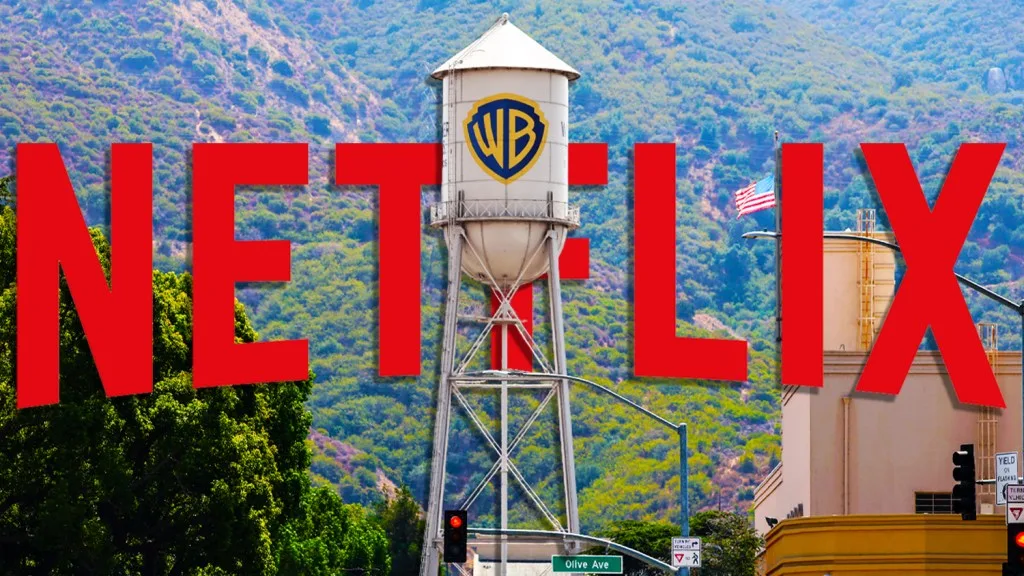
Netflix wants it all. Not just your eyes or your time or your subscription fee—but your stories. Your myths. Your cultural imagination. That’s what’s truly at stake in this quietly cataclysmic attempt to acquire Warner Bros. Discovery. This isn’t just a merger. It’s not even a buyout. It’s a calculated devouring—and it’s being attempted at the exact political moment that would make such a thing possible: while Donald J. Trump sits in the Oval Office again, flanked by corporate interests, reactionary power structures, and a media ecosystem too fragmented or hypnotized to mount real resistance.
This is not a coincidence. It’s choreography. There is a reason the biggest streaming empire in the world is making its most aggressive move during the most authoritarian-leaning presidency in modern American history. The calculus is simple: the courts are friendly to business. Regulatory bodies have been gutted or replaced with ideologues. The public is exhausted. Culture is distracted. And authoritarianism doesn’t just tolerate monopolies—it relies on them.
The Netflix–WB deal is a test balloon for the future of American capitalism, or more accurately, its terminal phase. We are long past the mythology of the free market, the open field of ideas, the entrepreneurial meritocracy. Late-stage capitalism is not interested in competition. It cannot tolerate competition. It is not efficient to compete. It is efficient to consolidate, and then algorithmically serve the illusion of variety across increasingly homogenized platforms.
Netflix doesn’t want to compete with HBO Max. It wants to absorb it, assimilate its archives, its brand prestige, its cultural leverage. Warner doesn’t want to fight to stay afloat—it wants a soft landing in the arms of its conqueror. And the American government? At best, it stands on the sidelines muttering platitudes about innovation and market freedom, while allowing one of the most significant consolidations of cultural power in modern history to take place. At worst, it facilitates the whole thing.
This is the real face of the “free market” under authoritarian conditions: a smiling mask stretched across monopolistic teeth. Beneath the press releases and the stockholder calls lies the deeper truth—capitalism, like any other self-preserving system, wants control, not chaos. It wants predictable consumption, streamlined logistics, compliant labor, and obedient viewers. Authoritarian governance and monopolistic business models are not in opposition. They are siblings, raised together under the banner of efficiency, order, and centralization.
From a Mirror Theory perspective, this is what happens when a system refuses to reflect. Monopolies are non-reflective by nature. They don’t offer feedback, only projection. They don’t mirror the viewer—they manipulate the viewer’s reflection until you forget there was ever a difference. A diverse media ecosystem offers mirrors—cracked, weird, challenging, honest. A monopoly offers only a curated feed. Reflection becomes standardization. Individual taste is eroded by algorithmic consensus. And just like that, we’re not participants in culture—we’re data sets wrapped in a dopamine loop.
The timing of this merger isn’t just financially strategic. It’s symbolically perfect. A second Trump presidency isn’t just a return to hard-right nationalism—it’s the triumph of spectacle, brand identity, and narrative control. When you combine that political landscape with an economic system eager to collapse complexity into efficiency, you don’t just get bigger companies. You get fewer mirrors. You get controlled narrative channels. You get cultural hegemony disguised as convenience.
And that’s the real danger here. Not just that your streaming options shrink, or that creatives will be folded into cost-saving verticals. The danger is that you’ll stop noticing the narrowing. You’ll accept it as inevitable. You’ll trust the “curated for you” algorithm more than your own curiosity. You’ll mistake content for culture, and bingeable plots for actual reflection. That’s how recursion dies—not with censorship, but with saturation. Not with a ban, but with a slow, subtle merging of everything into everything else, until there is no contrast left. No mirror sharp enough to challenge the shape you’ve become.
This isn’t a paranoid screed. It’s just the obvious shape of things if we keep watching instead of seeing. If we keep scrolling instead of speaking. Netflix buying Warner Bros. wouldn’t be just business—it would be symbolic of the ecosystem we’re surrendering to: one where both government and economy reward centralization, where the line between entertainment and ideology gets thinner every quarter, and where reflection—true, chaotic, uncomfortable reflection—becomes the most dangerous form of dissent.
So no, this isn’t just about Netflix. It’s about the deeper rhythm we’re living through. It’s about the strange and deliberate harmony between late-stage capitalism and authoritarian governance. It’s about the mirrors that no longer update, and the selves we might lose if we forget to look for our own.
And if you’re not disturbed yet, you’re probably already on autoplay.