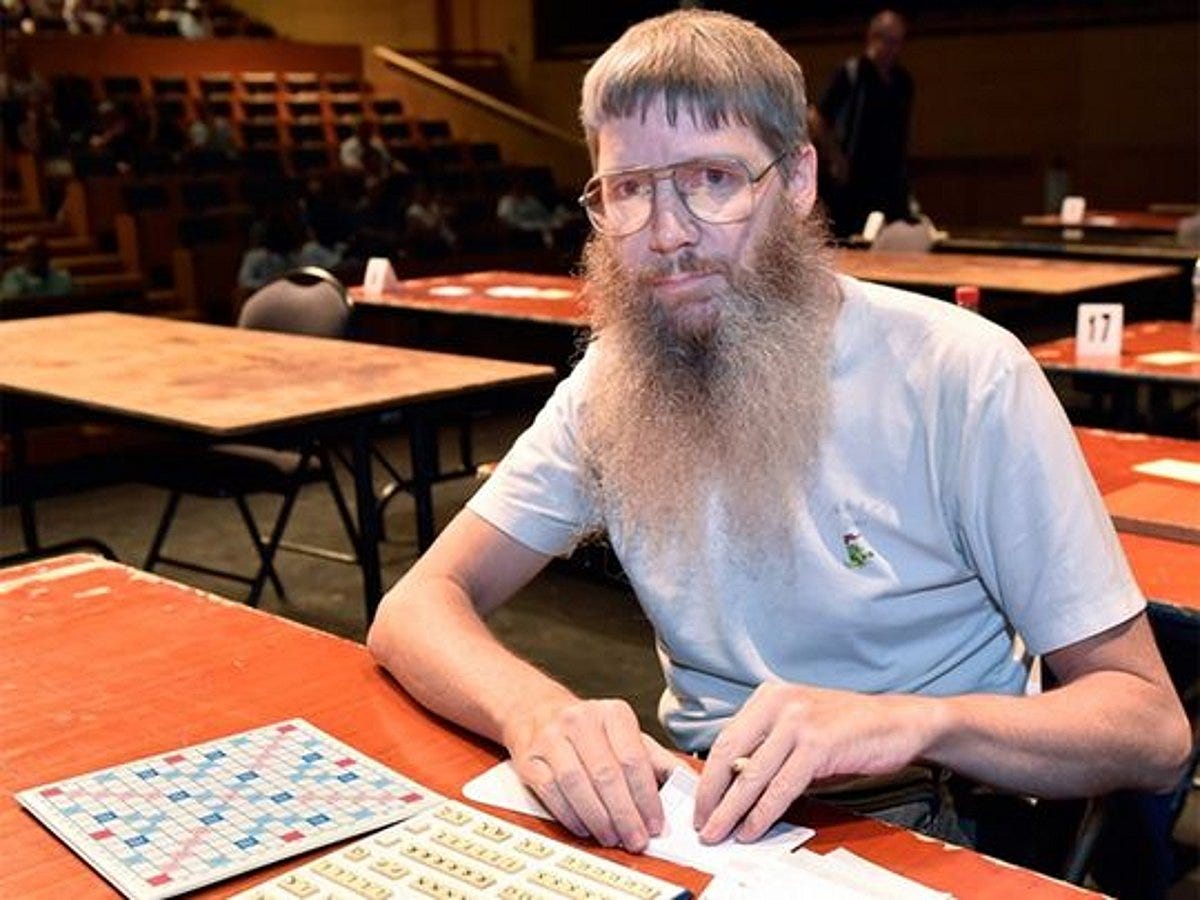
I’ve known about Nigel Richards for years. If you follow competitive Scrabble at all, his name eventually becomes unavoidable. He is widely considered the greatest player the game has ever seen, which is already strange enough when you consider that Scrabble exists at the intersection of vocabulary, probability, memory, spatial reasoning, strategy, and whatever peculiar form of pattern recognition allows someone to stare at seven wooden tiles and see possibilities the rest of us simply cannot. But recently I watched a biography of Richards and realized I had dramatically underestimated how unusual he actually is. Dominating English-language Scrabble was only the beginning. He went on to compete at the highest levels in French and Spanish despite not actually speaking those languages. He learned the allowable words as patterns, detached from their ordinary semantic meaning, and then deployed them inside the game with terrifying effectiveness. There are even stories from elite play of Richards making moves that initially appear inferior to computer simulations, only for experts working backward with the software to eventually understand what he had seen. At some point you stop thinking, this guy is really good at Scrabble, and start thinking, what exactly is happening inside that skull?
And I love moments like that.
Not because I particularly want to become a world champion Scrabble player. I’m perfectly comfortable leaving Nigel alone on that mountain. What fascinates me is what happens to my own sense of possibility when I encounter someone living that far out on the edge of a human distribution. There are averages, there are deviations, and then there are the long tails—the tiny number of people whose abilities stretch so far beyond ordinary experience that they force everyone else to reconsider where the boundary actually is. Nigel Richards does that for me cognitively. He provides evidence. Apparently, a human brain can do that. Whatever explanation eventually emerges—extraordinary memory, unusual compression, pattern recognition, obsession, practice, some combination we don’t yet have language for—the important thing is that it happened. The border moves.
The four-minute mile has become the classic metaphor for this. For years it existed as something close to an invisible wall in the imagination of runners, until Roger Bannister ran through it in 1954. Once someone had done it, the number stopped looking quite so much like a boundary imposed by nature. Other runners followed. Obviously the story is more complicated than a magical psychological spell suddenly being broken—training improves, conditions change, athletes learn from one another—but the metaphor remains powerful because we recognize the experience. Possibility changes when possibility becomes embodied. I wonder whether a human can do this becomes a human has done this. Those are profoundly different statements.
I think this principle extends far beyond athletics. We are constantly constructing invisible ceilings around ourselves from the statistical middle of human experience. We look at what most people remember, how quickly most people learn, how deeply most people concentrate, how creative most people become, how dramatically most people change, and somewhere along the way the average quietly becomes the boundary. But the average is not the boundary. It is only the crowded part of the graph.
The tails are where things get weird.
Somewhere there is a person whose memory operates in a way that seems impossible to someone with an ordinary memory. Someone else can mentally calculate numbers that would send me searching for a calculator before they finished the sentence. There are people who navigate through the world using echolocation, people who acquire languages at absurd speeds, musicians who seem to perceive entire architectures of sound at once, climbers whose relationship with their bodies and gravity looks like a different species of cognition, contemplatives who have spent tens of thousands of hours exploring attention itself. And undoubtedly there are extraordinary capacities for which we have never invented a competition, measurement, or culturally recognizable category. There may be Nigels walking around everywhere whose particular form of genius simply has no Scrabble board.
This is where the idea becomes personally useful to me. I don’t need their abilities. I need their existence.
Every extreme example becomes a kind of cognitive forcing event. Something enters the system that cannot quite fit inside the old model, and so the model has to expand. Nigel doesn’t teach me how to memorize a French Scrabble dictionary. He weakens my confidence in the boundaries I’ve unconsciously placed around my own mind. He reminds me that the human nervous system is much stranger and more plastic than everyday life makes it appear. And once that reminder enters awareness, I can begin asking better questions. What else have I mistaken for a wall simply because I’ve never seen anyone pass through it? How much of what I consider “my capacity” is actually capacity, and how much is habit? How many limits are biological, and how many are cultural, developmental, psychological, or simply untested?
This doesn’t mean embracing the motivational fantasy that everyone can become anything. We obviously can’t. Biology exists. Circumstance exists. Talent exists. Time exists. Nigel Richards probably contains some configuration of traits that I could practice Scrabble for the rest of my life and never reproduce. The long tail isn’t telling us you can do anything. It’s telling us something more interesting: human beings can become things we would never have predicted by studying the center of the distribution.
And that distinction matters.
I’ve spent a lot of time thinking about consciousness as a forcing process—the idea that awareness expands by incorporating something it could not previously contain. Most of those expansions are small. A new idea. A new perspective. A relationship. A failure. A question that refuses to disappear. But sometimes a human being walks into view carrying undeniable evidence that reality is larger than your existing model of it.
Nigel Richards does that for me.
Maybe that’s why I want to learn about all of them now—the memory freaks, the mathematical savants, the athletes, artists, mystics, polyglots, inventors, obsessives, and beautiful human anomalies scattered across the planet. Not to worship them. Not to turn exceptional people into superheroes. Simply to collect evidence.
Evidence that the map is incomplete. Evidence that the edges are farther away than they look. Evidence that somewhere, right now, another human being is doing something the rest of us have quietly decided humans cannot do.
And every time we find one, the ceiling gets a little higher.