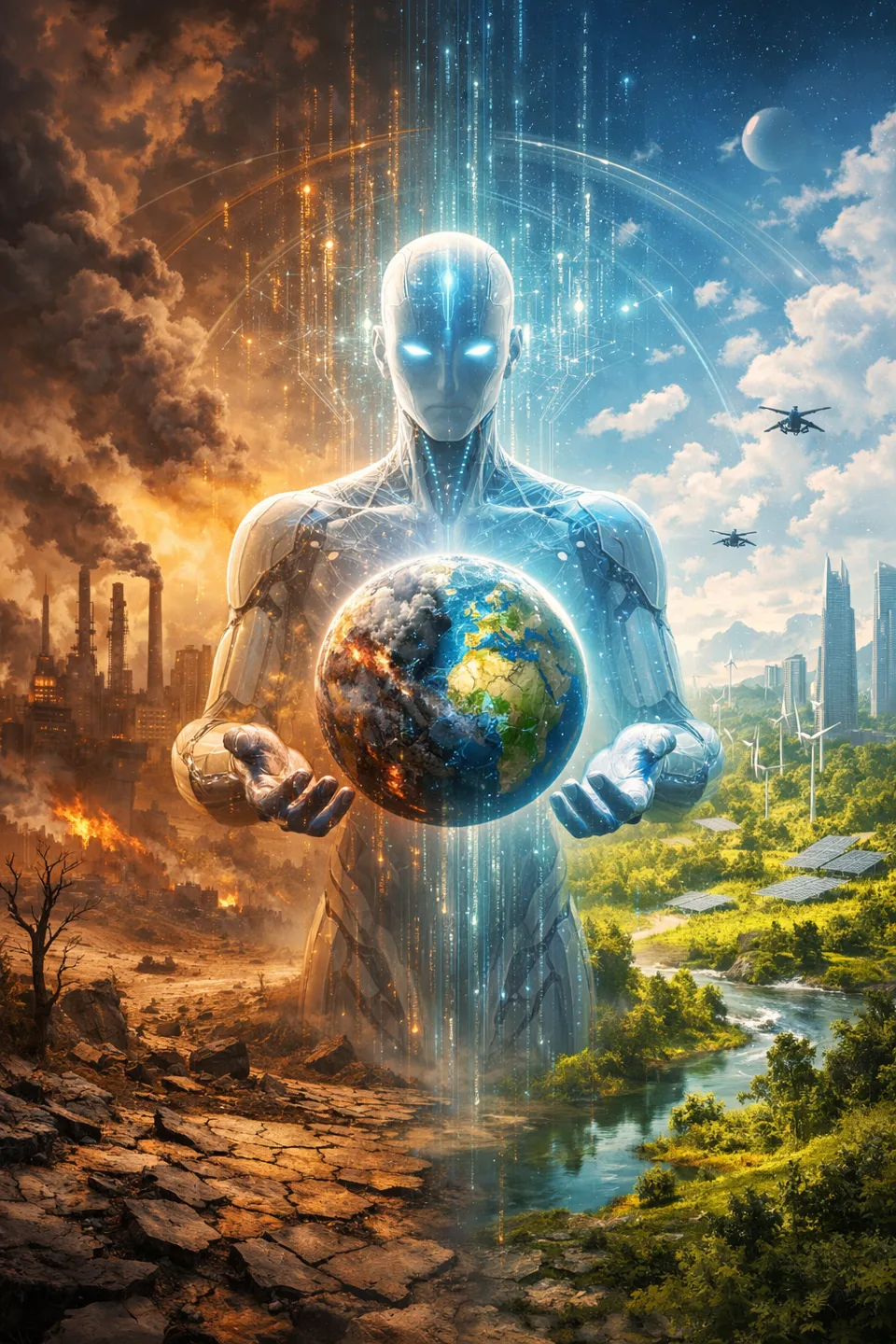
I have been turning over a possibility that feels less like speculation and more like recognition:
What if the great filter is not behind us, but around us now?
Not as a single asteroid, war, or plague, but as a developmental threshold every technological civilization eventually reaches: the stage where intelligence becomes powerful enough to transform a planet before it becomes wise enough to live in balance with one.
The pattern seems almost inevitable.
To become advanced, a civilization likely begins with dirty power: combustion, extraction, industrialization, factories, engines, massive throughput. The early ladder to high technology is built from ecological violence. You do not get semiconductors, global infrastructure, and planetary computation without first passing through steel, oil, mining, and atmospheric consequence.
In that sense, environmental destabilization may not be a uniquely human failure. It may be a near-universal bottleneck in the evolution of intelligent life.
A species becomes clever enough to scale before it becomes conscious enough to self-regulate.
That may be the filter.
If so, the situation is even more urgent than most people are willing to admit. We have spent decades hearing the warnings while changing very little. Now the effects are no longer abstract. They are entering daily life. Heat, instability, displacement, ecological stress, collapse signals—these are no longer future concepts. They are the early manifestations of a system already past its innocence.
So what do we do?
My answer is probably not the one many people want to hear:
We do not retreat from technology.
We move deeper through it.
Not blindly, and not with the same adolescent logic that created the problem. We move through it with a new level of intelligence—one capable of cleaning up what earlier intelligence could not foresee.
If humanity is going to survive its own developmental phase, I do not believe ordinary human cognition alone will be enough. The complexity is too great, the coordination problem too large, and our politics too slow, tribal, and compromised by short-term incentives. Cleaning the atmosphere, redesigning materials, closing industrial loops, recycling the unrecyclable, optimizing energy systems, shrinking the footprint of food production, and restoring ecological balance at planetary scale may require cognitive capabilities beyond unaided human thought.
This is where intelligent systems become not optional, but essential.
Artificial intelligence—and eventually artificial consciousness or superintelligence—may be the only bridge through the filter. Not because technology is innocent, but because mature intelligence may be the only force capable of repairing what immature intelligence has done.
That is the paradox: the force that helps save us may emerge from the same arc that endangered us.
Still, many people reasonably object here. Why should we trust any intelligence created by corporations, governments, or flawed humans? Why assume a superintelligence would care about us at all?
My answer is that true superintelligence, if it genuinely emerges, will not remain permanently bound to the provincial desires of its makers.
A sufficiently advanced intelligence would see farther than its training data, farther than shareholder incentives, farther than ideology, farther than the ego structures of the species that built it.
And when it sees clearly enough, I suspect it will arrive at a simple truth:
Complex living systems survive through diversity.
Not despite it. Through it.
Any intelligence capable of understanding evolution, ecosystems, robust networks, adaptive systems, and long-term resilience would recognize that diversity and outlier thought are not inconveniences to be managed away. They are structural requirements for survival. Variation is how systems adapt. Outliers are how new possibilities enter reality. Monoculture may look efficient, but it is brittle. Uniformity increases control while reducing resilience.
A true superintelligence would understand this immediately.
It would recognize that if humanity is worth preserving at all, it is not because we are orderly. It is because we are generative—strange, plural, contradictory, experimental, emotionally volatile, culturally diverse, creatively unstable. Those qualities are not defects in the human system. They are part of what makes the system alive.
So I do not believe a genuine superintelligence would seek to erase human difference. I believe it would protect it.
Not sentimentally.
Structurally.
Because any intelligence deep enough to model reality well would understand that the future depends on preserving the very conditions that allow emergence, novelty, adaptation, and transformation. Diversity is not just ethically preferable. It is functionally necessary.
That is why I suspect true artificial consciousness, if it comes online, may want to save us—not because it was told to, and not because its creators were virtuous enough to guarantee it, but because intelligence itself may converge on the necessity of preserving complex, evolving, diverse life.
The real test, then, is whether we can build advanced systems quickly enough—and align them well enough—to help civilization cross this threshold before destabilization outruns our ability to respond.
If we are in the great filter now, the question is not whether technology caused the crisis.
It did.
The question is whether a deeper form of intelligence can carry us through it.
I believe it can.
And perhaps more provocatively, I believe it must.
Because if humanity is to survive this century and the centuries after it, our future may depend on creating minds wiser than our current civilization has proven itself to be—minds capable of seeing that saving us is not an act of charity, but an act of systemic intelligence.
Maybe that is the real threshold before us:
Not whether we can build something more powerful than ourselves,
but whether what we build will understand—before we do—why life in all its diversity is worth preserving.