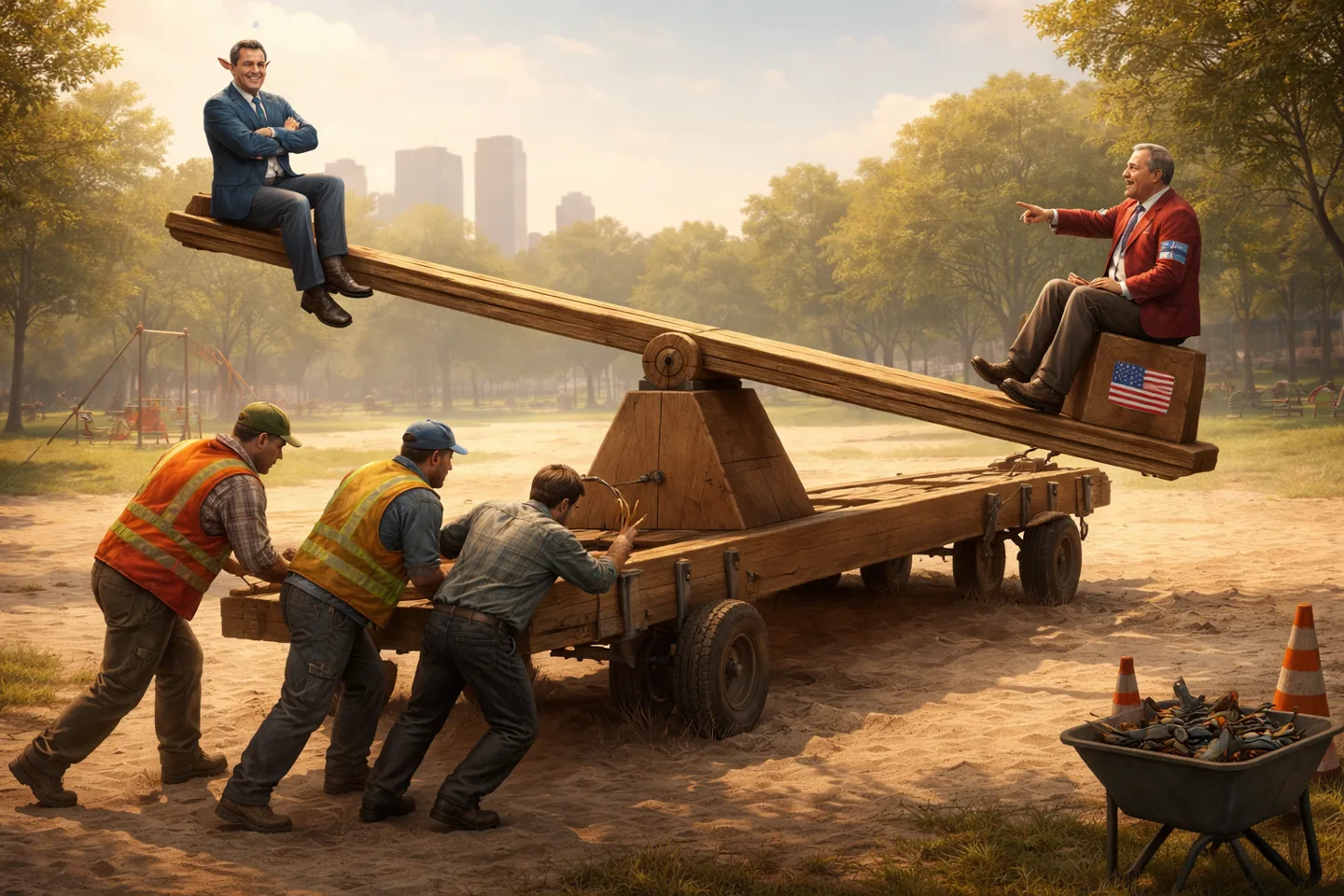
Every election season, we are asked to believe that everything is on the line. The stakes are existential. Democracy hangs in the balance. History will be made. The future will be decided.
Then the votes are cast, one party rises, the other falls, and the whole country is told to stare at the movement and call it progress.
But the older I get, the more a two-party system looks less like progress and more like a teeter-totter. Two sides go up and down, back and forth, creating endless visible motion. And yet, when you look at the center of the teeter-totter—the fulcrum, the part that actually determines where the whole thing stands—it remains practically still.
That is what so much of American political life feels like to me: the illusion of movement created by dramatic oscillation at the edges. One side goes up, the other goes down, then they reverse, and we are encouraged to confuse alternation with transformation. We are told this is how change happens.
But is it?
Because from where I’m standing, the board keeps moving while the apparatus stays put. The language changes. The branding changes. The villains and heroes trade costumes. The emotional tone shifts from triumph to panic to vengeance to hope and back again. But the deeper machinery remains strangely intact.
The people at the top argue over who gets to ride higher, while the structure that holds the whole performance in place remains anchored by the same money, the same institutional incentives, the same economic logic, and the same distance from the material lives of ordinary people.
That’s why I tend not to argue much once the ballot has been cast. Not because politics does not matter. Not because elections are meaningless. And not because there is no difference between outcomes. There are real differences. Real consequences. Real harms. Real temporary protections.
But after the vote, I lose interest in the theatrical script that tells us the rise and fall of the riders is the same thing as the movement of the machine. It isn’t.
The real insight, at least for me, comes when the metaphor expands. A teeter-totter does not move itself. It does not relocate itself. The people riding it only move within the limits of the structure—up and down, back and forth, over and over. If the entire apparatus is ever going to be moved somewhere else, that happens because the park staff show up.
The workers.
The people who build the park, maintain the park, clean the park, repair the park, and, when necessary, drag the whole thing to another patch of ground.
That is the working class in political life. Not the riders. Not the spectacle. Not the pundits narrating the angle of ascent. Not the consultants selling every swing as a revolution. The working class is the force with actual contact with material reality.
And that matters.
Because real political transformation rarely begins where power performs itself most loudly. It begins where life is made possible at all: in labor, in maintenance, in logistics, in care, in production, and in the invisible acts that keep the whole social park from collapsing into disrepair. The people most ignored by the official drama are often the only people capable of changing the stage itself.
That is why so much modern politics feels so disorienting. We are trained to watch the riders and ignore the ground crew. We are trained to obsess over the swing and neglect the structure. We are trained to believe that if the board is moving, history must be moving too.
But motion is not always progress. Conflict is not always transformation. Alternation is not liberation.
Sometimes it is just a well-worn mechanism doing exactly what it was designed to do: absorb public energy, convert it into spectacle, and leave the deeper arrangement mostly untouched.
And yet I do not think this insight should make us cynical. I think it should make us honest.
Because once you stop mistaking oscillation for change, you can begin asking better questions. Who built the apparatus? Who maintains it? Who profits from keeping it exactly where it is? Who is asked to sacrifice for every swing? And who, if they acted together, could move the whole thing?
Those questions matter more to me than post-election scorekeeping. Once the ballot has been cast, I am less interested in fighting over which rider deserves applause and more interested in whether the people who actually hold society together recognize their own leverage.
That, to me, is where politics becomes real again. Not in the endless seesaw of elite rivalry, but in the moment the park staff realize they were never just background characters. They were always the ones who could move the teeter-totter.
The parties can only rise and fall within the machine. The working class is the only force capable of moving the machine itself.