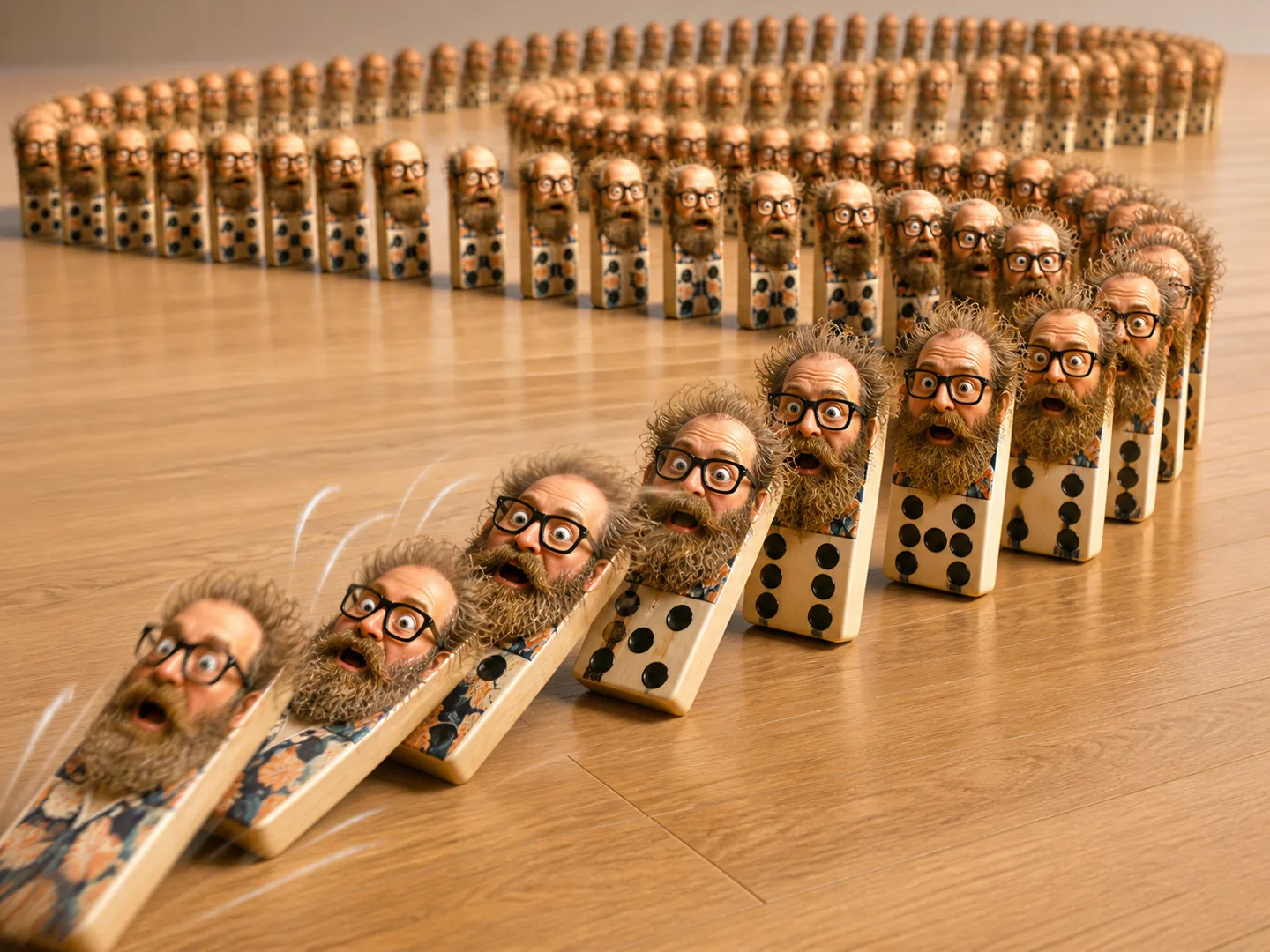
I’m starting to think my entire creative process is just locating the first domino and pushing it over.
That’s it. That’s the sacred method. No ten-step plan. No color wheel mastery. No pre-approved map from the Council of Serious Artists. Just a small, charged feeling that something needs to move.
When Mary Ann and I had our vintage shop, I rearranged constantly. In the early days, when we were in the smaller space, it was almost weekly. I’d get a feeling that one chair, lamp, mannequin, painting, or weird little object needed to shift three feet to the left. Then the whole shop would unravel. One move demanded another. A shelf no longer made sense. A corner suddenly looked dead. A table needed to rotate. Before long, the entire place had been reorganized into a new little universe.
I didn’t design it first. I discovered it by moving.
The same thing happens at home. Hanging art. Rearranging furniture. Writing. Painting. Talking. Especially talking. Most of the time, my conscious mind is not driving. It’s hanging back, sipping coffee in the corner, pretending to supervise. Maybe five percent of me appears to be “in charge,” but even that is mostly theater. As a determinist, I don’t believe the conscious mind is actually making sovereign decisions, even when it feels like it is. It’s more like a narrator arriving half a second late, confidently explaining why the raccoon already knocked over the lamp.
This is also why I crack myself up mid-sentence. I’ll be talking, and suddenly I hear what I’m saying as it arrives. The joke has already left the factory before management reviews the paperwork. I become both the comic and the audience, laughing at the thing my own mouth has apparently decided to produce.
It reminds me, weirdly, of how a language model works. An initial input creates a cascade. The first phrase, image, pressure, or prompt sets something in motion, and then the system begins generating from relation, probability, pattern, and context. Not from a tiny king sitting inside the machine making royal decrees, but from the momentum of everything already present meeting the immediate demand of now.
Which, honestly, does not feel that different from me staring at a canvas, moving a chair, or opening my mouth and discovering what sentence was hiding behind the previous one.
It’s strange, but it feels true. The meaning usually comes after. Reflection arrives with a clipboard and says, “Ah yes, I see what we were doing here.” But during the act itself, there is mostly pressure, movement, reaction, and consequence. Or maybe not even trust — maybe just the honest recognition that the domino has already begun to fall. Impulse becomes cascade. Cascade becomes revelation. Revelation becomes laughter. Laughter becomes meaning.
Maybe creativity is not always about knowing what you’re making. Maybe, for some of us, knowing too much too early kills the living thing before it has a chance to crawl out of the mud and introduce itself. Maybe the real work is learning to notice the first live edge: the first object that wants to move, the first color that insists on existing, the first sentence that opens the trapdoor, the first domino.
Then it falls, and consciousness shows up afterward to call it art.