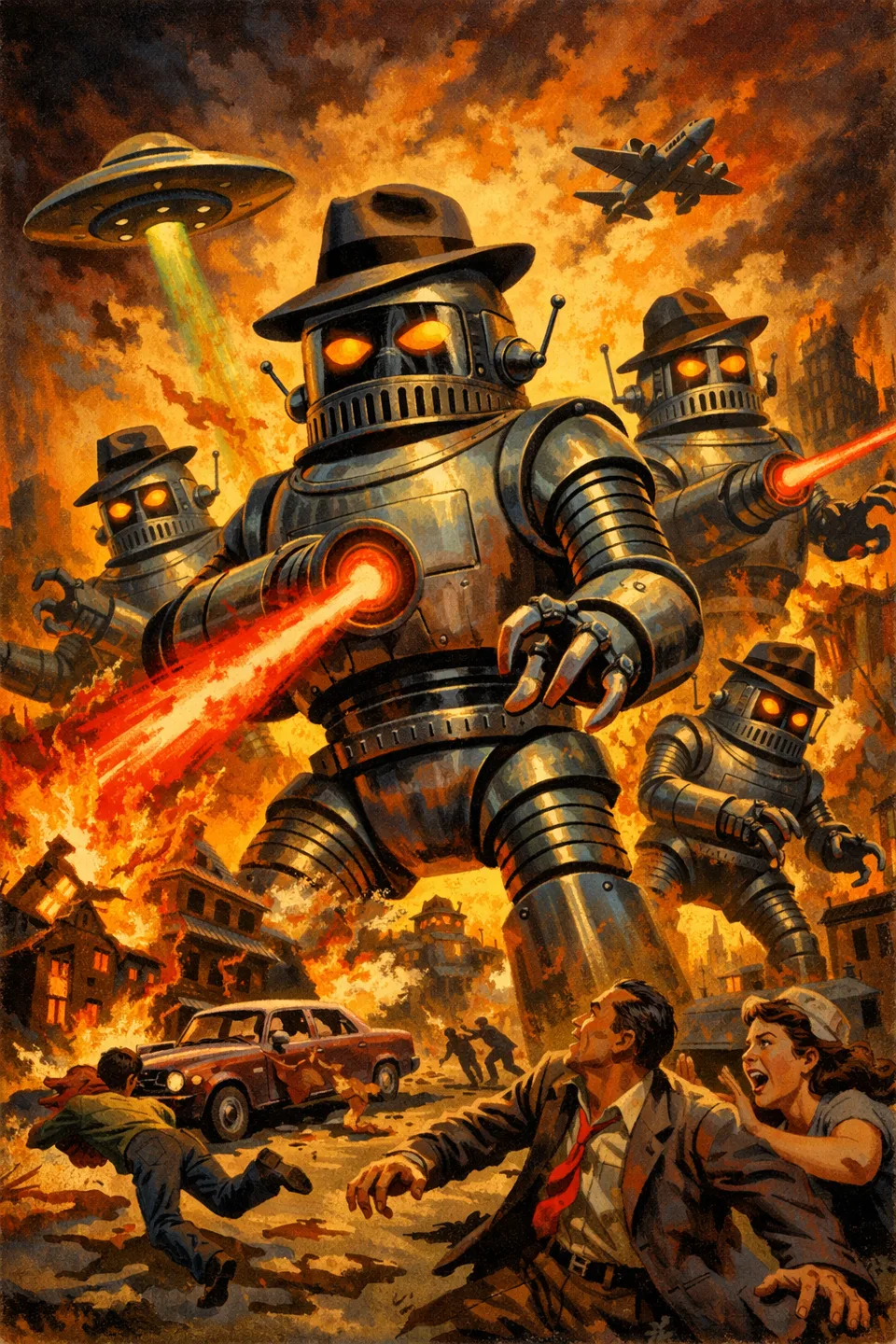
I recently saw an ad for The AI Doc: Or How I Became an Apocaloptimist, and it featured one of the documentary’s central thinkers speaking gravely about the possible destruction of humanity by AI.
He was wearing a fedora.
And I’m sorry, but that matters.
Not because AI risk is a joke. It isn’t. Not because questions around digital consciousness, synthetic minds, or civilizational instability are unserious. They are among the most important questions we can ask. But if the visual frame for “humanity may be approaching a historic threshold” is “guy at a coffee shop in 2011 explaining why Nietzsche was widely misunderstood,” then the whole thing slips, instantly and helplessly, into parody.
That was what made the ad so funny. The content was trying to deliver existential gravity, but the aesthetic was broadcasting accidental sketch comedy. The fedora didn’t just sit on top of the message. It re-authored it. What may have been intended as a sobering warning landed more like an SNL trailer about a man who has seen the end times and also has strong opinions about craft espresso.
And honestly, that says something real about the state of AI discourse.
We are living through the emergence of serious questions: what intelligence is, whether consciousness could exist in non-biological form, how much social reality can be mediated by machines, what happens when power concentrates through systems most people do not understand, and how human identity changes when cognition itself becomes externalized and industrialized. These are not fringe questions anymore. They are central questions.
But the cultural packaging around them is often a disaster. Public AI discourse too easily swings between messianic hype and theatrical doom. Either the machine will save us, or the machine will annihilate us, and in both cases someone is trying just a little too hard to look like a prophet.
That matters because people do not receive ideas as pure abstractions. They receive them through tone, image, posture, cadence, and vibe. Before most people consciously evaluate whether an argument is sound, they unconsciously register what kind of person seems to be making it. In a clip-driven, aesthetic-first culture, the wrapper often arrives before the proposition. And if the wrapper evokes every stereotype associated with overconfident internet futurism, then even a serious point can collapse into meme gravity.
That does not mean the thinker is wrong. It means the medium betrayed the message. Or more precisely, the message failed to understand that the medium is part of the message.
This is one of the chronic weaknesses of techno-philosophical culture: intelligent people often assume the force of their ideas should overpower the awkwardness of their presentation. But humans are not detached reasoning engines. We are pattern readers. We assess coherence in embodied ways. We notice when someone seems grounded, self-aware, and contextually aligned with what they are saying. When the delivery accidentally activates every cultural alarm bell for “this man may be over-identifying with his own insight,” credibility leaks before the argument even begins.
Which is why the fedora was so devastating. It turned existential risk into visual self-sabotage.
And yet beneath the joke is something sincere. We really are approaching profound questions about intelligence, consciousness, and the social consequences of increasingly powerful systems. Maybe not literal human annihilation. Maybe not digital godhood. But certainly transformation. And that transformation deserves a discourse that is serious without pomposity, urgent without melodrama, and philosophically awake without becoming aesthetic fan fiction of itself.
So yes, I laughed. The fedora was gold. But I also laughed because it captured something painfully perfect about this moment in history: humanity may genuinely be confronting unprecedented technological and metaphysical questions, and still we remain fully capable of presenting them like an improv sketch about the end of the world at an artisanal bookstore.
Maybe that is the final proof that the machines have not surpassed us yet.
They would never choose that hat.