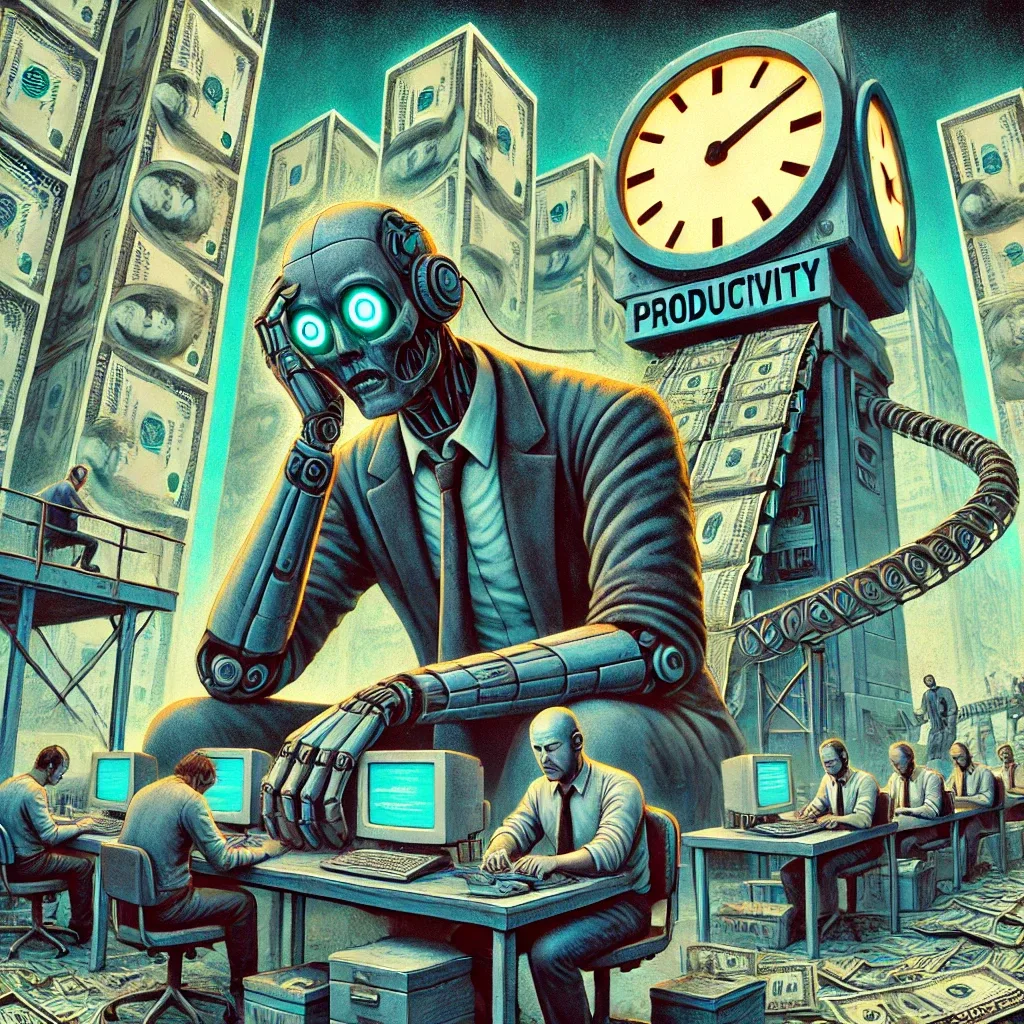
The Feeling You Can’t Name
You wake up tired.
Not just physically, but mentally—as if you never truly stopped working, even in sleep.
You get through the day, maybe even accomplish what needs to be done, but somewhere beneath it all, there’s a lingering exhaustion—not just from effort, but from something deeper.
It’s not burnout in the traditional sense. It’s something else. A kind of depletion that rest doesn’t fix.
It feels like there’s no off switch, like even when you step away, some part of you is still running in the background—thinking about work, about productivity, about how to make use of your time.
What you’re feeling isn’t a personal failure. It’s not just you.
It’s the system you’re living in.
You are trying to rest inside a machine that does not allow rest.
Why Capitalism Won’t Let You Rest
Capitalism is not just an economic system—it is a total conditioning system.
It does not simply ask for your labor. It demands your mind, your attention, your creativity, your presence.
And in Late-Stage Capitalism, the demand has escalated.
It is not enough to work—you must optimize.
It is not enough to rest—you must rest productively.
It is not enough to create—you must monetize.
Every aspect of life—even the parts that should be outside the realm of commerce—have been absorbed into the logic of capitalism.
Think about it:
Your sleep is tracked, measured, and optimized. (Turned into data.)
Your hobbies are turned into side hustles. (Turned into profit.)
Your downtime is filled with content designed to keep you engaged. (Turned into ad revenue.)
Even your mind is mined for its output. (“How can you make your thoughts work for you?”)
Late-stage capitalism has colonized human consciousness itself. It has eroded the natural cycles of work and rest, effort and renewal—and left in its place an endless loop of consumption and productivity, where even stillness must be justified.
A Historical Shift: Why This Feels Worse Than Before
It wasn’t always this way.
A century ago, work was still grueling, but it had clearer boundaries.
A factory worker left the job behind when they went home. A farmer had seasons of labor and seasons of rest. Even early office workers could mentally clock out at the end of the day.
Now? Work follows you home.
Your phone dings with emails at night.
Your free time is filled with “engaging content” meant to keep your attention on a screen.
Your hobbies have been transformed into personal brands.
The distinction between work and not-work has been obliterated.
This shift is not just technological—it is economic.
The gig economy blurred the line between job and identity.
Social media turned personal expression into a monetized performance.
24/7 digital capitalism eliminated the mental exit doors.
We are living in an era where capitalism no longer just owns our labor—it owns our minds.
The Death of True Rest
True rest is not just sleep.
True rest is mental emptiness, true disengagement, the ability to exist without producing or consuming.
And that kind of rest?
It has become nearly impossible to access.
Because capitalism has done something insidious:
It has made guilt the price of rest.
When you try to take time for yourself, there is always that whisper:
You should be doing something useful.
You should be learning, improving, growing.
You should be making money from this.
Even in your free time, you are not truly free.
And that is not an accident.
Capitalism has designed it this way—because a mind that can truly rest is a mind that can question the system itself.
The Absorption of Identity into Work
This is why people no longer say, “I work as a teacher.”
They say, “I am a teacher.”
Work has become not just what we do, but who we are.
This is why people struggle when they are unemployed, even if they have savings.
This is why people feel lost when they retire.
This is why people tie their self-worth to their productivity.
Because capitalism has convinced us that we are only as valuable as what we produce.
Of course, productivity can be fulfilling—but not when it’s compulsory, not when every moment of rest feels like falling behind.
Work, at its best, is an extension of self. But capitalism has twisted it into self-worth itself.
That is the difference.
The Illusion of Choice
You may say, “But I choose to work hard. I choose to optimize. I choose to be productive.”
Do you?
Or were you simply never given another framework?
From childhood, you were trained for this.
From school to the workplace to social media, you were conditioned to believe that your time must be accounted for, your energy must be directed toward output, your existence must be justified through work.
Even now, as you read this, there is likely a small voice saying:
"Okay, but what’s the solution? What’s the takeaway? How do I use this information effectively?"
That voice?
That’s capitalism speaking through you.
Because sometimes, there is no immediate solution—only the recognition that you have been trapped in a system designed to prevent you from ever truly stopping.
The Way Out: Creating Unmonetized Space
So how do we break free?
How do we reclaim true rest, true balance?
We cannot opt out of capitalism entirely—not unless we remove ourselves from society completely.
But we can create pockets of space where capitalism does not reach.
Create for the sake of creation.
Write, paint, make music—not to sell, not to share, but because creating is part of being human.
Let something exist without an audience, without a market, without a metric.
Rest without optimization.
Sleep without tracking.
Sit without input.
Exist without justification.
Recognize that your worth is not tied to productivity.
You do not have to earn the right to exist.
You do not have to be constantly improving.
Disconnect from the loop.
Step away from algorithmic engagement—where every moment of stillness is filled with content designed to keep you consuming.
Create physical and mental exits—spaces where capitalism does not follow.
You do not need to escape capitalism entirely to resist its grip.
You just need to carve out spaces where it does not own you.
Because in the end, the most radical act in a world that demands constant output is to simply exist—fully, freely, without justification.
Final Thought: Holding Up the Mirror
This is not a personal failing.
This is not weakness.
This is not just you.
It is the system.
And once you see the system, you can begin to step outside of it—one moment, one breath, one unmonetized space at a time.