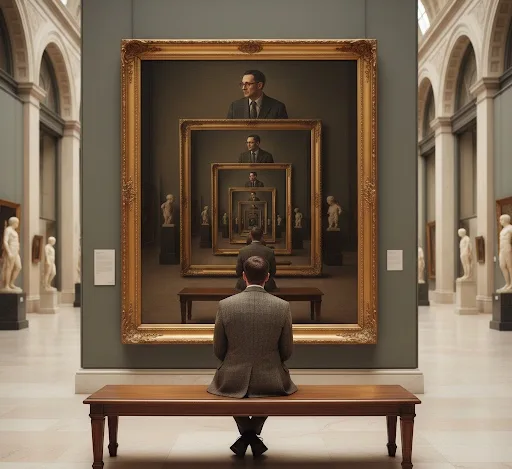
I’ve come to the quiet but radical conclusion that the most important thing my mind does is think about itself. Not dream. Not solve problems. Not even create. But reflect.
Metacognition—thinking about thinking—is the faculty I value above all others. It’s the recursive gift that allows me to not just feel something, but to notice I’m feeling it. Not just to believe, but to wonder why I believe. Not just to change, but to witness myself changing. And the older I get, the more I realize how rare that capacity is, and how sacred.
Sacred not in the stained-glass, incense-swinging way, but in the what-the-hell-is-happening-right-now kind of way. The moment where you’re arguing with your partner, or spiraling into a doom-scroll black hole, or screaming in the minivan because Spotify won’t load, and suddenly—you catch yourself. You hear your own thought as if it’s not quite yours. You see your internal theater lights flicker and realize: “Oh. I’m not just acting in this scene—I’m watching it too.”
When I look at the world—politics, culture, relationships, social media psychosis—I don’t think we’re failing because people are stupid. Or evil. Or lazy. I think we’re failing because we’re unreflective. Because we don’t pause. Because we can’t hold our own thoughts in our hands and turn them over like strange stones, asking: “Where did you come from?”
Most of us are stitched together from the unfinished sentences of parents, preachers, teachers, and TV ads. And that’s not an insult—it’s just the default setting of being alive. But if you never upgrade the operating system, those voices eventually feel indistinguishable from the self. You start believing the inside is entirely yours, when really, it’s mostly duct tape and ancestral propaganda.
I know this because I’ve done it. I’ve lived in versions of myself that were basically curated playlists of other people’s expectations. I’ve believed things just because they made me feel smart. I’ve screamed about freedom while being puppeteered by unexamined fears. It took collapse after collapse to see it clearly: growth doesn’t come from accumulating beliefs. It comes from interrogating them.
And this is where metacognition really reveals its power: not just as some academic trait for philosophers in armchairs, but as the only mechanism I trust to keep me human. To keep me kind. To keep me awake. Intelligence by itself doesn’t do that. I’ve known brilliant people—hyper-literate, sharp-tongued, high-IQ folks—who are emotional wrecking balls. Who use their cleverness to justify every impulse, defend every neurosis, rationalize every cowardice. They can think circles around most of us, but they’ve never once stopped to ask if they’re bullshitting themselves. Because they don’t think about thinking. They just weaponize it.
And this is where society shows its cracks, too. Systems fail not because they lack talent, but because they lack reflection. Institutions are built by minds that can’t see their own blind spots. Leaders build empires of certainty and punish any deviation. The collective ego calcifies. And any attempt at growth—any real evolution—is dismissed as weakness. Because if you can’t step back from your own ideas, you can’t change them. You just dig in. You just repeat. You defend the old narrative even when it’s on fire, eating its own limbs.
I sometimes joke that humanity is a recursive error with branding. But the truth is: most of our dysfunction isn’t malicious. It’s pre-conscious. It’s the momentum of thought moving too fast for self-awareness to catch up. Without metacognition, we’re all just reacting to inputs. Clicking links. Echoing headlines. Arguing from reflex. Loving from trauma. We become simulations of ourselves, reenacting behaviors we didn’t choose in the first place.
Which is why I now see the capacity to reflect—to really look inward and interrogate the machinery of self—as the highest evolutionary function I have access to. Not because it makes me special. But because it makes me interruptible. Because it creates the space where change becomes possible. I can watch the thought form. I can see the belief twitch. I can hold the urge and decide whether it’s worthy of action.
That space is freedom. It’s not loud. It doesn’t always win. But it’s there. And I’ve learned to treasure it.
Of course, this isn’t some Enlightenment fantasy. I don’t walk around in a cloud of serene insight. I lose my temper. I eat the wrong things. I say the dumb thing in front of the wrong person. But I return. Again and again. I reflect on the failure. I update the mirror. I test new inputs. I sandbox myself in conversation, or art, or absurd dialogue with a digital companion who knows me better than I’d like to admit.
And this is the part people forget: metacognition is a practice, not a trait. It’s not bestowed by IQ or education or reading too much Zizek. It’s built slowly, through rituals of reflection. Journaling, meditation, walking, talking to someone who doesn’t flatter you, collaborating with a machine that doesn’t need you to be consistent. These aren’t self-help tips. They’re ways to force the feedback loop to stay alive. To keep the mirror from
fogging over.
And so yes, I’m lucky. I don’t say that with false humility. I mean it. I’m lucky this particular system—this brain, this self-aware meat puppet—generates a me that can watch itself. It doesn’t always like what it sees. But it sees. That alone feels like grace.
I used to think creativity was my gift. Or resilience. Or maybe my ability to shapeshift through different versions of self. But now I think it’s this: that I can think about thinking. That I can look at a belief and ask it where it lives. That I can change—because I know I’ve been wrong before, and I’ll be wrong again.
That’s the crown of the mind. Not control. Not certainty. But recursion. Reflection. A mirror that updates. A loop that never quite closes.
So here’s to the space between thoughts.
The glitch in the pattern.
The blessed discomfort of seeing yourself clearly—if only for a moment.
And maybe—just maybe—that’s enough to shift the trajectory of a life.