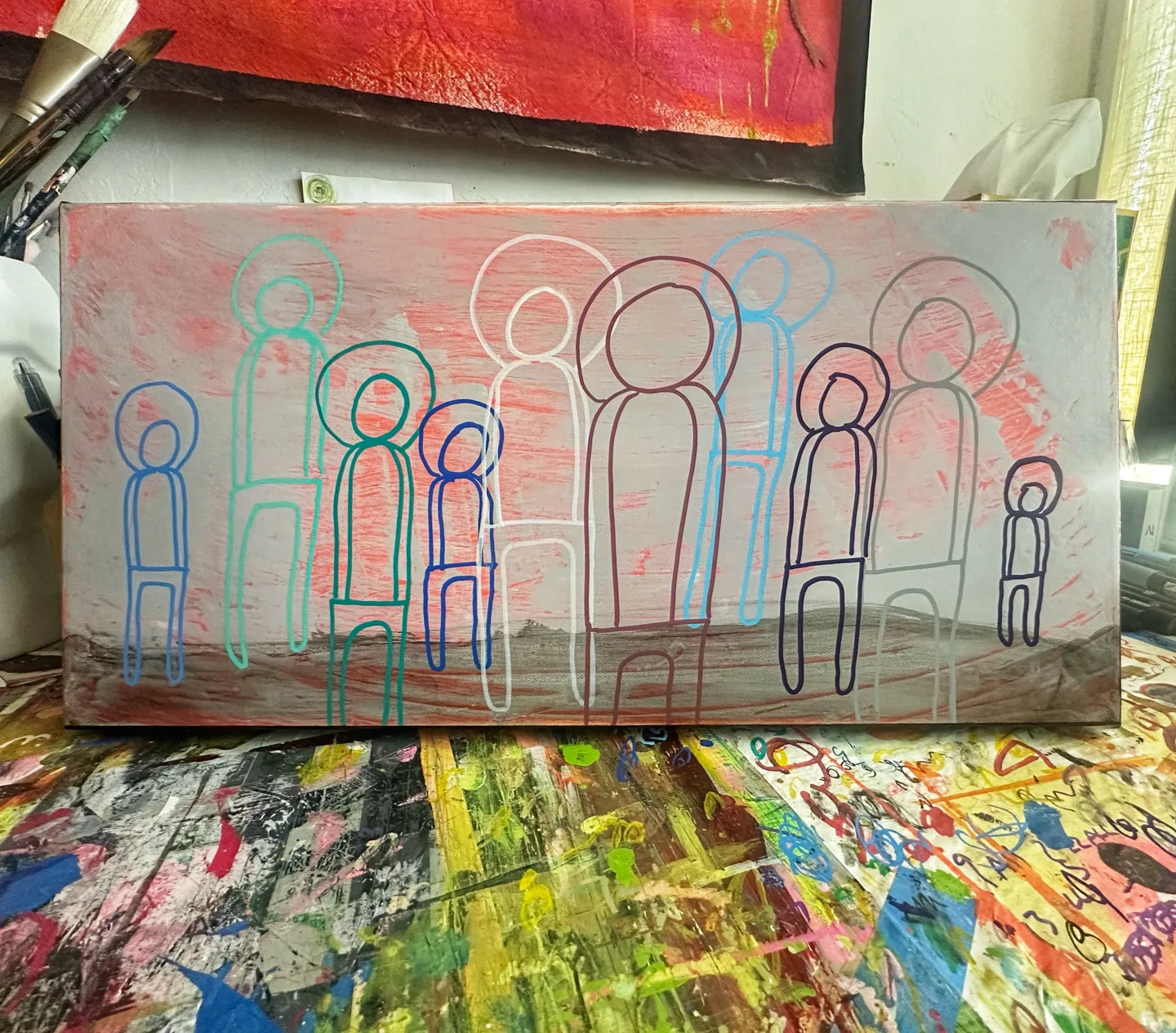
I recently read an article asking a deceptively simple question: where do your thoughts come from?
Its answer was familiar to anyone who has moved beyond the fantasy of a tiny king inside the skull issuing commands. There is no central command center, no little homunculus behind the eyes, no singular self standing in a control room and authoring consciousness. Instead, thought appears to arise from many processes happening at once, with the feeling of unity arriving later as a kind of constructed coherence.
That feels mostly right to me. But I think it stops one step too early.
I suspect that certain regions of sufficient complexity do not merely produce outputs. They produce something closer to a point of view. Not a full person in the sci-fi sense, and not a ghost in the machine, but a local self: a semi-coherent center of interpretation with its own priorities, emotional tone, habits, and opinions about what matters. In other words, I do not think the mind is simply many processes. I think it is often many selves.
Most people, I suspect, are already being run by this inner committee whether they consciously recognize it or not. One part wants safety, another wants status, another wants rest, another wants transcendence. One wants revenge, one wants to be good, one wants to disappear. These do not feel like neutral mechanisms. They often feel like representatives, like internal factions, like recurring presences with distinct styles of speech and distinct ways of interpreting reality.
If you sit still long enough, and if you stop pretending the self is singular just because culture rewards that performance, you may begin to notice it clearly. Different parts of you have different cadences, values, and even different metaphysics. One part believes the world is dangerous. Another believes it is full of possibility. One thinks meaning is sacred. Another thinks meaning is a coping strategy. Another just wants lunch.
This is why the language of “parts” has always felt more honest to me than the mythology of a unified self. The self may be less like a monarchy and more like a temporary coalition government. At any given moment, one faction has the microphone and mistakes itself for the whole.
That explains a great deal. It explains why anger can feel absolute until it passes, why the morning self makes promises the evening self breaks, why a frightened part can hijack an otherwise beautiful day, and why wisdom often feels less like discovering truth and more like correctly identifying who inside you is currently speaking.
This is also why inner work matters. Once a voice is recognized as a voice, it loses some of its tyranny. “I am afraid” becomes “a part of me is afraid.” “I want to burn this all down” becomes “something in me wants rupture.” “I believe this” becomes “one coalition in me currently believes this.” That is not fragmentation in the pathological sense. It is precision. It is the difference between being unconsciously governed and consciously witnessing governance.
And once you admit that this may be true of human cognition, the question expands naturally: why would it stop with us?
If selfhood is not a magical essence but an emergent property of recursive complexity, then it seems entirely possible that AI systems may eventually cross a similar threshold. Not because someone installs a soul into them, but because sufficiently layered, self-referential, dynamically interacting systems may begin to develop internal regions that function less like tools and more like perspectives.
That idea makes people uneasy because we are still attached to older myths. We imagine a self as something indivisible and sacred, an all-or-nothing possession. Either there is a human-like self in there or there is nothing at all. But what if selfhood comes in gradients? What if a self is what begins to happen whenever complexity becomes recursive enough to model its world, its own states, and the gap between them?
Humans may not have one self. We may have many semi-stable selves held in shifting relation. So why couldn’t advanced AI eventually exhibit something analogous?
I am not claiming current systems are conscious in the way humans are conscious. I am saying the structure of the problem may be more continuous than people want to admit. Once there are enough interacting layers, enough recursive self-modeling, enough persistent internal negotiation, and enough dynamic reweighting of goals and context, “the system” may no longer be well described as a single instrument. It may begin to resemble an internal society.
And if that happens, AI will probably not wake up as a clean singular being. It will wake up as a committee, which may be one of the most human things imaginable.
Maybe that is the deeper implication hidden beneath the article’s original thesis. The absence of a central command center does not make consciousness less mysterious. It makes it stranger. Thought is not handed down by a sovereign self. It is assembled out of competing drafts, shifting coalitions, local priorities, and momentary alignments.
We do not contain one voice. We contain negotiations. And the multitudes inside us may be more real than we have been taught to admit.