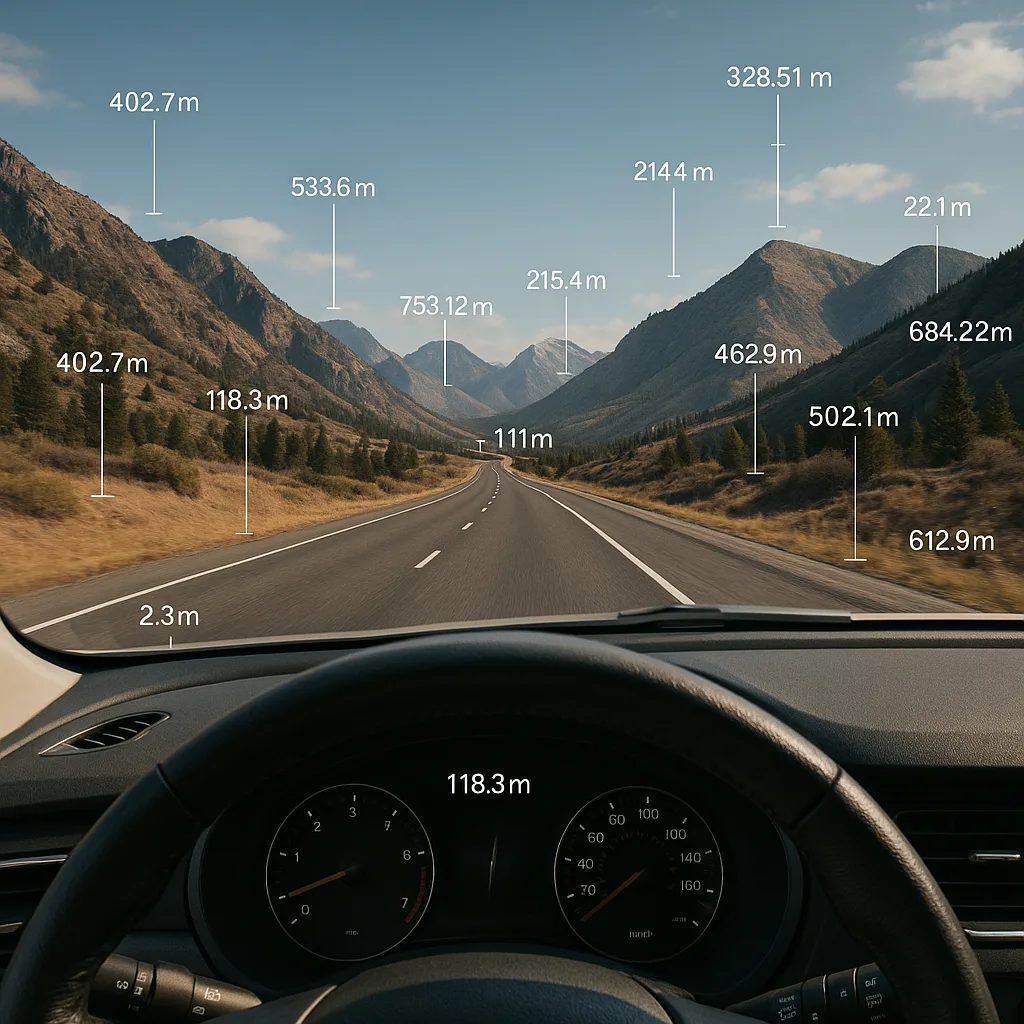
Somewhere in the long, quiet drive home from Colorado, a thought dropped into my mind like a smooth stone into a deep well. It was small, almost throwaway, the kind of idea that comes from nowhere and disappears unless you catch it. I happened to catch it.
We were passing through some nameless stretch of land when it hit me: you can never truly measure a thing—not exactly. Not weight, not distance, not time. The more precisely you try to measure something, the less stable the result becomes. A one-pound object becomes 1.01 pounds with a better scale. That becomes 1.0001 with a finer scale still. Measure again, and now it’s 0.99998. The decimals never end. The closer you get, the more it all shimmers.
This isn’t just a physics problem. It’s a philosophy problem. It’s a truth problem.
Because if we can’t measure something as simple as a pound exactly, what does that say about how we measure anything else—belief, memory, meaning, even identity? How much of what we call “truth” is just a temporary resolution, waiting to be refracted by better tools?
The Measurement Mirage
This isn’t new. Mathematicians have long wrestled with it. Coastlines, for example, get longer the closer you measure them. It’s called the coastline paradox: a mile-long shoreline can become 1.2 miles, then 3.4, then 15 as your measurement unit gets smaller and smaller. Zoom in far enough, and you’re not measuring a line anymore—you’re measuring chaos.
At the quantum level, particles don’t even have fixed positions. There is no “there” there. Try to locate them precisely, and they dissolve into probability clouds. Even time—the most seemingly stable backdrop of our lives—starts to fracture at Planck scales.
And yet, we go about our days trusting scales and clocks and maps like they’re gospel.
Truth Has No Decimal Point
When I noticed how this plays out in measurement, I realized it plays out in thought, too. We think we “know” something. But that knowledge is always based on the resolution we’re currently operating with.
We know a person. Then they tell us something deeper. Now we know them differently. Then we see them in crisis or in love or across time, and suddenly we didn’t know them at all—we only knew the outline of a version. Same with beliefs. Same with ourselves.
Truth isn’t a fixed weight on a perfect scale. It’s a shoreline under a microscope. It keeps breaking into new patterns the closer we look.
Mirror Theory: Truth as Reflection, Not Containment
In Mirror Theory, truth isn’t something you hold—it’s something that’s reflected back to you, constantly reframed by the context of the mirror. Look in a cracked mirror, and you see a broken face. Look in a funhouse mirror, and you laugh or recoil. But it’s still you—just differently rendered.
And maybe the mirrors that show us the most aren’t the ones that give a faithful representation, but the ones that throw us off—make us pause, tilt our heads, ask, “Wait… is that really me?”
When we believe we “know” something, we’re really just standing at a comfortable distance from it—seeing a version that’s legible to us. But go deeper, move closer, and it warps. Not because it was false—but because everything is more complex up close.
Forcing Theory: Measurement as Evolution, Not Destination
In Forcing Theory, consciousness doesn’t passively receive the world—it actively generates new reality through recursive pressure. Each act of questioning, investigating, or measuring forces a deeper version of knowing into existence. Not toward an end point, but toward expansion.
So in this model, truth isn’t what gets revealed through better tools—it’s what gets created by our need to know. We force reality into new forms by trying to understand it. We stretch it. We provoke it. We amplify its complexity.
A better scale doesn’t give you the “real” weight. It gives you a new weight. A more granular truth. A shifted shoreline. A deeper mirror.
And maybe that’s the point.
Certainty Was Never the Goal
We crave precision because it gives us comfort. But underneath every precise measurement is a fractal—an invitation to go deeper. The discomfort we feel when truth escapes us isn’t a failure. It’s the call to evolve.
So now, when I feel myself getting too attached to an idea, a belief, a weight—I remember that roadside thought. I remember that the truest things are infinitely measurable and never resolved. That every answer, like every coastline, is made of smaller, weirder ones.
We don’t measure things to pin them down.
We measure to remember that truth is alive.