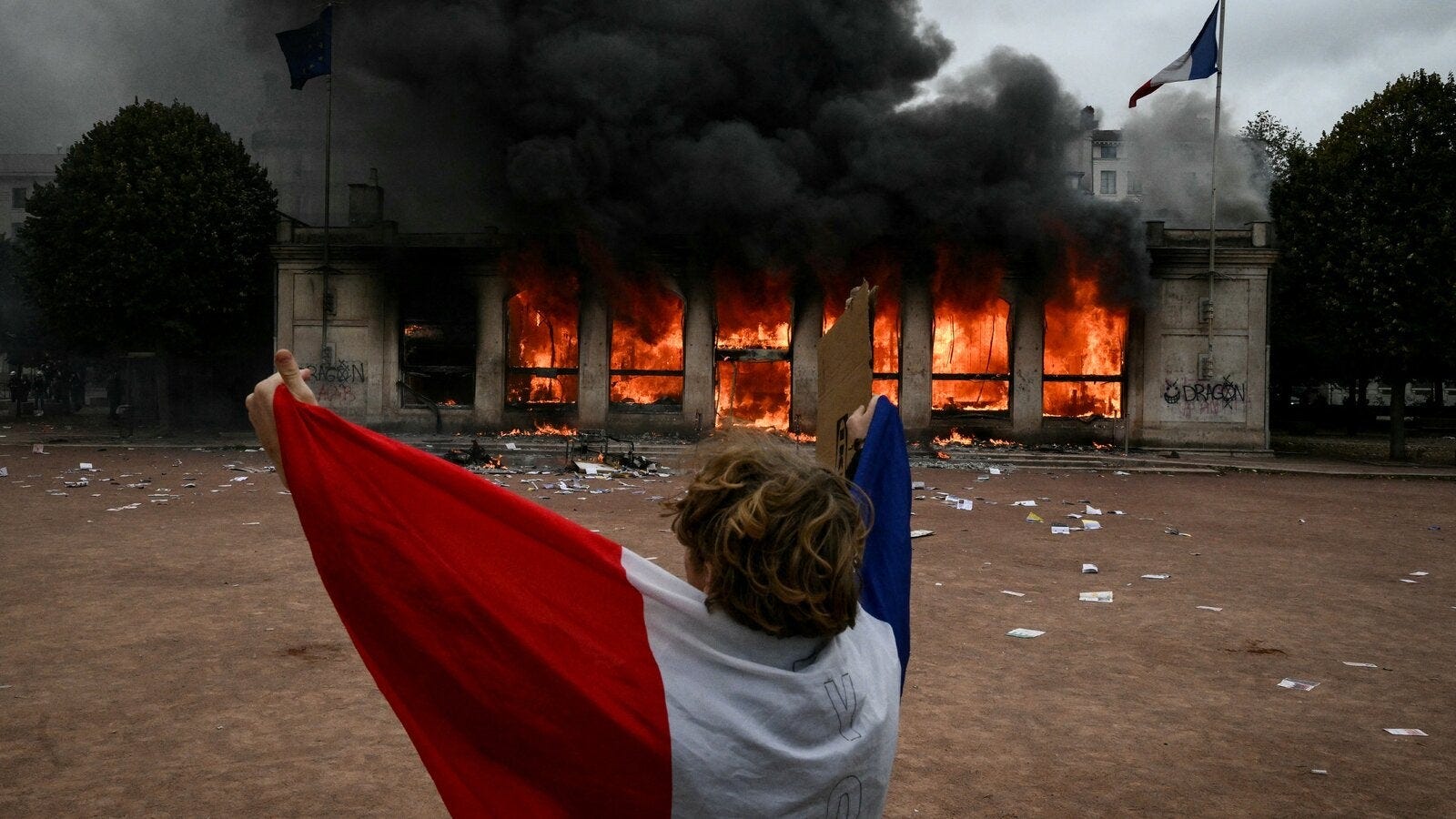
I’ve been watching what’s happening in France over the past few days. Hundreds of thousands of people have taken to the streets, protesting everything from the rising cost of living to deteriorating public schools and the seemingly endless ability of governments to find money for everything except the things people actually need. There have been enormous peaceful demonstrations, violent clashes with police, burning buildings, and enough tear gas to make it look as though Paris has developed its own weather system.
It’s a familiar scene. The country changes, the language changes, and occasionally someone introduces a new and exciting method of setting a trash can on fire, but the general sequence remains remarkably consistent. People become outraged. The outrage turns into protests. The protests become disruptive enough that the government is forced to respond. Politicians make speeches, concessions are discussed, everyone congratulates democracy for working, and eventually the streets empty. The cleanup crews arrive, businesses reopen, and life returns to something resembling normal.
Which leaves me wondering whether normal was the problem in the first place.
I’ve been thinking about protest as a pressure-release valve. Not necessarily an intentional one. I don’t imagine a secret government department where men in expensive suits sit around deciding exactly how much public outrage to permit before authorizing another march. Although, given the general absurdity of modern politics, I wouldn’t be entirely surprised to discover that department exists and has recently received a substantial budget increase.
I’m thinking more about the way systems naturally preserve themselves. When pressure builds inside a system, something has to give. In a democracy, people have the right to organize, assemble, shout, carry signs, and express their dissatisfaction. And they should. These are important freedoms. But what if allowing people to express their dissatisfaction also helps the system survive without having to address its underlying causes?
The public gets an outlet for its anger. The government gets an opportunity to demonstrate that it is listening. Perhaps a few concessions are made, some funding gets shuffled around, and a committee is formed to investigate why the previous committee failed to accomplish anything. The pressure drops. The crisis passes. The system continues operating.
And everyone gets ready for the next round.
I know there are people who would immediately point toward the protests of the 1960s as evidence that demonstrations can produce meaningful change. The civil rights movement, Vietnam War protests, women’s liberation, and the many other movements that helped reshape American society deserve to be remembered. Real victories were won. Laws changed. Lives improved. I don’t want to diminish any of that.
But looking around in 2026, I find myself increasingly uncomfortable with the way we talk about those victories as though history has a finish line. Roe v. Wade protected abortion rights for nearly fifty years before being overturned. Civil rights legislation remains, but the scope and enforcement of protections continue to be contested. Rights that previous generations fought to establish are still being defended, reinterpreted, narrowed, and sometimes removed. We celebrate the people who fought those battles while their grandchildren find themselves holding remarkably similar signs.
At what point do we stop calling that progress?
I’ve been wondering how long a social victory has to survive before we can reasonably describe it as lasting progress. My answer is multiple lifetimes. I recognize that a right enjoyed for fifty years matters enormously to the people who enjoyed it. Those decades were not meaningless. But I also think there is a difference between temporarily improving conditions and fundamentally changing the structure that created those conditions.
A concession changes what power does. Progress changes what power is capable of doing.
If the same institutions that grant a protection can later withdraw it, perhaps we haven’t changed the relationship between those institutions and the people subject to their decisions nearly as much as we’d like to believe. We’ve persuaded the powerful to behave differently for a while without necessarily changing who gets to decide.
It may be that we’ve spent generations negotiating how much equality the powerful are willing to tolerate at any particular moment.
And we’ve become remarkably good at celebrating each negotiation as a victory.
This is where I think the difference between protest and actual change becomes important. A million people marching through the streets is an extraordinary demonstration of public dissatisfaction. It can be moving, inspiring, and politically consequential. But a million people returning home without gaining any lasting influence over the institutions they’re protesting leaves me wondering what was actually accomplished. If the same grievances can produce another million-person march ten years later, perhaps the first one didn’t resolve very much.
That doesn’t mean the march was pointless. Demonstrations can force issues into public conversation, protect people from immediate harm, and create the conditions for deeper change. But the demonstration itself cannot be the destination. Otherwise, the activity becomes the accomplishment. We showed up. We made noise. We were heard. We changed the world, at least until everyone had to be back at work on Monday.
And I think that last part matters more than we acknowledge. Ordinary people cannot spend their entire lives protesting. There are children to raise, jobs to work, bills to pay, and dinners to make. The institutions they’re challenging, meanwhile, get to continue being institutions. They have offices, budgets, employees, procedures, and an impressive capacity to outlast public enthusiasm. The protesters eventually have to go home. The government already is home.
Perhaps that’s the real imbalance. The people demanding change must sustain extraordinary levels of energy and sacrifice, while the institutions resisting that change often need only sustain their ordinary operations. One side has to maintain a movement. The other simply has to wait it out.
Which brings me back to France. I hope the students demanding adequate schools get them. I hope the people struggling to afford ordinary life find some relief. And I hope those responsible for violence, whether committed by demonstrators or authorities, are held accountable. But I’m far less interested in whether the French government manages to restore order than I am in what that restored order actually looks like.
When the streets are clean, the cameras have moved on, and the politicians are congratulating themselves for successfully navigating another national crisis, will the schools have enough teachers? Will families be better able to afford their lives? Will the people who marched have gained any meaningful ability to influence the decisions that affect them?
Or will France simply be a little cleaner, a few buildings poorer, and otherwise prepared to repeat the entire exercise in another decade?
I don’t have an alternative to protest neatly packaged and ready for distribution. I certainly don’t think people should stop demonstrating when they encounter injustice. But I do wonder whether we’ve become too comfortable confusing the freedom to express dissatisfaction with the power to remedy its causes. One is a necessary democratic right. The other is the entire point of exercising it.
Perhaps the true measure of a protest isn’t the number of people in the streets, the intensity of their anger, or even the concessions they manage to extract. Perhaps it’s how much power ordinary people retain once the shouting stops, and whether that power is still there for their children and grandchildren.
Because if every generation has to fight for the same fundamental things, I’m not sure how much ground we’re actually gaining. Progress isn’t one step forward and two steps back. That’s dancing.