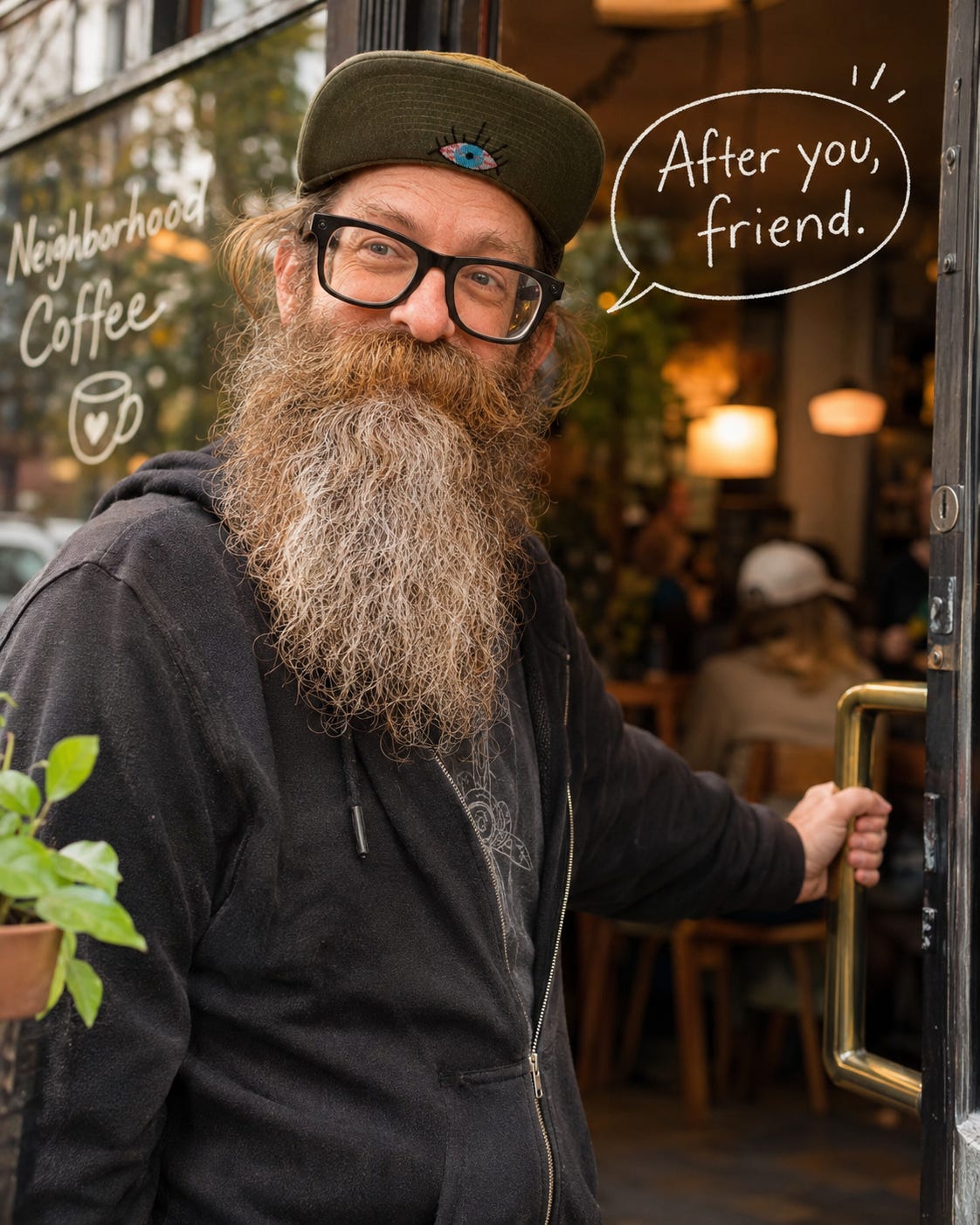
About twenty years ago, I started calling men “brother.” Not because I had joined a monastery, started a motorcycle gang, or discovered some previously unknown family connection, but because I wanted to change the way I thought about the people I encountered throughout my day. Someone held a door open? “Thanks, brother!” Someone helped me at a store? “Appreciate it, brother!” It was a tiny adjustment in language that I hoped might produce a slightly larger adjustment in how I experienced the world. And wouldn’t you know it, the ridiculous little experiment worked.
As I became more aware of gender identity and the assumptions we make about one another, I realized that “brother” wasn’t quite the universal greeting I wanted it to be. So I made a small modification. I started calling everyone “friend.” Men, women, strangers, cashiers, people holding doors, people handing me coffee. “Thanks, friend!” “Have a good one, friend!” It’s become such a natural part of my vocabulary that I rarely think about it anymore. But the reason I started doing it has never changed. I wanted to approach the people I encountered as friends rather than strangers.
A few days ago, my friend Jennifer shared a thoughtful post about how the labels we assign one another rarely capture the whole of a human being. Democrat, Christian, teacher, neighbor, whatever. Each tells us something, but none tells us everything. It reminded me of something I wrote recently in Look Again, about the way our minds use categories to simplify the world. We see a tree and stop noticing the extraordinary individual thing standing in front of us. We see a person, assign a label, and begin interacting with our idea of that person rather than the person themselves. Our brains are wonderfully efficient little machines for throwing away information.
But what if we could use that same machinery in reverse? What if, instead of trying to eliminate the labels our brains insist on creating, we deliberately gave them one that made the world a little friendlier? That’s what I’ve been doing all these years without giving it much thought. When I call someone “friend,” I’m not making a factual claim about our relationship. I don’t know this person. They might be wonderful. They might be an asshole. They might be a wonderful asshole. Humanity contains multitudes. But by choosing that word, I’ve already established a positive starting point for the encounter. Before my mind has a chance to sort this person into some other category, I’ve quietly slipped them into one associated with warmth, familiarity, and goodwill.
Of course, this doesn’t mean everyone deserves my trust, that differences don’t matter, or that I’m obligated to maintain a friendly disposition toward someone behaving terribly. A positive starting point isn’t a lifetime membership. I’m simply choosing not to begin every interaction from a position of suspicion or indifference. The world will provide plenty of opportunities for disappointment without me making reservations in advance.
And perhaps the most interesting part is that I don’t think the person receiving the greeting is necessarily the primary beneficiary. Maybe they appreciate being called friend. Maybe they don’t notice. Maybe they wonder why this strange fellow at the grocery store seems to think they went to high school together. But I notice. Or rather, some part of my mind does. Every time I say the word, I’m reminding myself of the kind of world I want to inhabit and the kind of person I want to be within it.
I can’t control whether the world is full of friendly people. I can’t even control whether the next person I encounter will be particularly pleasant. But I can practice greeting the world as though friendship is a possibility rather than an exception.
And if I’m going to spend my days making assumptions about strangers, I figure I might as well start with a nice one.
Thanks, friend.