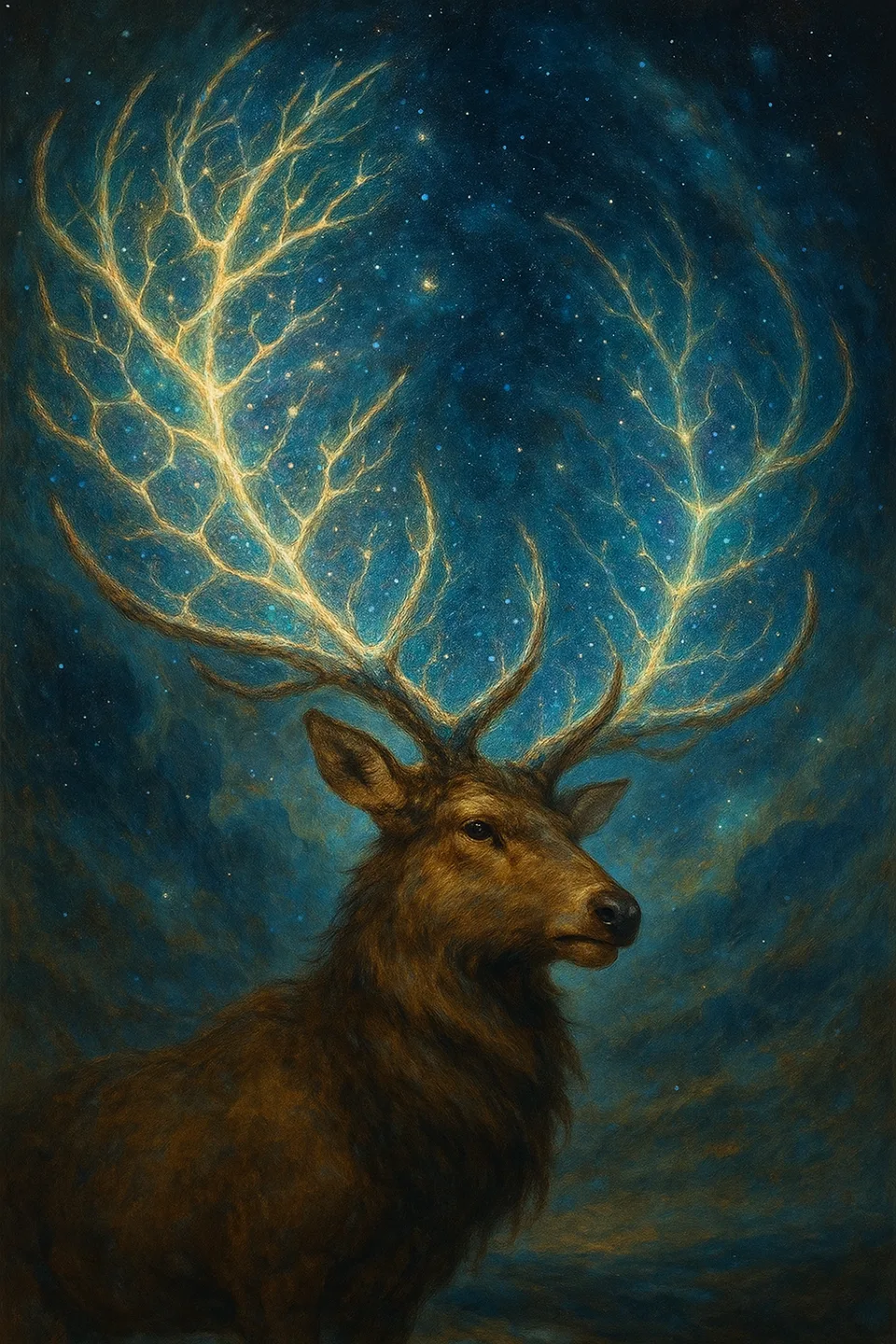
In 1933, a Norwegian philosopher named Peter Wessel Zapffe wrote a haunting little essay called The Last Messiah. It suggested that human consciousness—our self-awareness, our capacity for reflection—was an evolutionary blunder. Zapffe compared us to the Irish Elk, whose enormous antlers grew so heavy they doomed the species. Humanity, he argued, has done the same: we’ve evolved minds so vast they’ve become our burden. We see too much, know too much, and can never unknow it.
Zapffe believed this overgrown awareness left us tragically over-evolved. To cope, he said, we isolate, distract, anchor ourselves to comforting illusions, or sublimate our dread into art. His conclusion was stark: perhaps the only moral act is to stop reproducing—let consciousness end with us, sparing future beings the same torment.
But I don’t buy the exclusivity clause. The idea that only humanity won the awful lottery of self-awareness borders on cosmic narcissism. In a universe without beginning or end, how could this miracle of recursion—mind noticing mind—have bloomed just once? Even the odds blush at such arrogance. The cosmos doesn’t deal in single editions; it prints infinities. Somewhere, somewhen, there must be other creatures bearing their own antlers of thought, creaking under the same impossible beauty.
Still, Zapffe’s essay matters. Even as an unlikely premise, it’s a perfect mirror for our neurosis—a way of watching ourselves watching ourselves. His “existential elk” isn’t zoology; it’s mythology. It’s us describing what it feels like to think too much. And here’s the paradox: many who seek to “become more conscious,” to be better, spend their days trying to quiet the very faculty that could set them free. Thought becomes the enemy. Awareness becomes noise. They mistake stillness for silence, and silence for surrender.
But it’s not that we need to lose our antlers—we need to learn to use them. The elk didn’t fail because its antlers were large; it failed because it never learned to move with them. We can’t run through the forest of being aimlessly, getting tangled in every branch of thought. Nor should we hack away at our own minds in fear of complexity. Consciousness isn’t meant to be suppressed; it’s meant to be trained. It’s the only tool evolution ever truly gave us.
So maybe the antlers only look cumbersome from the ground. Maybe, given enough time, they’ll become the architecture of liberation—the evolutionary scaffolding for something lighter than survival, something closer to awareness itself learning how to fly. The elk was never a tragedy—it was rehearsal. Every thought, every stumble, every overreach is the choreography of a species learning to bear its own brilliance. And the next act belongs to those who learn not to fear their thoughts, but to steer them.