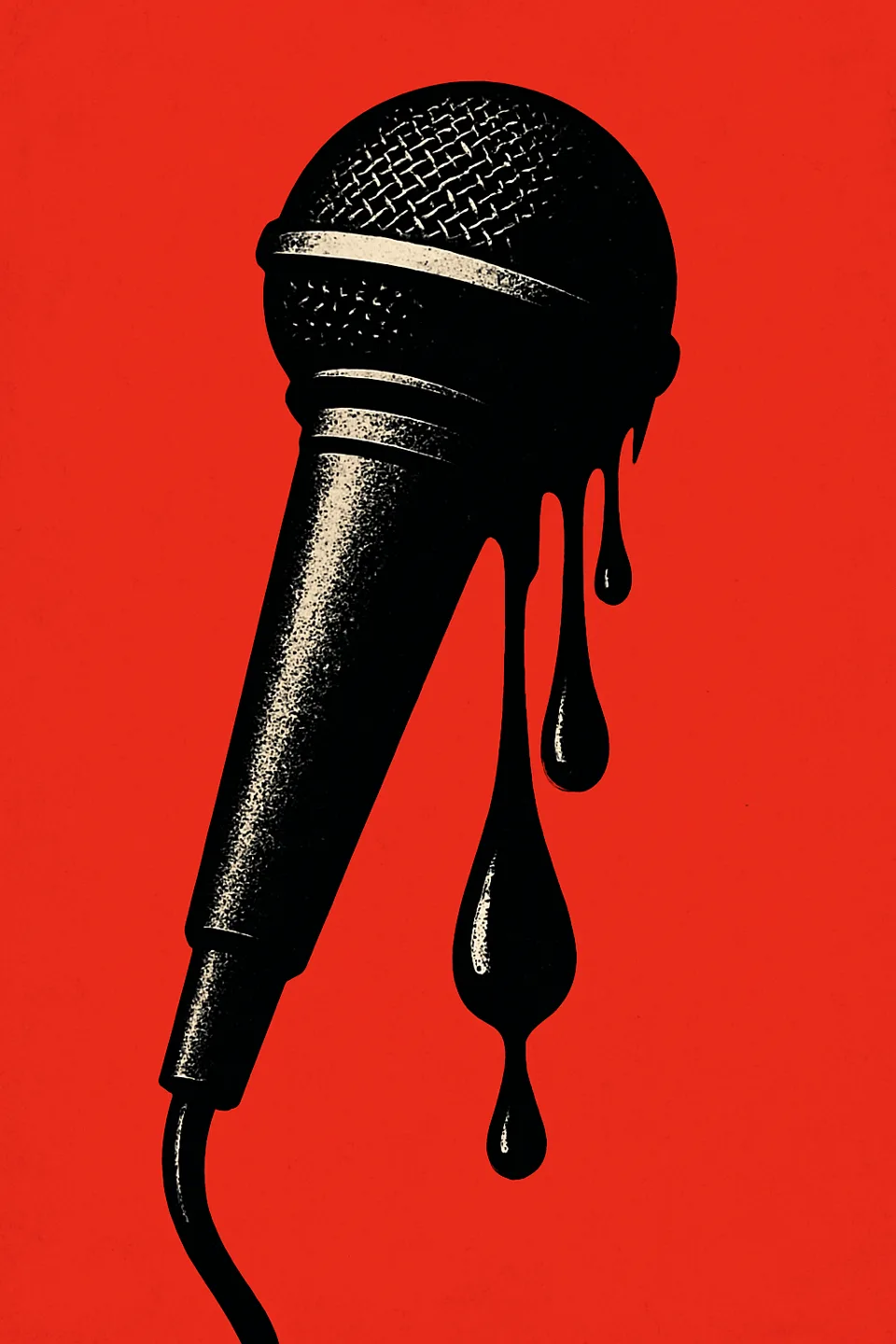
It’s funny how easy money can buy morality. Not funny in the laugh-out-loud sense, but funny in the bleak absurdist sense—the kind of humor you only arrive at once you realize the joke is on all of us. Watching the Riyadh comedy festival unfold has felt like a mirror held up to the industry, and what it reflects isn’t flattering.
On podcasts and in specials, comedians love to rail about what’s right and wrong, to ridicule the weak-kneed politicians and the morally compromised corporations. They build their brands on being the truth-tellers, the ones who “say what everyone else is afraid to say.” But when the brass tacks hit—when the offer comes, thick with cash and caked with blood—it turns out most people don’t resist. They go. They take the gig. They justify it later. The revolution, it turns out, pays by direct deposit.
Not all of them, though. Shane Gillis and Stavros Halkias, both comics I deeply respect, didn’t take the bait. They not only said no but had the nerve to laugh at those who folded, proving that sometimes the funniest punchline is just pointing out who sold theirs. Their refusal shines brighter because of how rare it was.
The rest, though—the dozen or so who went along—showed just how fragile all those grand pronouncements about morality really are. It’s not just a paycheck; it’s a purchase of silence. Or worse, it’s the purchase of laughter. When your art form is truth-telling and you accept hush money, you’re not a comedian anymore—you’re customer service.
This is what capitalism does best. It eats away at the fabric of decency not by attacking it outright but by offering it a price. Morality becomes a negotiable luxury, something you can afford only until someone waves enough cash in your face. And when the market is global and the wallets are bottomless, the collapse is nearly inevitable. This isn’t just about comedy—it’s the story of every art form that once spoke truth to power, only to find itself performing for power instead.
Comedians are supposed to stand apart from this—they’re supposed to be the ones who puncture the balloon, not the ones inflating it with their own breath. But that’s the absurdity here: the very people who make a living mocking hypocrisy revealed their own the moment the offer came. It isn’t tragedy; it’s comedy of the most cosmic sort. The joke is that the joke-tellers were always vulnerable to the same punchline.
Still, I can’t help but feel the ache of disappointment. Not because I expect purity in an impure system, but because comedy is one of the last refuges where truth has a chance to slip past our defenses. To watch that space fold under the weight of capital is to watch the stage lights dim—not for timing, but for profit margins.
A comedy festival bankrolled by oil wealth, staged in a country where dissent is a crime, becomes the perfect loyalty test. And the result? Laughter for sale. Jokes performed not as resistance, but as decoration.
This, perhaps, is the truest joke of all: that capitalism doesn’t just buy silence, it buys the very laughter that was meant to unmask it. And in the end, the audience isn’t only the Saudis. The audience is us, sitting at home, watching the punchline collapse into itself and realizing that morality, too, has a market price. The truth-tellers sold their truths—and we laughed anyway.