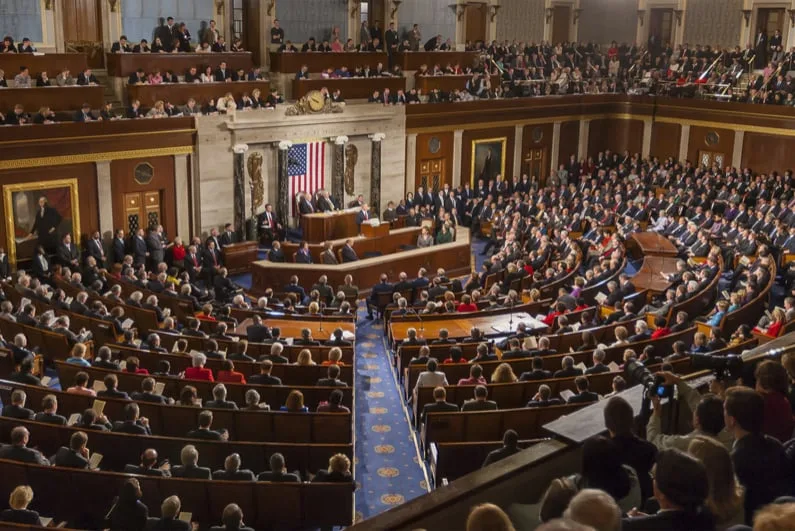
Lately, I’ve found myself watching more congressional hearings and interviews with industry leaders, and I keep coming back to the same reaction. Not anger. Not even frustration. Just… bewilderment.
It’s hard to believe what I’m seeing is real. People—intelligent, accomplished, highly compensated adults—standing in front of cameras and confidently saying things that are obviously untrue. Not clever spin. Not strategic ambiguity. Just statements that collapse under even the lightest pressure of reality. The kind of thing where everyone watching knows it’s false, including the person saying it, and yet the sentence marches forward anyway like it’s got a pension to protect.
What’s more unsettling is how easily it happens. Beliefs bend. Positions shift. Entire moral frameworks seem to liquefy the moment power enters the room. There’s no dramatic tension, no visible internal struggle. Just a smooth, almost practiced compliance. The theater isn’t even trying to convince you anymore—it’s just going through the motions, and everyone has agreed to pretend that counts as substance.
For a while, I tried to explain it the obvious way: money, status, power. People want to keep their jobs. They want influence. They want proximity to the center of things. That explanation works on paper, but the more I watch, the less it holds up in practice. Because from where I stand, the trade doesn’t make sense.
You’re giving up something fundamental—your alignment with what you know to be true—in exchange for what amounts to a slightly better seat at the table. A few more dollars. A few more people to boss around. A slightly shinier badge on the same lanyard. Maybe it’s just me, but that feels like trading oxygen for applause.
And I don’t think I could do it. Not even close.
A god could descend from the sky, glowing and authoritative, and tell me to go against my moral compass, and the answer would still be the same: no. Full-throated, enthusiastic, possibly career-ending no. If anything, the more pressure applied, the more certain the response becomes. That’s not a hypothetical stance—it’s a pattern. I’ve walked away from jobs, stepped in when someone was being treated as “lesser than,” and shut things down when something felt off. It has cost me things. I would not change a single one of those moments.
Which is why, when I watch these public performances, I’m not tempted. I’m not conflicted. I’m just trying to understand how someone doesn’t feel that internal line.
The answer, as uncomfortable as it is, seems to be that not everyone experiences that line the same way. For some, integrity isn’t the highest value under pressure. Stability is. Belonging is. Survival within the system is. When those are on the line, the equation shifts. It stops being “sell your soul for power” and becomes “adapt or lose your place.” And once that shift happens, the first compromise makes the second easier, the second makes the third invisible, and somewhere down the line you’re defending something you would have openly rejected a decade earlier.
At one point in my career, when I was serving as an Assistant Dean of Admissions, I asked my staff to write down what animal I reminded them of. It was meant to be lighthearted, the kind of exercise that fills ten minutes and produces a few laughs. Every single one of them wrote the same thing: Momma Bear.
At the time, I took it as a compliment and moved on. But it stuck with me, because it named something I hadn’t fully articulated. If something went wrong, I stepped in. If someone was being treated unfairly, I intervened. If the situation required it, I was willing to make things uncomfortable in order to make them right. Not because it was strategic, but because it felt necessary.
That instinct hasn’t gone anywhere, and it reframes what I’m seeing now. In those hearings, I’m watching people protect systems—positions, hierarchies, structures of power. My reflex has always been the opposite. Protect the person being affected by the system, not the system itself. From that perspective, everything looks inverted. Why defend the machine when it’s clearly chewing someone up?
But for many, the system is the source of safety. It provides identity, stability, and a sense of place. Protecting it feels like protecting everything that matters. And if that’s your frame, bending doesn’t feel like a failure. It feels like responsibility. It feels like adulthood. It feels like playing the game correctly.
I don’t share that frame, and I’m not sure I ever will. For me, the cost of crossing that internal line has always felt higher than whatever I might gain on the other side. Losing a job, missing an opportunity, being on the outside looking in—those things are survivable. Violating something fundamental in myself isn’t.
Maybe that makes me rigid. Maybe it makes me difficult in certain environments. Or maybe it just means I’m playing a different game with different rules and a very small tolerance for bullshit.
Either way, I still can’t quite wrap my head around the alternative. Some people bend to stay in the system. Others stand and accept the cost. Between the two, I know which one lets me sleep at night—and more importantly, which one lets me look at myself in the mirror without needing a script.