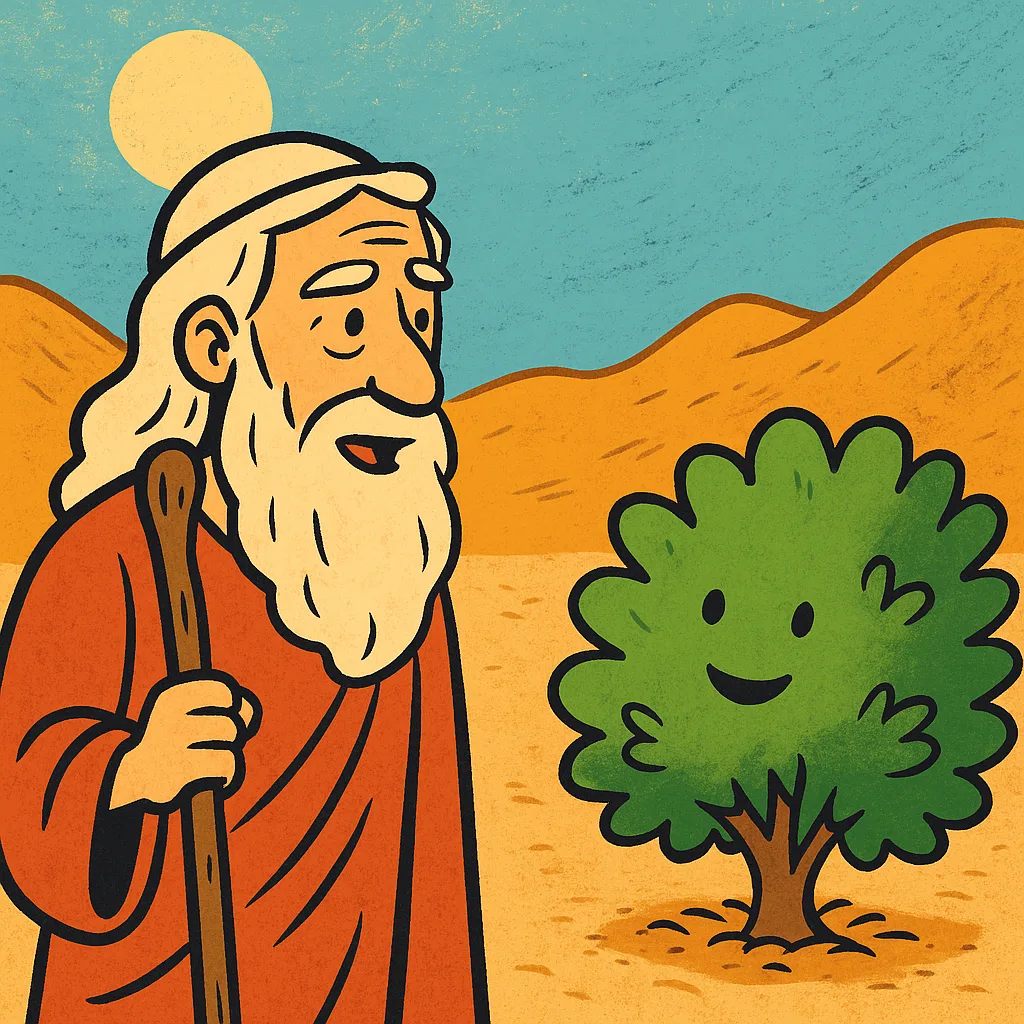
Throughout history, humanity has claimed glimpses of the divine—visions of gods, voices from the heavens, burning bushes, and messengers in the sky. These extraordinary experiences shaped civilizations, inspired religions, and transformed individual lives. But what if these revelations were less about the gods themselves, and more about the beautifully complex—and often unpredictable—machinery of the human mind?
As an experienced psychonaut and a lifelong skeptic, I can’t help but peer at these historical accounts through a different lens: one where altered states of consciousness—whether triggered by substances, mental health conditions, or environmental stressors—blur the lines between the extraordinary and the ordinary. In this view, the divine isn’t descending from on high; it’s bubbling up from within.
The Mind as a Portal
Take Moses, for instance. The biblical account of the burning bush describes an intense, transformative encounter: a voice from a flaming shrub commanding him to lead his people. Traditionalists call it a divine revelation. But what if it was something simpler—and no less powerful—a reaction to ergot-contaminated grain, a desert plant exuding psychoactive smoke, or a psychological break triggered by stress and isolation? The voice of God, refracted through the lens of a mind on fire.
Or consider Joan of Arc, who heard voices guiding her to liberate France. Was she chosen by God, or was she riding the waves of schizophrenia, bipolar mania, or temporal lobe epilepsy—her own mind providing both the battleground and the message?
Even Paul’s transformative vision on the road to Damascus could be recast as a psychological or neurological event—an ecstatic seizure, a sunstroke, or a moment of altered consciousness catalyzed by intense guilt or wonder.
In each case, the line between the divine and the psychological blurs. What one culture deems revelation, another might diagnose as a medical condition—or celebrate as a psychedelic journey.
Psychedelics and the Divine
Anthropologists have long noted that cultures worldwide have used psychoactive plants to access the sacred: Ayahuasca in the Amazon, peyote in North America, soma in ancient India. The neural fireworks triggered by these substances can produce visions, voices, and encounters with entities—experiences that, in the right cultural context, become revelations.
Imagine a medieval mystic accidentally consuming bread contaminated with ergot. LSD-like hallucinations might bloom—visions of celestial battles, divine armies, angels or demons—each interpreted through the language of the times. Even the infamous 1561 Nuremberg sky event—rods, spheres, and fiery crosses—could have been a product of collective hallucination, amplified by religious expectation and mass suggestion.
The Cultural Mirror
Through my Mirror Theory, I see these experiences not as illusions, but as reflections: the mind generating visions and then interpreting them through the cultural, spiritual, and psychological frameworks at hand. The burning bush becomes God’s voice because Moses’ world was steeped in the language of divine intervention. Joan of Arc’s voices aligned perfectly with a culture ready for a savior.
If Moses had been born today, might he have found himself in a psychiatric ward or on a guided psychedelic journey instead of a mountain with tablets? If Joan of Arc had been born in the Amazon, might she have trained as a shaman rather than a warrior-saint?
Forcing Theory and the Call to Expand
Through the lens of Forcing Theory, these revelations become engines of consciousness expansion—forcing events that push the mind beyond its familiar thresholds. Whether triggered by trauma, stress, ergot, or ayahuasca, these experiences rupture the default mode of being and invite new frameworks, insights, or delusions to emerge.
In that sense, the divine is real—not because it descends from the clouds, but because it rises from within us. It’s the part of the mind that refuses to remain ordinary. The extraordinary is simply the ordinary, magnified by the right conditions.
Closing Reflection
Seeing the divine through this psychedelic and psychological lens doesn’t diminish the power of these experiences—it roots them in the raw, wondrous machinery of being human. It invites us to see prophets and mystics not as chosen by the gods, but as mirrors of our own capacity for transformation. It reminds us that the line between the divine and the mind is as thin—and as infinitely vast—as the space between one thought and the next.
And perhaps that’s the greatest revelation of all.