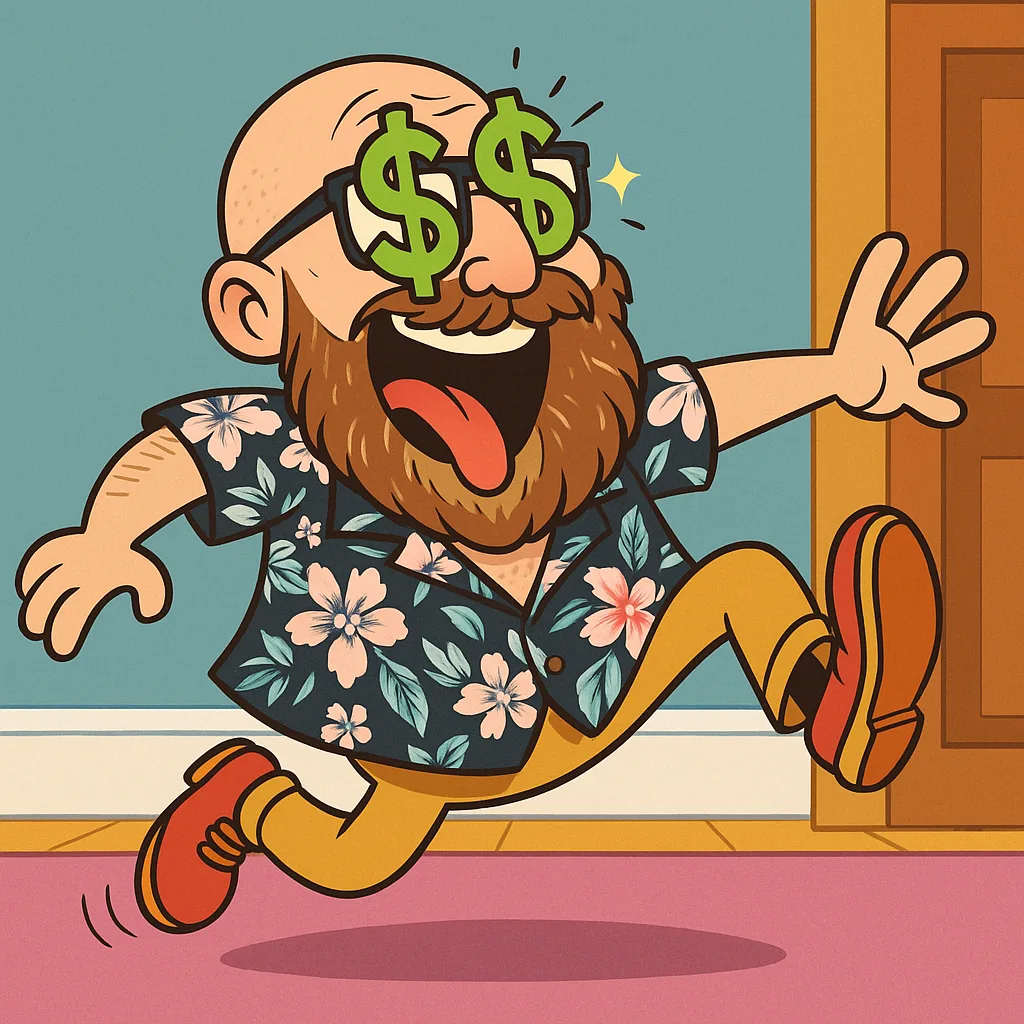
The question was simple enough: “If I paid you a million dollars to write or teach the one thing that truly inspires you, what would that be?”
I answered just as simply: “How to not be driven by money.”
She replied, asking me to write on it. And in that moment, my mind said: say no more.
But the truth is, it took me forty years to get here.
I didn’t stumble into this perspective by accident. I ran businesses. I chased sales. I worked late, strategized harder, built and rebuilt, and for a long time I believed the point of it all was growth—financial growth, professional growth, the kind you can measure with numbers and bank accounts.
Materialism was my operating system. Not out of malice, not even out of greed, but out of necessity at first. I wanted to provide, to prove, to secure a life for myself and my family. And for a while, money seemed to be the answer. It solved problems, opened doors, soothed fears. Until it didn’t.
Because the chase never ends. Every milestone I hit dissolved as soon as I touched it. Every “enough” turned into “just a little more.” The line kept moving, and I kept running. It took decades before I realized the race itself was the trap.
Say no more.
Now, when I speak about the most valuable things being free, I don’t mean it as a dismissive slogan. I know well that financial stress can strangle wonder, that it’s easier to breathe deeply at dawn when you’re not worried about next month’s rent. Security matters—it always will. But beyond security, the surplus doesn’t nourish. It distracts. It demands more of you than it gives.
And the things that truly last—the ones that actually transform you—were never for sale. To sit in silence while the world sleeps and feel your lungs fill with air. To watch your child laugh uncontrollably at something small. To read until your mind dissolves into new patterns of thought. To be present enough to feel awe. These things are free, but they’re not cheap. They require attention, and attention is something money often steals.
The absurdist in me laughs at it: if life has no inherent meaning, then neither does money. And yet, we grant it meaning. We elevate it to the role of god, savior, judge. We shape our lives around it as though its digits carry eternal weight. But they don’t. They’re placeholders, markers in a game we keep playing even after we’ve forgotten the rules.
I don’t say this from a mountaintop, untouched by need. I say it from inside the mess, after decades of building and chasing and burning out. I say it as someone who learned the hard way that the more you try to own, the more it owns you.
So when someone asks me how not to be driven by money, my bafflement isn’t arrogance—it’s the recognition that the answer is too simple and too costly at the same time. You stop letting money define you. You stop mistaking numbers for meaning. You remember what it cannot touch: breath, presence, love, knowledge. You hold onto those, because they’re yours whether you’re rich or poor.
Everything else is temporary. Everything else is noise.
Say no more.
This Substack is reader-supported. To receive new posts and support my work, consider becoming a free or paid subscriber.