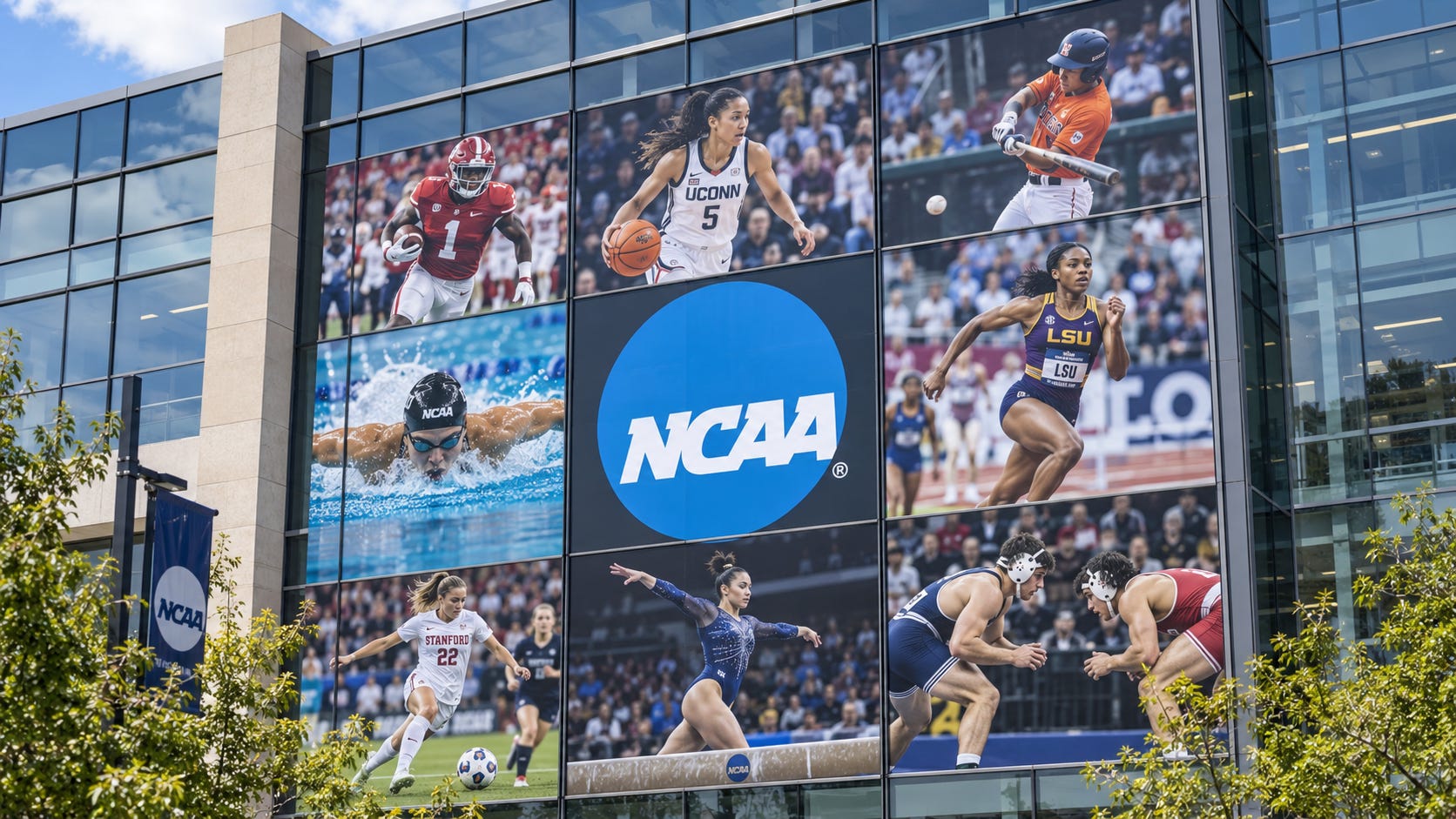
The recent Senate passage of the Protect College Sports Act brought a familiar American absurdity lumbering back into the room wearing a blazer, carrying a binder, and pretending it has always cared deeply about fairness.
The bill passed the Senate 77–22 and now moves to the House. Its supporters describe it as a stabilizing measure for college athletics, and the bill does include real athlete-facing provisions: a federal NIL right, scholarship protections, medical coverage requirements, limits on agent fees, medical-cost coverage for several years after eligibility, and safeguards for women’s and Olympic sports. So, to be clear, this is not a cartoonishly evil piece of legislation twirling a little villain mustache in the corner. There are parts of it that matter. Athletes should not lose scholarships because they get hurt. They should have medical coverage. They should be allowed to profit from their own name, image, and likeness without needing a law degree, a compliance officer, and a blood sacrifice to the ghost of Knute Rockne.
But the larger farce is still there, sweating under the mascot head.
For decades, college athletics has operated as a massive entertainment economy while insisting, with the straightest possible face, that it is mostly about school spirit and character development. Television networks made money. Conferences made money. Coaches made money. Athletic departments made enough money to build facilities that look like the lobby of a venture-backed wellness cult. All of that was treated as business, competition, ambition, and institutional excellence. It was the market. It was America doing America things.
Then the athletes — the actual people whose bodies create the product — began asking a dangerous little question: What am I worth?
That is when the priests of the free market began clutching their pearls. Suddenly, too much competition was bad. Suddenly, the invisible hand needed adult supervision. Suddenly, the sacred market became a feral raccoon loose in the athletic department, and somebody had to catch it before the players figured out how capitalism works.
That is the joke. Or it would be the joke, if it were not so maddening.
We worship “the market” until the wrong people start winning inside it.
College sports did not become corrupted when athletes started getting paid. The money was already there. It was in the media deals, the conference realignment, the coaching salaries, the sponsorships, the donor suites, the apparel contracts, the bowl games, and the endless parade of administrators explaining why none of this should technically count as professional sports.
The problem was never money. The problem was money reaching the labor.
That is the part we are apparently supposed to pretend not to notice. The system was perfectly comfortable with capitalism as long as the value flowed upward, outward, and around the athlete. But once the person on the field began claiming even a portion of the value generated by their own talent, suddenly everyone rediscovered restraint, tradition, amateurism, and the fragile moral ecosystem of Saturday football.
They don’t oppose the market. They oppose the market discovering the true value of labor they had grown accustomed to receiving at a discount.
And that discount has never been abstract. NBER research on big-time college athletics found that football and basketball players received less than 7 percent of the revenue they generated, while much of the remaining value flowed toward coaches, administrators, facilities, and non-revenue sports. The same research found that Black athletes made up nearly half of football and basketball players in the studied Power Five programs, but only 11 percent of athletes in money-losing sports; it also found that revenue-sport athletes came from high schools with lower median family incomes than athletes in other sports.
That is where the racial dimension enters — not necessarily as a cartoon villain, not always as explicit intent, but as structure. A machine does not have to shout a slur to produce racialized outcomes. Sometimes it only needs a spreadsheet, a tradition, a legal category, and a very sincere committee meeting.
The old arrangement asked disproportionately Black athletes, often from less wealthy backgrounds, to generate enormous value for institutions that then redistributed much of that value elsewhere. Some of that redistribution supported worthy things. Women’s sports matter. Olympic sports matter. Non-revenue athletes matter. The question is not whether those programs deserve support. Of course they do. The question is why their survival so often seems to require suppressing the bargaining power of the athletes generating the most revenue.
That is the strange moral accounting at the center of the whole thing. The broader ecosystem must be protected, we are told, but the burden of that protection keeps landing on the athletes whose labor made the ecosystem possible. It rarely seems to land with the same weight on television contracts, conference structures, coaching salaries, administrative growth, or the arms race of facilities built to impress seventeen-year-olds and their parents during recruiting visits. Somehow, when the system gets expensive, the solution is to make sure the players do not get too expensive.
Supporters of the bill argue that college sports are under real pressure, especially women’s and Olympic sports. AP has reported that backers see the legislation as a way to preserve smaller programs and the Olympic pipeline, including requirements tied to maintaining scholarship and roster levels. That concern should not be waved away. The college sports ecosystem is tangled, weird, and financially unstable in ways that do not fit neatly on a bumper sticker.
But still, the mirror is sitting right there, and the image in it is ugly.
We have built a culture that treats markets as sacred when they enrich institutions, but reckless when they empower workers. We cheer competition when it benefits owners, executives, administrators, brands, conferences, and media partners. We call it chaos when the people doing the work begin competing for their own value.
So no, this is not really a debate about whether money belongs in college sports. Money has been there the whole time. This is a debate about who is allowed to touch it without being accused of ruining everything.
And that is the farce: a billion-dollar machine wrapped in the language of tradition, education, and protection, suddenly terrified that the labor force might look around and realize it has been the product all along.
The market was holy until the workers found the altar. Now everyone wants rules.