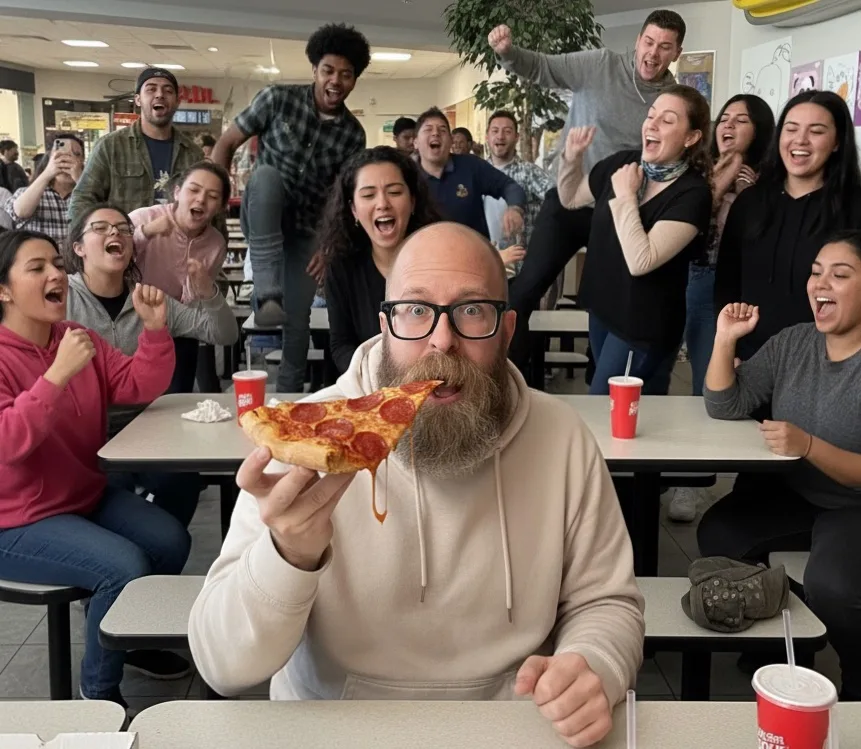
There I was, sitting in the dim hum of the food court, basking in the fluorescent afterglow of a perfectly mediocre Tuesday. Before me: a Sbarro slice, wide as a yoga mat and glistening with the kind of industrial cheese that promises both transcendence and regret. Each bite was a small religious experience—grease and gluten aligning in sacred geometry. I was halfway to taste nirvana when the air changed. Not metaphorically. It shifted. Like the prelude in a horror film when the violins begin to whisper. I looked up just in time to see a man—no, an organism of unearned confidence—clap twice above his head and launch into what I can only describe as a choreographed ambush. Then another joined him. Then another. Within seconds, I was surrounded by a flash mob. In a mall. At noon.
Now, I don’t know if you’ve ever tried to maintain inner peace while a dozen smiling strangers leap into your periphery like caffeinated show ponies, but let me tell you—it’s a very specific kind of hell. My body froze, mid-bite, like a deer caught in headlights, except the headlights were human and they were singing Don’t Stop Believin’. I didn’t want to move because I didn’t know the rules. Do I clap? Do I look away? Do I pretend to be invisible? My pizza wasn’t finished, and it doesn’t travel well. Do I abandon it? What if they see me leaving and incorporate me into the performance? I could see it: the choreographer, sensing fear, making me the emotional centerpiece—“You! The man with the pizza! You are the symbol of longing!” No. Absolutely not. I would rather perish.
The whole thing lasted maybe three minutes, but in that time, I experienced every stage of the Kubler-Ross grief cycle. Denial (this can’t be happening). Anger (I paid good money to chew in peace). Bargaining (if I stay perfectly still, maybe they’ll think I’m a mannequin). Depression (they’re doing jazz hands). Acceptance (death is fine). When the song ended and they bowed to the crowd—as if we’d asked for this—I realized what had truly transpired: a fundamental violation of the social contract.
I hadn’t consented.
Not in the big moral way we usually talk about consent, but in the smaller, everyday kind that makes civilization possible. Consent is the invisible glue that keeps society from becoming a mosh pit of unwanted energy. It’s what lets me exist in a shared space without becoming an involuntary extra in your emotional outburst. It’s why I don’t jump into your yoga class and start screaming about the moon. Consent is what separates art from assault, performance from intrusion, connection from kidnapping.
Even friends do it. They rename you without permission—“Z-Dawg,” “Daddy Z,” “Zaddy Lightning.” No. I didn’t sign the nickname consent form. I didn’t tick the box that says “I agree to be called a gender-neutral breakfast item in public.” You think it’s affection; I feel like I’ve been rebranded against my will. Same with surprise parties. You yell “Surprise!” and my soul briefly leaves my body. I’m not startled because I’m ungrateful—I’m startled because my nervous system is built for quiet corners and controlled lighting.
What we’re talking about here is relational trespassing: the act of pulling someone into your experience without their agreement. The flash mobber thinks they’re spreading joy, but what they’re really doing is holding you hostage with enthusiasm. It’s joy without consent. And joy without consent is just performance terrorism.
And yes, I know how ridiculous that sounds. I can hear it even as I say it. I’m not joyless; I’m just a believer in emotional autonomy. If you want to express yourself, great. Express the hell out of yourself. But don’t weaponize surprise. Don’t turn the food court into a theater of non-consensual bliss.
We could issue Flash Mob Permits—or better yet, everyone carries cards: green means “yes, I’m down for public whimsy,” red means “please let me chew.” It’s simple. It’s democratic. It’s all I ask.
Because I’ve been on stages. I’ve sung, acted, clowned, made a spectacle of myself willingly and often. I love when people express the wildness in them. But that’s the key word: willingly. Consent is what makes shared humanity bearable. Without it, even beauty becomes intrusion.
And yet, as absurd as it all is, there’s a strange cosmic lesson here too. When people from our past—or strangers in the mall—force their energy onto us, it becomes a kind of distorted reflection. A funhouse mirror. Maybe these moments are absurd mirrors reminding us who we are by showing us what we don’t want to be. The flash mob is a mirror of uninvited joy; the latex guy in aisle four is a mirror of unapologetic freedom. Each one is, in its own way, an invitation to clarity—albeit one that smells faintly of Axe body spray and mozzarella.
So yes, I’ll still grumble when I see a group of adults practicing a dance routine outside Panera. I’ll still whisper “I do not consent” when a stranger calls me champ. But I’ll also laugh, because this is the absurd theatre we live in. We’re all trying to express, to be seen, to feel real in a world that keeps remixing itself without asking. And maybe the best I can do is sit, finish my slice, and hope the next flash mob at least hands out programs.