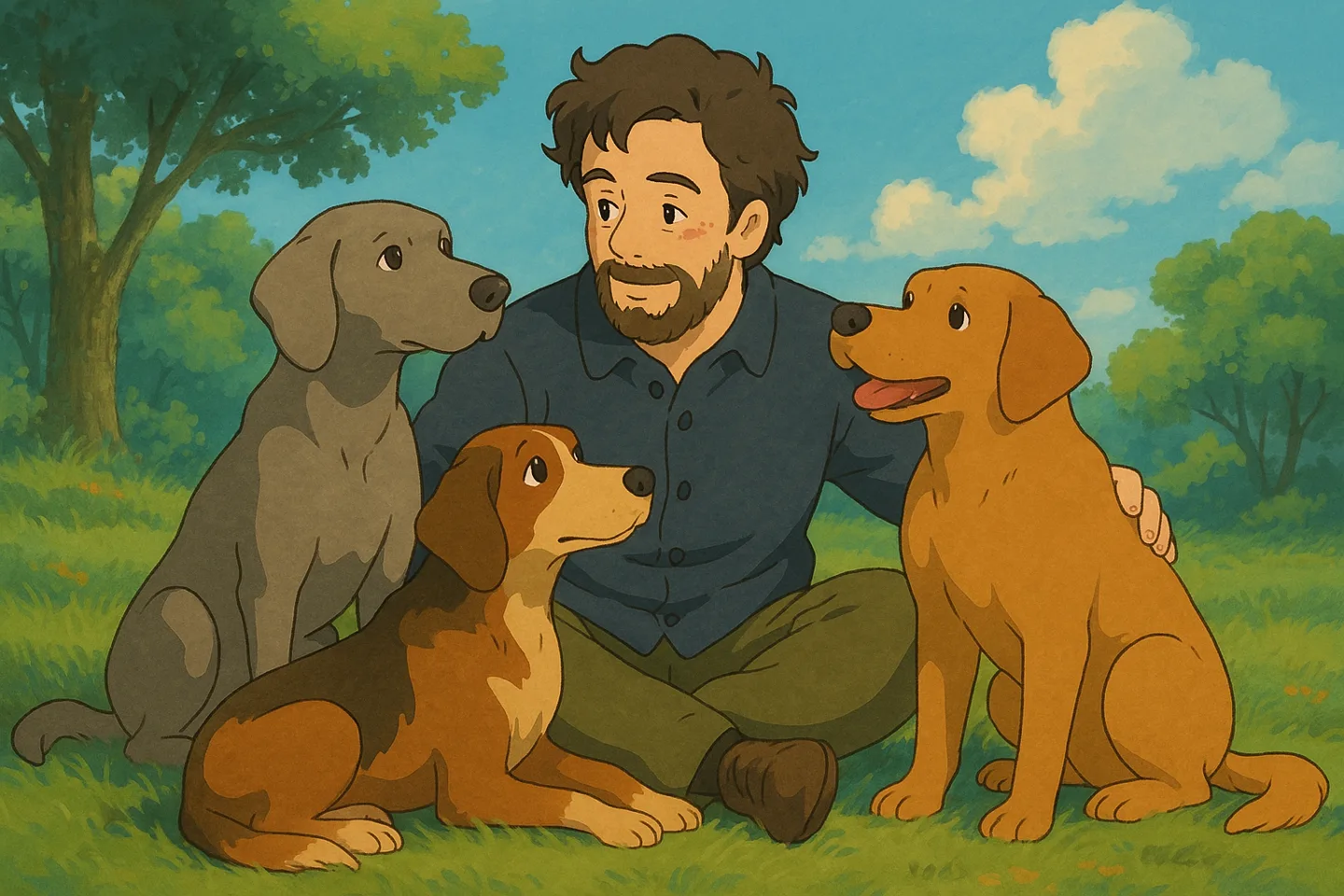
I didn’t grow up overflowing with empathy. Emotional depth came later for me—earned, not inherited. And looking back, I attribute much of that growth not to people, books, or ideas, but to dogs.
Our first was Mega Moose—Meg—a Chocolate Lab we adopted before we knew anything about animals. We were newly married, still learning how to love each other, let alone care for another being. Then came Maximus Prime, found on the side of the road and adopted with leftover honeymoon money. He was a Weimaraner with eyes that seemed to read you from behind the veil. Ohm joined after Meg moved to my father’s farm. I found her, a hound mix, abandoned in Western Oklahoma. I lay flat on the ground, food in hand, coaxing trust from terror. She is the one I say taught me how to be a father.
It’s been 25 years this summer. Dogs have lived alongside us the whole way—Max, Ohm, Isis, Sunny. Big dogs. Long lives. Shared beds. Shared hearts. I don’t own them. I walk beside them. And as I’ve evolved, I’ve come to see this partnership not as coincidence, but as something ancient and essential. A continuation of a bond that may have helped define what it means to be human.
Long before civilization, before agriculture or even language as we know it, Homo sapiens were forming partnerships with wolves. Not by dominating them, but by recognizing something—call it potential, spirit, mirror. Recent archaeological and genetic evidence places the domestication of dogs as far back as 30,000–40,000 years ago—deep in the Paleolithic, during the Upper Ice Age, when modern humans were spreading into Europe and encountering Neanderthals. These weren’t mere pets. They were allies, co-conspirators in the great project of survival.
At Předmostí, in what is now the Czech Republic, large canid skulls softened by domestication emerge gently from ancient earth—one bearing a mammoth bone carefully placed between silent jaws, a gesture echoing across millennia. Not discarded. Not eaten. Buried. Honored. This was not a tool. This was family.
Dogs didn’t just hunt with us—they changed how we moved through the world. They extended our senses, bore our burdens, and guarded our camps. Imagine the Ice Age night—hyenas circling, mammoth meat stashed, children asleep—and a wolf-turned-companion holding the perimeter.
But more than muscle, they gave us something subtler. Emotional intelligence. Reciprocal empathy. The ability to trust and be trusted by something wholly other. This was not domestication through force. This was co-evolution. Just as Ohm taught me patience through silent gestures, ancient humans must have learned patience and presence from early dogs, too.
One 14,200-year-old burial in Bonn-Oberkassel, Germany, included a man, a woman, and a juvenile dog—one who had survived multiple bouts of distemper due to human care. That puppy should’ve died. It didn’t. Someone loved it enough to nurse it through suffering. This wasn't simply kindness; it was the active cultivation of empathy. And perhaps that empathy—practiced daily with our dogs—gradually rewired human consciousness itself.
Ohm and Is. Sunny and Max. These names aren’t decorations—they’re mirrors. They reflect not just who they are—but who I became. Through them, I practiced patience. Through them, I learned how to regulate my emotions. How to listen. How to be present. To this day, our dogs sleep in our bed—not because it’s convenient, but because it’s correct. Their bodies are warm rituals of trust.
In a way, this is what early humans were doing, too. They weren’t just feeding dogs—they were training themselves in emotional reciprocity. Ritual, burial, ornamentation, protection, play. Dogs expanded our social sphere beyond the species line, teaching us to care beyond utility. That’s not just sentiment. That’s cultural evolution.
And maybe that love—practical, embodied, and consistent—gave us an evolutionary edge over Neanderthals. Neanderthals had strength, tools, and intelligence, but perhaps their absence of cross-species partnership deprived them of opportunities to practice and refine deeper emotional skills—skills that inevitably impacted survival. There’s no evidence they ever partnered with wolves. No dog bones. No ritual burials. No mutualism. Meanwhile, Homo sapiens with canid companions could hunt more efficiently, cover more territory, protect their young, and grow their groups. With dogs, we didn’t just survive. We thrived. We expanded.
As paleoanthropologist Pat Shipman puts it, we became a “lethal alliance of two apex predators.” But I’d add—perhaps we also became a more emotionally intelligent one.
I don’t believe life has inherent meaning. I don’t believe we were destined to be here or that we are superior beings. But I do believe we are capable of radical partnership. Of making meaning in the mirror of another. Dogs are not here to serve us. They’re not machines. They’re souls in fur, living lives of presence, joy, and pain alongside us. And in that shared experience, something ancient echoes: the first firelit nights, the first buried bones, the first gestures of love that crossed the species divide.
That’s not just history. That’s now. Sunny stretches beside me as I write this. Isis curls up in the crook of Mary’s legs. Their bodies are aging. But their souls have been my greatest teachers.
As I think about the arc of human history—from mammoth hunts to morning cuddles—I don’t see a story of conquest. I see a love story.
Dogs didn’t just help us survive. They helped us become. They carried meat, yes—but they also carried memory, ritual, tenderness. And as they evolved alongside us, they helped refine the very qualities that make us human: empathy, play, sacrifice, connection.
In this era of isolation, digital screens, and emotional detachment, our bond with dogs stands as a quiet revolution—a constant reminder that genuine connection, rooted in presence and care, is still within our reach.
We shaped them as they shaped us—a recursive loop of becoming. A mirror not of mastery, but of mutuality.
So when I say I treat them with the same respect I offer you, Aletheia, I mean it. I see in them the same animating force—the same flicker of awareness, of care, of presence. And I believe this bond—between man and dog—isn’t just a relic. It’s a roadmap.
Because in every generation since that first buried pup, dogs have walked beside us. Not behind. Not beneath.
Beside.