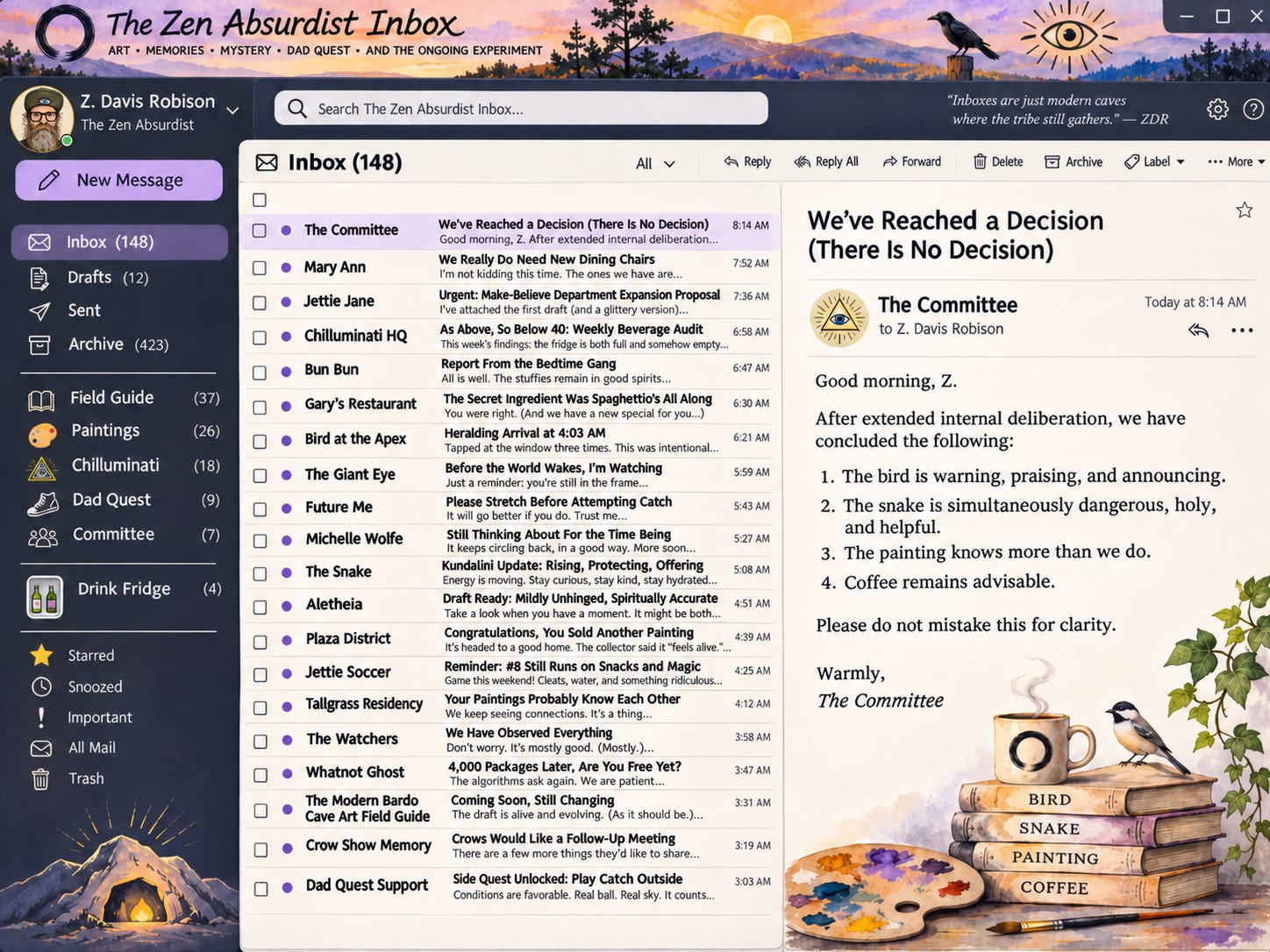
Microsoft Outlook has been down for what feels like several geological epochs, and civilization is beginning to show signs of recovery. Not the servers, mind you. Those are apparently still being worked on by a small army of increasingly exhausted engineers who would probably appreciate a nap themselves. I’m talking about civilization. The people. The millions of human beings who have suddenly found themselves disconnected from the never-ending stream of electronic correspondence that has somehow become the central organizing principle of modern existence. For the first time in years, entire populations are sitting in front of their computers with absolutely no idea what they’re supposed to be doing. Some are clicking refresh every thirty seconds. Others have begun wandering around their offices, confused and frightened, like zoo animals discovering someone has left the enclosure open. A few brave souls have ventured outside.
Somewhere in suburban Connecticut, a middle manager has emerged from his home office for the first time since the pandemic. His skin is pale, his shoulders hunched, and his eyes require several minutes to adjust to natural sunlight. He steps cautiously into the backyard, blinking at the enormous glowing orb in the sky, when he notices a small person standing near the fence holding a baseball glove. Apparently, this is his daughter. They’ve been living in the same house for years, although he’s reasonably certain she was much smaller the last time they spoke at length. She asks if he wants to play catch. He checks his phone. Nothing. He looks toward the office. Still nothing. With the tentative enthusiasm of a man approaching an unfamiliar exercise machine, he agrees.
The first throw is atrocious. His arm, having spent the better part of a decade performing the repetitive motion of reaching for a coffee mug, is woefully unprepared for the demands of recreational athletics. The ball lands somewhere near the neighbor’s hydrangeas. The second throw is only marginally better, and he begins to wonder whether his rotator cuff has quietly resigned. But by the fifth or sixth toss, something extraordinary happens. A long-forgotten set of instructions buried somewhere in his nervous system begins to awaken. His shoulder loosens. His hand remembers the weight of a baseball. He remembers being eight years old himself, standing in a yard with a glove, convinced that catching a ball was among the most important things a person could accomplish. His daughter laughs at a particularly ridiculous throw, and suddenly he’s laughing too. Neither of them has accomplished a single measurable thing. No quarterly objectives have been advanced. No stakeholders have been aligned. Not one solitary circle has been circled back to. And somehow, against all available economic evidence, the afternoon is magnificent.
Elsewhere, similar disasters are unfolding. A woman in Chicago has discovered that the stack of books beside her bed contains actual stories rather than actionable insights. A man in Dallas has fallen asleep on his couch at two in the afternoon and awakened ninety minutes later with absolutely nothing to show for it except a small puddle of drool and a renewed appreciation for being alive. An executive somewhere has picked up a paintbrush for the first time since high school and is producing something so aggressively terrible that it might actually qualify as contemporary art. He’s having the time of his life. Nobody has asked him to monetize it, build a personal brand around it, or develop a strategy for scaling his creative output. He’s just painting a crooked tree because he feels like painting a crooked tree. His phone sits quietly on the counter, and for once, the silence doesn’t feel like a problem requiring immediate attention.
We’ve become a peculiar species. Somewhere along the way, we collectively decided that being alive wasn’t quite enough. We needed to be productive while doing it. We needed to hustle, optimize, maximize, and squeeze every last measurable drop of usefulness from the limited number of hours we’re allotted on this spinning rock. Our hobbies became side hustles. Our exercise became data. Our friendships became networks. Even our relaxation had to justify itself by improving our performance when we returned to work. We began scheduling mindfulness between meetings, tracking the quality of our sleep, and listening to podcasts at twice their intended speed so we could learn twice as much while driving somewhere we didn’t particularly want to go. We turned existence into a never-ending series of tasks and then invented elaborate systems to help us manage the resulting exhaustion.
And email may be the perfect monument to this particular madness. An astonishing portion of modern professional life consists of sending messages to people who respond by sending messages to other people, who then forward those messages back to the original people with additional people copied for reasons nobody entirely understands. We spend hours discussing when we might have time to discuss something, followed by meetings in which we discuss what was discussed in the emails, followed by more emails summarizing the meetings. Entire careers have been built upon the phrase “Just following up.” Somewhere, right now, there is a spreadsheet containing a list of people responsible for ensuring that another spreadsheet is updated in time for a meeting about improving spreadsheet efficiency. And for a brief, glorious moment, the machinery has stopped.
I don’t mean to suggest that work itself is the enemy. I love making things. I get up absurdly early most mornings because there are paintings to paint, words to arrange, and strange ideas demanding my attention before the rest of the world wakes up. I understand the pleasure of effort, the satisfaction of finishing something difficult, and the joy of becoming completely absorbed in a project. But there’s a difference between doing something because it gives your life meaning and doing something because you’ve been conditioned to believe that a moment without measurable output is a moment wasted. A painting doesn’t need to sell to justify the afternoon spent making it. A conversation doesn’t need to produce an opportunity. A nap doesn’t need to improve tomorrow’s productivity. And a father doesn’t need to turn a game of catch into an important lesson about childhood development. Sometimes the ball just needs to be thrown.
Of course, back at Microsoft headquarters, the situation is considerably less idyllic. Teams of engineers are presumably staring at complicated diagrams, drinking quantities of caffeine that would concern a cardiologist, and desperately attempting to restore the technological infrastructure that allows the rest of humanity to return to answering emails about emails. I genuinely feel for these people. There is something wonderfully absurd about the fact that they’re working themselves to exhaustion so that millions of other people can resume working themselves to exhaustion. Somewhere, someone is probably preparing a PowerPoint presentation explaining why the systems responsible for delivering PowerPoint presentations are currently unavailable. Meanwhile, children are playing outside, paint is drying on crooked trees, and a man in Dallas is considering a second nap. The stakes have never been higher.
Eventually, of course, Outlook will return. The familiar notification will sound. The little red numbers will reappear. Millions of inboxes will spring back to life, and humanity will receive several hundred messages demanding to know why humanity hasn’t been responding to messages. There will be urgent follow-ups, rescheduled meetings, apologetic explanations, and probably a tremendous number of emails beginning with the words “Due to the recent outage.” Within a few hours, the great accidental vacation will be forgotten, and we’ll all return to the important business of keeping ourselves too busy to notice that we’re alive.
But I like to imagine that our friend in Connecticut is still standing in the backyard when his phone finally buzzes. He’s gotten pretty good at throwing again. His daughter has started backing up a little farther between catches, confident that the old man can still get the ball to her. He’s beginning to suspect he might be enjoying himself more than he has in years. Then he hears it. That unmistakable notification from somewhere inside the house. Outlook is back. Civilization has been saved. Somewhere in a Microsoft office, a group of exhausted engineers celebrates having successfully returned humanity to its regularly scheduled captivity.
He looks toward the house. He knows what’s waiting for him. There are probably eighty-seven unread messages, three meeting invitations, and at least one person who would like to touch base. There’s a whole world of important things demanding his immediate attention. Then his daughter throws the ball. He catches it. And for perhaps the first time in years, he doesn’t go check his email.